by Citizens for Global Solutions | Feb 19, 2009 | Global Cooperation, United Nations
We were thrilled to hear that this April the Obama Administration will be sending a delegation to represent the United States at a preparatory meeting for the United Nations Durban Review Conference in Geneva, Switzerland. The Durban II Conference will review the commitments established by each country in the original U.N. World Conference Against Racism held in Durban, in 2001. In 2001, the United States led a walkout of the Durban Conference because of the anti-Jewish and anti-Israel message that dominated the conference. Others already fear a repeat in Durban II because anti-Israeli states like Iran have played such a large role in the Conference’s preparations. The outcome document of the original Conference includes recently added language impugning the state of Israel. A friend of Citizens for Global Solutions, Congressman Howard L. Berman, Chairman of the House Foreign Affairs Committee, echoed our sentiments when he stated,
“The decision to engage in, rather than to withdraw from, the debate in Geneva is constructive, it is critical that the United States regain its moral voice at the U.N. by jumping into the fray and stipulating clear redlines for re-focusing Durban II, including the removal of language in the Outcome Document attacking Israel or singling it out for criticism. We should continue challenging the status quo at the U.N. by re-engaging in and restructuring its human rights mechanisms in order to break the choke-hold that non-democratic states currently have on them.”
In September 2008, Berman authored a House Resolution (H.R. 1361) that urged the Bush Administration to get involved in the Durban II Conference. Now we are so pleased to see his good work come to fruition. Canada has stated that they will not be attending and France and the Netherlands are considering not attending. Whether or not U.S. participation will be able to make a difference is unclear but even if the U.S. is forced to walk out, our presence in Conference preparations will send a message. “By standing up to those who are trying to hijack the proceedings, and by telling them that we refuse to accept outright anti-Semitism or an attempt to single out Israel in the context of a racism conference” stated Berman, “we are reasserting our moral leadership in world affairs”.
by Citizens for Global Solutions | Dec 6, 2008 | Global Cooperation, United Nations
I just participated in 2 back-to-back Obama transition team meetings with Eric Schwartz. Eric is in charge of the US/UN transition team and also handles multilateral issues for the National Security Policy team, which is why the transition asked him to meet with us.
The first meeting was with a delegation from the Partnership for Effective Peacekeeping (PEP) and the next was with members of the Washington Working Group on the International Criminal Court. (WICC is a coordinating group of the Washington based organizations committed to ICC). Citizens for Global Solutions play a lead role in both of these coalitions.
Meetings with transition team members are opportunities to share priorities with the incoming administration. They are “listening” sessions for the transition team members. Eric was a great listener, extremely well versed in the issues we discussed and generous with his time.
Our object was to give the incoming administration pragmatic objectives that could be accomplished during a 4 year term on our issues. While there was a good deal of consensus on these goals between the very high level organizations which participated, I am only sharing these as priorities for Citizens for Global Solutions and will let others speak for themselves.
For the PEP briefing 7 priorities were discussed:
- Pay down nearly $1.6 billion in U.S. arrears to the U.N. and request Congress permanently lift the cap on U.S. dues to U.N. peacekeeping; ensure an adequate Presidential request for FY 2010.
- Balance the inequity between UN Security Council mandates and the resources provided to support those mandates; encourage more active political support on an ongoing basis by the Security Council members.
- Work with DPKO, Security Council members, and major troop contributing countries to ensure U.N. peace operations have adequate resources, training, and mandates to protect civilians from violence, and adhere to basic human rights standards. Increase US peacekeeping participation and leadership by putting more blue helmets on US troops.
- Include conflict prevention and civilian protection as fundamental pillars of U.S. foreign policy in the next National Security Strategy of the United States.
- Voluntarily restrict the use of the United States’ veto in the Security Council in situations involving genocide, major war crimes and major crimes against humanity.
- Support the expansion of the UN Department of Political Affairs to enable it to more effectively respond to emerging crises.
- Stand up the Civilian Response Corps with dedicated staffing and request funding for a Conflict Response Fund – to provide the State Department with a pool of money to draw upon quickly to respond to emergencies.
For the WICC meeting we shared 3 priorities:
- Reinstating the U.S. signature to the ICC treaty (which was “unsigned” by President Bush and John Bolton).
- Constructive U.S. participation in the ICC’s governing body, the Assembly of State Parties in preparation for the ICC’s 2010 Review Conference.
- Expanding, deepening and further formalizing the official channel of U.S. cooperation with the Court so that we can help bring to justice the those responsible for atrocities in Darfur, the Congo, Uganda and other cases the ICC is involved in.
While these are not CGS’s only priorities, they are the ones that we had the most agreement on within these working groups.
Again, Eric was in listening mode and indicated repeatedly that he could not speak for the President-elect. But my takeaway from these meeting is simple – I’m more optimistic now about the Obama administration accomplishing some very positive changes in how the US operates within the U.N. and with other nations. And whatever the outcome on our specific priorities, I’m very confident our issues will be effectively communicated to policy-makers at the highest level — because Eric not only understood the issues as well as anyone around the table, but made clear he appreciated the values that inform our work in these critical areas.
by Citizens for Global Solutions | Dec 1, 2008 | Global Cooperation, United Nations
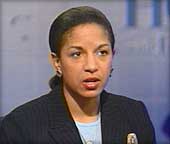
 President-elect Obama’s announcement of Susan Rice as U.N. ambassador is welcomed news. Even more welcome is the re-elevation of the U.N. Ambassador to a cabinet level position, as it was in the Clinton administration. This is a clear signal that the Obama administration intends to seriously engage with the United Nations. Rice, who is knowledgeable and passionate about Darfur and other conflicts, will be a strong advocate for assertive U.S. multilateral engagement.
During today’s annoucement Obama stressed that Rice will send a “message that our commitment to multilateral action must be coupled with a commitment to reform. We need the UN to be more effective as a venue for collective action — against terror and proliferation; climate change and genocide; poverty and disease.” I believe she will be able to, in a postive way, get this job done. Its the task of the decade.
There have been many positive statements about the appointment made today, but I particularly appreciated U.N. Foundation president Tim Wirth’s:
“President-elect Barack Obama’s selection of Susan Rice as the next Ambassador to the United Nations, and his decision to once make this critical posting a cabinet-level appointment, sends an unambiguous signal to the world that the United States intends to reengage with the United Nations at the highest levels. Ms. Rice understands the importance of fostering international cooperation as a means of tackling the great global challenges we face, including climate change, poverty, nuclear proliferation and terrorism.”
Clearly, Citizens for Global Solutions will support Susan Rice’s appointment and urges a speedy confirmation to enable her to begin her task of forging effective solutions at the U.N. for today’s global concerns.
by Citizens for Global Solutions | Oct 3, 2008 | Global Cooperation, United Nations
“Experience also shows that to be effective, we must adopt a model of partnership, not paternalism.”
Embracing a more multilateral approach to international events, President Bush gave a determined and pointed speech at the opening of the 63rd General Assembly at the United Nations on Tuesday, September 23, 2008. Words like “terror” “fight” and “cooperation” were Bush’s popular picks for describing the international body’s drive against extremists and the need for all member states to work together to eradicate such threats. Reminding member states that they have an “obligation” to help other nations, Bush elaborated upon the ways in which members could work together. Instead of simply passing resolutions, he urged the countries to take a more pro-active approach against terrorism, and to prevent crises from erupting in the first place. Bush also took several swings at his critics by stating that those who believe that terrorists would “pose less of a threat if we’d only leave them alone” are not addressing the root cause of the problem, but rather are adopting the precise passive approach that these terrorists prey upon. He emphasized the potent and continued threat encapsulated in terrorism, and the dire need for the international community to work together to resolve the problem. Unlike his previous speeches in 2003, Bush placed a lot more emphasis this time upon the need for cooperation between states and the success that this would surely bring to the fight against terror.
On the other hand, the cooperative language of the speech speaks clearly to the multilateral approach the Bush administration has been forced to adopt as the Iraq war drags on. Bush made it a point to applaud developing democracies like Afghanistan and Liberia in their struggle against insurgents. Making references to the Colored Revolutions of Eastern Europe, Bush drew satisfaction from the fact that there is a global trend for struggling nations to fight for their independence, creating the space for international bodies like the U.N. to work effectively in such areas. When addressing the Georgian issue, Bush criticized Russia’s actions as having “violated” the U.N. Charter’s declaration of “equal rights of nations large and small” and re-affirmed the America’s commitment to the country’s sovereignty.
What Bush failed to mention, however, is the large and increasing debt that the U.S. owes the U.N. in payment dues. Now at a sum of over $2 billion dollars, this fee hinders the U.N.’s ability to do what is being asked of it – ranging from furthering human rights efforts to delivering aid. Bush is calling on the U.N. to assume a bigger role in fighting global terrorism, but the U.S. isn’t contributing financially to the efforts. Still, the underlying multilateral tone of the speech speaks favorably for the U.S.’s efforts at engaging other member states in the United Nations. It’s a shame that it took eight damaging years for the Bush administration to see the value in active allies.
by CGS Blog Archive | Jul 29, 2008 | Peace & Disarmament, United Nations
President Mahmoud Ahmadinejad spoke today on Iranian national television about the role of the United Nations in nuclear disarmament. Like with North Korea and India, the United States has attempted to persuade Iran to abandon its uranium enrichment program and to open its plants to international inspection. But unlike these countries Iran remained indifferent to the entreaties. In exchange for Iran’s cooperation in suspending its uranium enrichment program, the United States promised to ease economic and diplomatic sanctions it has imposed on Iran for the past decade. Ahmadinejad proudly rejected the proposal responding that Iran is using its nuclear technology solely for energy generation and pointing out the bias existent in the United Nations. He said it is unfair for members of the Security Council to require Non Nuclear Weapon States to dismantle their nuclear programs when they themselves possess nuclear weapons. He also condemned attempts of the United Nations to curb nuclear energy production of smaller nations while closing its eyes to members of the Permanent Five’s expansion of atomic arsenals.
Mahmoud Ahmadinejad brings up valid points. News have been circulating that the United Kingdom plans to spend approximately 3bil pounds on replacing its nuclear supply of warheads. Bound by Freedom of Information Act to release such information to the public, documents implying UK’s decision to upgrade its warheads have been released, despite of the assurance of the British Government to the contrary. Such a massive upgrade will require at least 4 decades to complete and comes before a non-proliferation conference scheduled for 2010. Such a long commitment goes starkly out of line with foreign secretary Willam Hauge’s recent statements calling countries to take urgent steps to reform and better enforce the Nuclear Non-Proliferation Treaty. The United States is taking center stage in bringing about suspension of nuclear programs in India and North Korea. The US however possesses the largest number of nuclear weapons: 9,960 nuclear warheads 5,735 of which are considered active, though the United States is bound by the Nuclear Non-Proliferation Treaty to move towards nuclear disarmament.
In some things President Ahmadinejad got it right: Permanent Five should stop dictating policy and begin developing a global plan on how to create a nuke-free world. This means the United States, Russia, China, France and the United Kingdom has to each begin dismantling its nuclear weapons.
by Citizens for Global Solutions | Jun 17, 2008 | Global Cooperation, News, United Nations
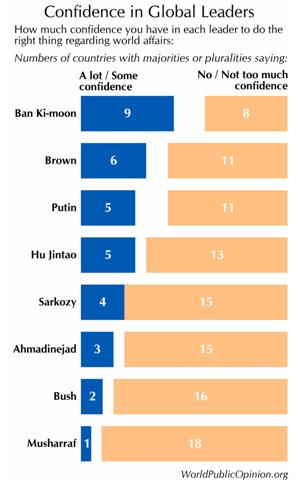
The latest poll from WorldPublicOpinion.org demonstrated that out of 20 nations surveyed, no political leader inspires substantial confidence or trust “to do the right thing regarding world affairs.” The international players investigated in the report included global and regional leadership from Africa, the Americas, Asia, Europe and Eurasia/Middle East. The largest focus area of analysis included global opinion surveys of United States President George W. Bush, French President Nicolas Sarkozy, British Prime Minister Gordon Brown, newly-transitioned President Vladmir Putin, President Hu Jintao of China, Iranian President Mahmoud Ahmadinejad, and President Pervez Musharraf of Pakistan. The 19,751 respondents were taken from nations that comprised 60 percent of the world’s population, large and small territories both represented.
President Bush resulted as one of the worlds least trusted leaders, ranking the second to last world leader that inspires confidence in global affairs. Fifteen nations rate the leader of the free world negatively, while only two (Nigeria 60%, and India 45%) are even marginally positive. Interestingly, Bush is surpassed only to Pakistani President Pervez Musharraf, who is rated only slightly more negative in more nations worldwide. This is no surprise, considering even in the United States Bush’s approval rating has recently hit an all-time low. According to the latest Washington Post-ABC poll, 68 percent of Americans disapprove of the job President Bush is doing – 54 percent strongly.
According to WorldPublibOpinion.org’s study, Chinese public opinion of Bush has softened, with a ten point increase in positive views since last year. Not surprisingly, the most negative views come from the Middle East region, and despite foreign policy efforts nearly all Palestinians (95%) express low confidence, 79 percent with “no confidence at all.” Argentina and Mexico were also largely negative, with Mexico’s negative outlook increasing 16 points since last year. Ironically, Iran reported the mildest negative ratings in its region. Bush also got the highest average percentage of negative ratings, totaling 67 percent.
The most fascinating piece of information provided by this study, in my opinion, shows that the only international leader in play to elicit more confidence than distrust regarding global affairs is UN Security General Ban Ki-moon. Ban’s country of origin, South Korea, gave the largest number of positive ratings at 83 percent “a lot/some confidence.” Nigeria, China, Britain, France, India, Indonesia, and Azerbaijan all gave majority positive ratings as well. Very interestingly, despite sanctions from the UN Security Council to stop uranium enrichment programs, Iranians also reported mostly positive (43 to 18%). The nations demonstrating largely negative views were all five from the Middle East region, the largest in Palestine. The US, Russia, Argentina and Thailand expressed ?not too much? confidence predominantly, relatively few with “no confidence at all.” Those expressing a lack of confidence are surmised to be expressing a lack of familiarity with the largely new and low-profile UN Secretary General.
What does this reveal about the status and opinion of global leadership? At least from this specific analysis, the overall worldwide consensus indicates more confidence in the United Nations leadership than any other national figure worldwide. Steven Kull, director of WorldPublicOpinion.org reported, “While the worldwide mistrust of George Bush has created a global leadership vacuum, no alternative leader has stepped up into the breach. Hu Jintao and Vladmir Putin are popular among some nations, but more mistrust them that trust them. Also, the nations that trust them are not organized into any clusters that have the potential to be a meaningful bloc.”
Encouragingly, with the November elections emerging, the next President of the United States has an opportunity to regain international trust regarding global affairs, hopefully alongside UN Secretary General Ban Ki-Moon.

 President-elect Obama’s