by Rene Wadlow | Dec 18, 2015 | Global Justice, Human Rights
December 18 was set by the UN General Assembly to call attention to the role of migrants in the world society. The date was chosen to mark the creation of the International Convention on the Rights of All Migrant Workers and Members of their Families. The aim of the Convention was to ensure that migrants and their families would continue to be covered by the human rights standards set out in the Universal Declaration of Human Rights, the Covenants, and other human rights treaties.
In practice, migrants are often “between two chairs”–no longer of concern to the State they have left and not yet covered by the human rights laws of the State to which they have gone.
Ratifications of the convention have been slow, with several governments making reservations that generally weaken its impact. In 2004, a commission of independent experts was set up to study the reports of governments to the UN on the application of the convention–a commission that is part of the human rights treaty bodies. Reports from each government party to the convention are to be filed once every four years. However, the discussions within the migration treaty body and its subsequent report attract the attention of only a small number of people. The discussion deals with the report of only one government at a time, while migration is always a multinational issue and can have worldwide implications.
Moreover, many States consider that earlier International Labour Organization conventions deal adequately with migrant rights and see no need to sign a new convention.
Citizens of the world have stressed that migration flows have an impact on all countries. The changing nature of the world’s economies modify migration patterns, and we need to plan for migration as the result of environmental and climate changes.
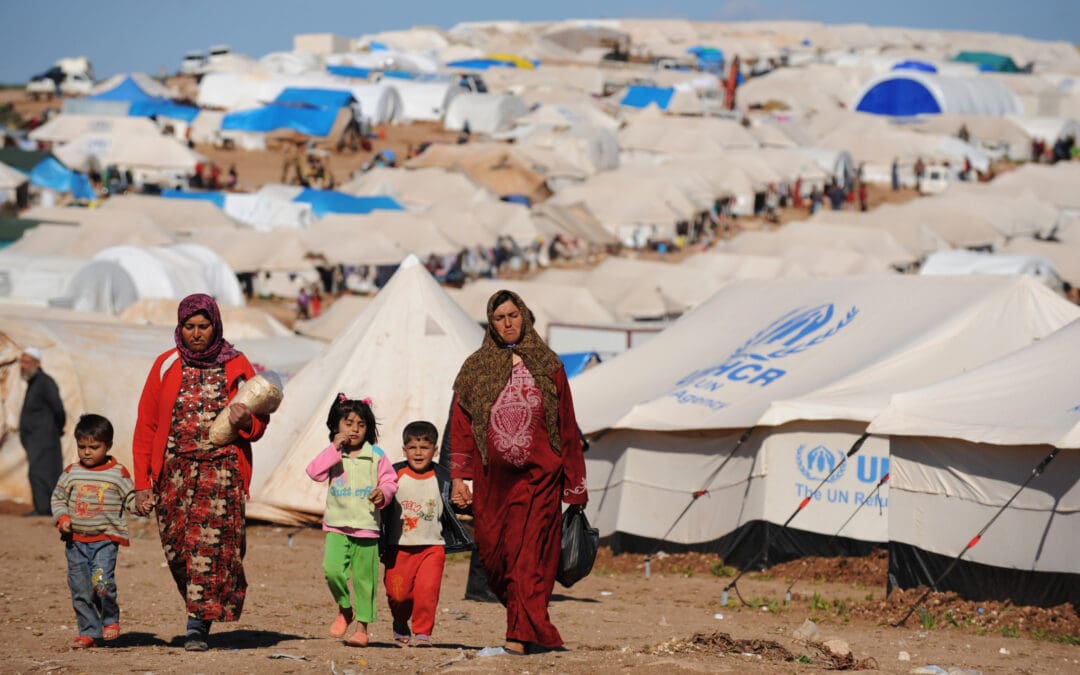
The current flow of migrants and refugees to Europe has become a high-profile political issue. Many migrants come from areas caught up in armed conflict: Syria, Iraq, Yemen, Afghanistan, Somalia. The leaders of the European Union (EU) have been divided and unsure in their responses. Local solidarity networks that offer food, shelter, and medical care are overwhelmed. Political debates over how to deal with the refugees have become heated, usually with more heat than light. The immediacy of the refugee exodus requires our attention, our compassion, and our sense of organization.
EU officials have met frequently to discuss how to deal with the migrant-refugee flow, but a common policy so far has been impossible to establish. At a public level, there have been expressions of fear of migrants, suspicion of possible terrorists among them, and rejection of their cultures. These popular currents, often increased by far-right politicians, make decisions all the more difficult. An exaggerated sense of threat fuels anti-immigration sentiments and creates a climate of intolerance and xenophobia.
The Association of World Citizens, which is in consultative status with the UN, is calling for a UN-led world conference on migration and refugee issues, following earlier UN world conferences on the environment, food, housing, women, population, youth, human rights and other world issues. Such conferences usually follow a common progression:
- Research and data collection by UN agencies, national governments, NGOs, and academic institutions;
- Regional meetings to study the regional dimensions of the issue;
- A world conference of government representatives and consultative NGO participants that sets a plan to influence action by UN agencies, national governments, and NGOs.
Only a UN-led conference with adequate research and prior discussions can meet the challenges of worldwide migration and continuing refugee flows. There is a need to look at both short-term emergency humanitarian measures and at longer-range migration patterns, especially at potential climate modification impact. A world conference on migration can highlight possible trends and start to build networks of cooperation to meet this world challenge.
by Jack Pearce | Dec 17, 2015 | Global Justice
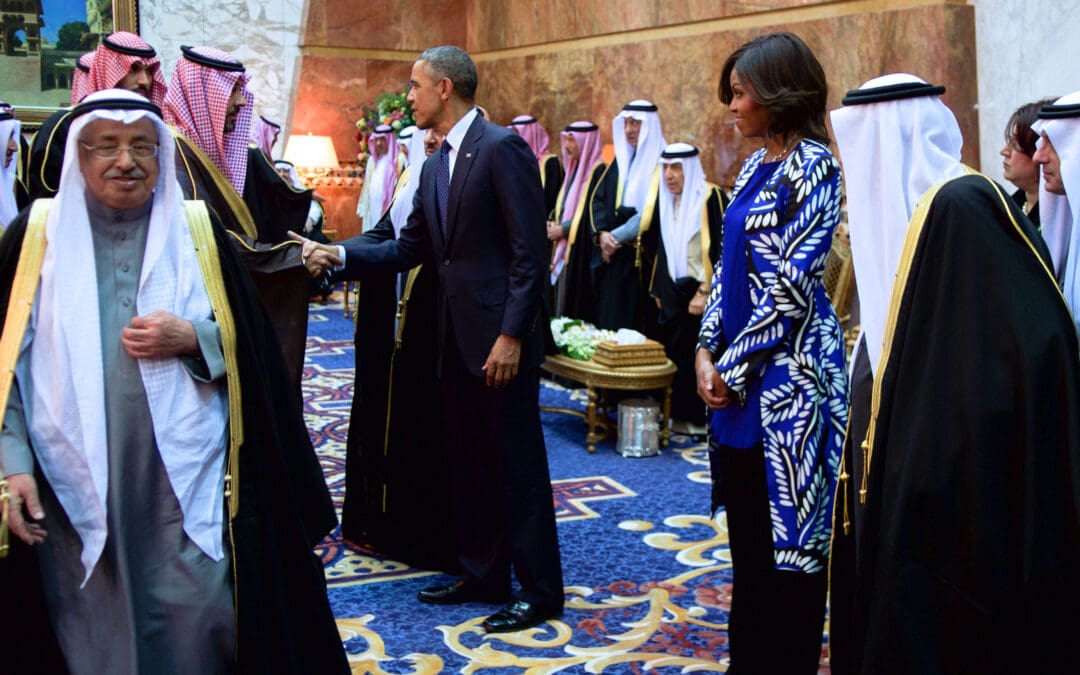
There are two major issues in the Middle East that pose dangers to international trade, security, and economic well-being. In a prior post, I addressed the difficulties and dangers of international jockeying over Syria getting out of control. Here I address the concern that the combination of despotic, repressive family rule and archaic Wahhabi Islam in Saudi Arabia may lead to continuous civil unrest in Europe and beyond, as well as a severe disruption of oil supplies from the Persian Gulf region with massive economic consequences worldwide.
Saudi Arabia is a tough nut to crack, and in economic terms, a much larger one.
As long as the current royal family stays in power and there is a large profit margin in Saudi oil (and no major breakdown in the Persian Gulf area–from hostilities over Syria, for example), international oil markets are likely to remain stable.
But a portion of the oil profits go to support of a form of Islam (Wahhabi/Salafi) which is deeply opposed to the modern world order in Europe, the United States, Africa, Indonesia, and even in Russia.
Impartial commercial risk analysts have noted that Saudi Arabia is considered one of the worst violators of human rights in the world and is among the most prolific users of the death penalty. There is severe gender inequality, a lack of religious freedom, and the Shi’a minority (comprising around 10 percent of the population) is believed to be economically and politically marginalized by the Sunni elite.
Though near term prospects for Saudi Arabia and its current rulers may be rated as stable, loss of royal control is assessed as possible in some circumstances. A popular uprising in the country or major fissures in its governance, which interrupted Saudi oil exports, could set oil prices soaring worldwide. In the extreme, this would be seen as a massive risk to the world economy.
The United States has a history of making contingency plans for potential disruptions of Saudi oil flows. However, such plans could involve major interventions and an expensive active role with potential blowback. And contingency plans do not always fully anticipate the scope and complexity of the events they attempt to address.
A prolific analyst argues that pressures on oil prices combined with the social welfare costs of the Saudi population, the costs of supporting Wahhabi jihadism abroad, internal backlash against the Saudi regime by Wahhabi hardliners, and the “overhead” or parasitism costs of a huge royal family put Saudi rule at substantial risk in coming years.
Those who make it their business to assess political risks for companies with substantial assets at stake internationally cannot afford to wear blinders; they see what many public office holders apparently are reluctant to say.
The royal family, and the entire country, depend upon the industrialized world to make wealth out of Arabian oil. But Wahhabi/Salafi Islam is a major threat to political stability in the Middle East and a disruptive factor in Europe. And the royal family has from its inception leaned upon Wahhabi Islam to maintain its control of the population of the Arabian Peninsula.
The relationship between the royal family and the Wahhabi/Salafi movements has more than one facet.
The royals clearly try to suppress challenges to their control from any direction, including jihadi Islamists dissatisfied with their perceived accommodations of the infidels abroad. There is some evidence that they and the clerical establishment may attempt to put a moderate face on Islam when ISIL/Al Qaeda cruelties become embarrassing.
But substantial sums nevertheless flow into exporting the Saudi brand of Islam. Prominent Saudi clerics have displayed an aggressive sectarian orientation regarding countries the royals need not further antagonize at this time. Clerical calls against women driving cars in Saudi Arabia illustrate the far removal of the Saudi clerical establishment from global norms at this time. It is also far removed from reported behaviour of privileged Saudi youth. The clerical establishment is thus an anchor for the royals, but also a ball-and-chain.
A path to resolving this Arabian puzzle could be peaceful evolution toward a form of constitutional monarchy. This could include some caps on the royals’ take from the treasury, gradual but consistent liberalization in Saudi Arabia, and curtailed funding for the worldwide spread of the Wahhabi social control system. In the long term, both the royals and the citizens of Saudi Arabia are best served by blending into the world culture rather than milking it while simultaneously trying to subvert it.
There needs to be more explicit, public recognition of the Saudi dilemma and the associated Islamic dilemma. There is no need to condemn all of Saudi Arabia or all of Islam; to be clear, my opposition is to ISIL/Wahhabi culture that violently rejects all forms of governance other than obsolete caliphates and promotes complete male subjugation of female sexuality wherever it is manifested outside of Saudi Arabia.
Though the royal family’s money can be rewardingly spent and reliably invested in the global system, the world should deal with them amicably as just one element in global hydrocarbon supply systems, subject to external and internal constraints in a world moving toward expanding options to fossil hydrocarbons as rapidly as technically and economically feasible.
As a global citizen, do you agree with these views? Comment and let us know!
by CGS Blog Archive | Dec 14, 2015 | Global Justice, Human Rights
There are too many issues in the world. While I can blog, read, or talk about them, I think taking an action makes a stronger impact; whether it impacts an entire population or one person, every life is valuable and dear to my heart.
That being said, I am an advocate for ending human trafficking and personally passionate about women and children. I volunteer for a non-profit organization in Orange County, which works in sync with Saddleback Church’s Justice and Trafficking Initiative. My role is to make contact by profiling the victims of sex trafficking and to help them get out of the life.
One night, my advocacy partner and I were walking in a dark alley in California. We saw a petite blonde girl who was very beautiful. She had a black dress on and looked scared. I approached her from a distance and had the following conversation:
Me: Hey. It is going to be a cold night huh? What’s your name?
Her: Yeah. My name is Belle.* I gotta work right now. I can’t talk.
Me: You like your job?
Her: Well, I have never done it. Tonight is my first night.
Me: How old are you?
Her: 18
“She is not 18,” I thought to myself. She looked like she was 14 or 15.
Her: Look, I really can’t talk. They are following me since it is my first night. I have to do this.
Sure, this girl was being followed. A girl who was probably a minor was being forced to have sex. Like her, so many young girls around the world are ripped from their childhood on a daily basis. Regardless of age, no should ever have to have sex against their will.
Keeping the goal of Peace, Justice, and Strong Institutions in mind, UN Secretary-General Ban Ki-moon called to use the 2030 Agenda for Sustainable Development as a “roadmap for stamping out root causes and freeing all enslaved people in our world.”
When we think of slavery, most of us think of the transatlantic slave trade that took place about 200+ years ago. Slavery still exists today, and it is better known as human trafficking.
According to the United Nations, human trafficking is defined as “the recruitment, transportation, transfer, harboring, or receipt of persons by force, abduction, fraud, or coercion,” for the purpose of forced labor or sexual exploitation.
According to the Global Slavery Index, 35.8 million people in the world currently are being trafficked. Now keep in mind that these are the reported numbers. Human trafficking is a crime that happens in the shadows; the true number of victims is most likely higher than the reported number.
The United Nations Office of Crime and Drugs (UNODC) collected human trafficking data from 2010-2012 and presented a report on it in 2014, which included the following findings:
• Victims of 152 different citizenships have been identified in 124 countries across the world.
• At least 510 trafficking flows have been detected.
• Some 64 percent of convicted traffickers are citizens of the convicting country.
• Some 72 percent of convicted traffickers are men, and 28 percent are women.
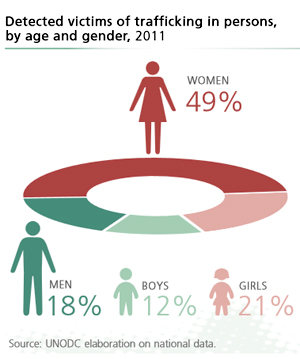
• 49 percent of detected victims are adult women.
• 33 percent of detected victims are children, which is a five percent increase compared to the 2007-2010 period.
Only 28% of offenders are convicted because they often intimidate victims with threats and abuse. The women also may not have the freedom to leave the watchful eyes of their pimps–not unlike the girl who was followed in the alley. This is because the pimps are in charge of collecting the money for the trafficker as well as keeping “their girls” under supervision.
The UNODC has detected 510 international trafficking routes, and this is probably only the tip of the iceberg. Because human trafficking has become so global, it can be difficult to assess in which State the felon should be convicted.
The International Criminal Court (ICC) was created to seek justice for crimes against humanity, and global human trafficking is one of them. While many Americans are on board with the Court’s work, the U.S. is not a State party to the ICC. It is important to support the ICC because the world today is interconnected, and criminal networks–traffickers, cartel operators, smugglers–are no exception.
Traffickers usually aren’t just exploiting people, but often are involved in other criminal activities, such as embezzling funds and promoting State corruption, manufacturing and trading drugs, and aiding the growth of poverty and hunger. For example, based on several of my conversations with the girls on the streets of Southern California, they usually have to bring $500 back at the end of the night and if they don’t, then the pimps won’t provide them with food or necessary feminine products.
One of the survivors we helped was tested for vitamin deficiency; she was lacking in zinc, vitamins D and C, and desperately needed more B-12 as recommended by her doctor. People who are not affected by hunger, poverty, or trafficking usually have access to all of these nutrients.
Human traffickers make people work or have sex in a forced manner. They exploit children. They deny basic needs such as food and water. They promote drugs and corruption. If and when caught, they should be prosecuted by the International Criminal Court. It is crucial to seek justice for the victims that have been exploited all over the globe.
*Name has been changed in order to maintain privacy.
by Sarah Del Vecchio | Dec 9, 2015 | Global Justice, Human Rights
After the November terrorist attacks in Paris, President Francois Hollande referred to the group more commonly known as ISIL or ISIS as “Daesh.” The name has been used intermittently by both government officials and media outlets, but to many, this usage was a pointed statement.
Daesh is the Arabic acronym used for ISIS, standing for “al-Dawla al-Islamiya fi al-Iraq wa al-Sham.” The Boston Globe reported last year that,
The term ‘Daesh’ is strategically a better choice because it is still accurate in that it spells out the acronym of the group’s full Arabic name, al-Dawla al-Islamiya fi al-Iraq wa al-Sham. Yet, at the same time, ‘Daesh’ can also be understood as a play on words—and an insult. Depending on how it is conjugated in Arabic, it can mean anything from ‘to trample down and crush’ to ‘a bigot who imposes his view on others.’
There are several factors at play here. From a political standpoint, there is the obvious issue of legitimacy. Both Islamic and State leaders refuse to address Daesh as the “Islamic State,” as it offers legitimacy to the terror group as a caliphate. With this in mind, United KingdomPrime Minister David Cameron announced this week that he and other British government officials would discontinue the use of “ISIL,” “ISIS,” or “the Islamic State.”
There are also ramifications for Muslims abroad. Over the last few weeks, as anti-refugee and anti-Muslim sentiment has grown in the United States, the terminology used in this conflict is important. In April, The Huffington Post found that roughly 55 percent of Americans had “either a somewhat or very unfavorable view of Islam.” Islamophobia shows little sign of decreasing in the United States, particularly in the aftermath of the San Bernardino shootings. By utilizing terms like “ISIS” and “ISIL,” we reinforce the notion that this group represents the Islamic faith—something that has been vehemently disputed.
As the media and government leaders take notice and begin to use “Daesh,” the public should follow suit. By distinguishing Daesh from the millions of peaceful practicing Muslims, we openly defy Daesh’s mission to ignite war between Islam and the West.
If that is not enough, there is the subtle-but-unmistakable jab at Daesh. Australia’s Former Prime Minister Tony Abbott aptly stated earlier this year, “Daesh hates being referred to by this term, and what they don’t like has an instinctive appeal to me.”
by Victoria Barrow | Dec 4, 2015 | Global Justice, Human Rights
Lately the news has been flooded with horror stories of the ISIS-led attacks occurring around the world. After hearing about these, it’s easy to wonder: how in the world can any sane individual partake in such brutalities?
How is an organization that is so extreme and so violent able to get bright, young people, including an increasing number of Western foreigners, to drop their normal lives and risk it all for a terrible cause?
To answer these questions, let’s take a look at how ISIS convinces young individuals to join their efforts.
Online Recruitment
The internet is the perfect place for ISIS recruiters to find and target future members. Online, it is easy to remain anonymous and to keep recruitment a secret process. Identities are easily masked, and information is easily transmitted.
ISIS recruiters are motivated to convert others to jihadists not only to propagate the values they believe in, but also to make a significant amount of money. ISIS pays its supporters up to $10,000 for every person they recruit. The price paid depends on who is recruited–if the people are well educated, such as computer specialists or doctors, they are worth more.
A wide variety of online platforms are used to find potential recruits, including Facebook, Twitter, and Youtube. Then recruiters spend thousands of hours engaging with these individuals, keeping in regular touch and slowly ushering them towards the theological concepts ISIS is built on.
Recruiters often use techniques mentioned in a manual written by the Islamic State called “A Course in the Art of Recruiting.” This pamphlet advises recruiters to “share [their] joys and sadness” in order to draw closer to targets and to focus on the basics of Islam without mentioning jihad. The goal is to establish close relationships with the potential recruits and make them feel they have made new friends.
Isolation
One of the most important parts of ISIS conversion is isolation. According to Mubin Shaikh, a former member and recruiter for an extremist Islamic group, recruits “look for people who are isolated and if they are not isolated already, then [they] isolate them.”
Often the easiest people to target are teenagers. Many teens feel they don’t fit in and that they want to participate in something larger. This makes it easier for ISIS to recruit them; they are able to exploit the fact that teenagers are still trying to figure out their place in the world.
Recruits isolate individuals by getting them to spend more and more time online and away from reality. They also warn recruits that sharing their conversion to Islam with others may lead them to danger. Progressively, recruits begin to feel more connected to their new online “brothers and sisters” rather than to their families and friends.
Manipulation
Of course, no American or European teen believes they are being converted to migrate to a warzone and join a remorselessly murderous and radical group. The ideas that recruiters plant into their heads are fantasy. Two young American women, for example, were lured to Syria on the pretext of providing humanitarian aid. After a new “friend” helped them enter the nation, they were taken to an ISIS compound and ended up serving as sex slaves for ISIS fighters.
Other recruits are lured by the promise of joining a sort of utopian movement and participating in something bigger than themselves, or simply for the sake of adventure. Many are told that ISIS’s goal is to build a homeland in Syria and Iraq where the holy could live according to God’s law.
Muslim Millennials
Another frequently targeted group of individuals are young Muslims, who are often faced with an identity crisis. According to Farah Pandith, this “struggle for identity means there is an opening for extremists–to give them purpose, to give them a sense of belonging.” A new report by Congress says that over 250 Americans have attempted to join ISIS, and that many of these are former refugees.
18-year-old Dahir Ali, for example, explains that many people come up to him and tell him he is a terrorist since he is Muslim. Terrorist groups like ISIS are looking to recruit exactly such people–those who feel like outsiders. Ali’s community in Minneapolis has the largest population of Somali in the country, many of who came as refugees in the 1990s. Since 2007, two dozen have left to join extremist groups.
As we can see, the recruitment process is a crucial part of converting people into ISIS extremists. Unfortunately, it is incredibly difficult to prevent this process from occurring due to the nature of the internet. Understanding the logistics of recruitment can, however, help us understand the role that manipulation and lies play in fueling extremist movements.
by CGS Blog Archive | Nov 30, 2015 | Global Justice
This year, GivingTuesday is arriving just in time.
We’re seeing four million refugees fleeing Syria; 38 million people worldwide internally displaced from war, terror, and suppression in 2014 alone;barrel bombs dropped on civilians by their own government; and countless other atrocities.
Now, under great pressure from the spread of terrorism, extreme weather, unrestrained war and huge migration flows across the globe, leaders from around the world are catching up to our vision of a well-governed world.
Citizens for Global Solutions has been invited to join global policy leaders in promoting crucial United Nations reforms, reforms that can prevent the triumph of terrorism, the cataclysm of global warming, or even World War III.
On Tuesday, December 1, Citizens for Global Solutions is participating in GivingTuesday, a day where people all across our nation come together for one common purpose: to celebrate generosity and to support the worthy causes in which they believe.
We invite and encourage you to join the movement and to support Citizens for Global Solutions’ efforts to create a movement for crucial global governance initiatives before the window of opportunity closes.
These next five years hold our best opportunity to help turn “the worst of times”—experienced so horribly and routinely throughout history—into “the best of times” for our human family.
This GivingTuesday, we ask you to place your trust in Citizens for Global Solutions and join a force dedicated to ensuring a just and secure future.
So get ready and help Citizens for Global Solutions make this GivingTuesday our most successful yet!
Share this event on Facebook with your family and friends, tweet about it, or visit our GivingTuesdaypage to learn how you can be a force for nature.