by Citizens for Global Solutions | Apr 9, 2009 | Climate Justice, Global Cooperation, News
The United Nations Framework Convention on Climate Change [UNFCCC] may not begin until December 7th but the preparatory talks are already underway. The Framework Convention on Climate Change consists of 192 countries, including the United States and China. All parties meet once a year in a Conference of Parties. Since the first commitment period of the Kyoto Protocol will end in 2012, a new Climate Change agreement will need to be negotiated immediately. Therefore, the goal of the Copenhagen conference is to establish a new agreement to stabilize greenhouse gases in the atmosphere in order to prevent dangerous climate changes in the future.
Countries will meet in advance of the conference in a series of preparatory talks. The purpose of the preparatory talks is to allow countries the chance to focus on and review in detail the issues that will be discussed in the Copenhagen negotiations. Three more two week meetings are scheduled to occur before the final meeting in Copenhagen. Bonn, Germany was the site of the latest round of negotiations which concluded April 8, 2009. The climate change team of the Obama Administration attended and shared their enthusiasm and dedication for the creation of a productive treaty in Copenhagen. Todd Stern, from the U.S. Climate Change team stated:
We do not doubt the science, we do not doubt the urgency, and we do not doubt the enormity of the challenge before us. The facts on the ground are outstripping the worst case scenarios. The costs of inaction – or inadequate actions – are unacceptable.
Discussions in Bonn have established positive momentum for a smooth and constructive UNFCCC in Copenhagen. The Executive Secretary of the UNFCCC, Yvo de Boer, clearly laid out the four areas that the Copenhagen Protocol must deal with successfully:
- On what industrialized countries will do, through individual targets, to reduce greenhouse gas emissions
- On what developing countries will do to limit the growth of their emissions
- On finance, since developing countries cannot be expected to act on this issue without financial support
- On governance, since a governance structure is needed that gives an equal voice to developing countries in how the resources available for mitigation and adaptation are used.
Key issue areas such as “targets for the reduction of greenhouse gas emissions by industrialized countries and the matter of financing mitigation and adaptation measures in developing countries appeared to be stymied” (Click here for full article ). CGS will follow the upcoming meetings and keep you in the loop on the resolution of those key issues.
by Citizens for Global Solutions | Oct 22, 2008 | Climate Justice, Global Justice
Climate change is often discussed as a global problem. We constantly hear catch-phrase warnings such as ‘melting ice caps,’ ‘rising sea levels,’ ‘desertification,’ and ‘greenhouse gases.’ What we don’t often hear about are the real problems pollution and climate change are creating today in small communities across the globe.
What’s the problem?
According to a recent report on the world’s most dangerous environmental hazards, as many as 40% of the world’s deaths each year can be attributed to water, soil and air pollution. The report, released yesterday by two environmental organizations, the Blacksmith Institute and Green Cross Switzerland, articulates the profound effect that anthropogenic pollution is having on human life.
In communities the world over, people are dealing with disease, disability, neurological damage and illness as a result of deteriorating environmental conditions .
For instance, in Nanjing, China cyclists have begun to wear masks as they ride through the city streets under a thick blanket of smog. Inhaling the airborne particulates that contaminate urban areas across the globe can lead to chronic pulmonary and cardiovascular stress as well as severe respiratory diseases.
(For more information on Urban Air Quality or the rest of the Toxic Top Ten worst pollution problems in the world, click here.)
What is being done?
Authors of the report commended the world for working together to fight global health threats such as AIDs and Malaria. However, “while much attention has been paid to these pandemics, the relationship between human health and pollution seems to have been largely ignored.”
What should we do?
The first step is acknowledging and understanding the problem. People across the globe must realize that each day they are affected in very real ways by irresponsible legislation and lax environmental regulations. The problem is not just global; it’s local. Secondly, as the report states, “there is a great need to address critical environmental health threats that have had no attention in the global dialogue.” Alongside global discussions of hunger, poverty and genocide we must also consider the health of our environment, because, as we have found out the hard way, an unhealthy environment leads to unhealthy people.
by Madeleine Lesser | Jul 11, 2008 | Climate Justice
Correct me, please, if I’m wrong, but given the state of global disruption, shouldn’t the American people, especially the presidential candidates, do everything they can to promote a sustainable environment? The Democratic National Convention Host Committee has done just that – they have proposed guidelines to encourage organic food and products to be distributed at the Convention in August 2008. Apparently, these conditions do not appeal to Washington Post contributor, David Montgomery.
Montgomery’s “The Red, White and Eat Your Greens Party,” published July 11, completely bashes the efforts put forth by the democrats. He mocks (although he claims, sarcastically, not to) the “Lean ‘N Green” guidelines, which include:
Lean
- Half of the meal (or 50%) of the plate is made up of fruits and/or vegetables
- A colorful meal – include at least three of the following five colors: red, green, yellow, blue/purple, and white (Garnishes not included)
- No items are to be fried
Green
- 70% or more of ingredients by pre-cooked weight are certified organic and/or grown or raised in Colorado
- 70% or more of ingredients by pre-cooked weight are fresh and (not pre-processed)
Furthermore, he goes on to make fun of the Host Committee’s acceptance of conventional produce, along with the (preferred) organic produce: “Note the repetition of the word ‘voluntary.'” Instead of exploiting the use of the word “voluntary,” Montgomery should embrace that the Committee is aware that change will not happen over night, and taking smaller steps to a larger goal is the smartest way to achieve that end. Would he rather the Committee make it “mandatory” and possibly cause immense difficulty planning the event if the resources just aren’t available?
The main goal of promoting organic foods is to educate and encourage a more environmentally sustainable community. It is hard to understand where Montgomery, and those who support his rejection of the efforts made by the Host Committee, is coming from. Just because instilling “radical” guidelines are not what we’re used to, and are possibly a bit uncomfortable, does not mean that they aren’t valid. Out-of-the ordinary propositions may seem “weird” or “odd” at first, but upon closer examination, may turn out to be significant and appropriate. Attempting to make a healthier, more lasting environment really isn’t so “odd,” but apparently to some, it is.
by Madeleine Lesser | Jul 3, 2008 | Climate Justice, Global Cooperation
Global warming seems to be a reality that can be more accurately described as “global disruption.” John Holdren, professor at Harvard’s Kennedy School of Government and Director of the Science, Technology and Public Policy Program at the Belfer Center for Science and International Affairs, claims that the effects of global warming are not merely a matter of temperature; although increased temperature is a the root of many of the problems. He recognizes that the climate on the whole is affected, as can be seen by changing winds, ocean currents, storm patterns, melting glaciers, flooding, and droughts. Clearly, the increase in global warming has led to global climate change entirely.
Increased global temperature exacerbates already existing and inevitable natural disasters. For example, hurricanes have been, and probably always will be, a fact of life; but the reality is that increased temperatures and higher levels of carbon dioxide produce more intense hurricanes. Overall, since the 1970s, hurricanes characterized by levels 4 and 5 have risen from 20% to 35% in the 1990s. Furthermore, total precipitation has increased 7% over the past hundred years.
Most of us have been plagued by the photos of polar bears that are dying as a result of melting ice caps. Melting glaciers not only lead to the death of polar bears, penguins, and other mammals, but add to a rise in sea level. There are two problems here: poor, innocent mammals are dying as a result of global warming that has been, in many regards, the fault of humanity; and a rise in sea level that will eventually displace and possibly take the lives of thousands, if not millions, of people.
Moreover, the melting of the arctic permafrost in Canada, Alaska and Russia has negatively affected many ecosystems. At first, the melting will create new lakes, but eventually those lakes will evaporate and release methane from peat bogs native in the permafrost.
Conversely, an increase in temperature has led to an increase in evaporation in many areas. Because the earth is considered a “closed system,” the evaporation will lead to more rain, and more rain can cause greater erosion. And, over time, a significant augmentation of erosion can lead to desertification.
What will it take for our government to make serious policy changes and actually attempt to fix the global climate change that we have exacerbated by carbon dioxide emissions from our cars, factories, homes, etc.; by deforestation; by the use of aerosols; and many, many others? Yes, global warming is a natural cycle that has occurred in the past, but there is no denying that human activity has severely affected this natural phenomenon’s characteristics. There have been great efforts by companies to do their part to address these issues with the introduction of hybrid vehicles and fluorescent light bulbs, but more needs to be done at the root of government. We need to take responsibility for our more than 25% contribution to carbon dioxide emissions by signing Kyoto and making reductions. We need to allocate money to research and development of alternative fuel and energy – now, not tomorrow or the next day. This problem is not going to fix itself – serious change must happen today because if we don’t take action we’ll surely regret it in the near future.
If we don’t act, how can we expect, or ask, anyone else to?
by Citizens for Global Solutions | Feb 5, 2008 | Climate Justice, Global Cooperation
Now that I’m done gloating (for now) about the New York Giants Super Bowl triumph, I can pay more attention to important things like our country’s energy choices. My friend and former colleague Heather Hamilton reports back from a forum that confirms what we’ve been discussing here for a while:
U.S. in the World research for a meta-analysis of polls and focus groups on climate change has found that the argument that the U.S. needs to reduce its dependence on foreign or Middle Eastern oil to protect national security actually increases public support for drilling in the Arctic National Wildlife Refuge and other non-renewable, domestic energy sources like coal and nuclear energy.
Unfortunately, while talk of “ending dependence on foreign oil” leads to losing policies, for now, it also leads to winning politics. For the time being, most voters think energy independence is important and achievable and candidates are unfortunately all too willing to indulge them.
by Citizens for Global Solutions | Dec 14, 2007 | Climate Justice, Global Cooperation

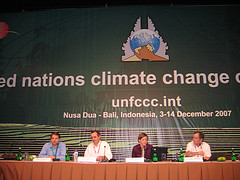
As of this writing, the UN Framework Convention on Climate Change talks in Bali have not yet produced a final agreement. That’s ok. The tectonic shift in international climate politics has already occurred.
It was clear almost from the beginning of the event that the U.S. was engaged in “hard obstruction,” attempting not only to avoid commitments for itself but actively working to block other countries from setting further targets for greenhouse gas emissions reduction. That’s been the policy in place for the last seven years.
What has changed is the European position. In past years, Europeans have been content to state their preference for a faster pace toward a new set of emissions targets and then timidly give up 90 per cent of their negotiating position to bring the U.S. on board. The diplomats would then typically attempt to downplay any major rift and present a far more united front than really exists.
This year is different. When the Americans flatly rejected any mention of a new set of targets, the EU promised to boycott the U.S.-hosted major emitters climate summit, which is at best a complement and at worst a distraction to the UNFCCC process.
As a result, it looks likely that the U.S. may compromise. But even if no compromise is reached or targets agreed to, this is a major step forward. Environmental and civil society groups have long been pushing for the Europeans to move forward with an ambitious agenda that the U.S. may eventually catch up to. It seems at last that if the U.S. will not come along, Europe is willing to make progress anyway. By 2009, we should all be on the same page.
I’ve heard that there has also been significant progress on the adaptation and deforestation angles in Bali, but I have yet to read through the details of either. Plus, I always like it when youth find their voice on this issue. Any way you slice it, this conference will be seen as a major step forward.
Update: A deal has been brokered in a small group that a larger plenary will consider in a few hours. It calls for a “two-track” process, dealing with both Kyoto and the larger UNFCCC, that will culminate in a new deal to be finalized in Copenhagen in 2009. Unclear as yet whether it includes any mention of concrete targets. UN Dispatch, It’s Getting Hot in Here, and Bali Buzz are following closely.