
Originally published on the CGS blog on June 29, 2011.
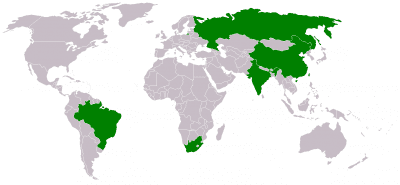
The Woodrow Wilson Center for International Scholars hosted an event yesterday on the rising star in multilateral organizations; BRICS. The conference included experts from all member states: Brazil, Russia, India, China, and its newest member, South Africa. There has been a lot of curiosity as to how these nations are going to work together when they seem to have so little in common. For instance, China, India and Russia all have nuclear weapons. Brazil and South Africa have a decent amount of “western culture” within their societies. China’s economy is larger than all other member states combined. It is easy to see why the world is curious about this dynamic and disparate group.
I was pleasantly surprised with India’s expert, Inderjit Singh, a professor from the National War College. He was not only critical of India’s low literacy rates, government corruption and human rights issues, but he was also very critical of China. He attacked the Chinese “model of modernization,” which he claimed should be a model for no one considering the massive amounts of human rights violations they have committed in their process of achieving economic growth. Mr. Singh went on to say that although India does not approve of China’s history, they will not condemn them and will continue to work with them.
China’s representative, Wei Da, from the China Institute of Contemporary International Relations, discussed China’s role as an equal partner in BRICS. Even though their economy is much larger than the other members’, China has not been a global player for very long and has a lot to learn about interacting with democracies in the western world. Mr. Wei Da also told his American audience that BRICS is not a challenge to the west, but an effort to partner with the G-7 so that they can work together. He said that within the next twenty years there will be a dramatic power shift within the international community and that nations need to begin working together now. Emerging powers will not be stopped, so the best option is for multilateral organizations to work together and increase global cooperation.
Russia’s expert, Fyodor Lukyanov, editor of Global Affairs in Moscow, agreed with China’s statements. He said that for Russia, BRICS is a way to show the U.S. and the EU that if they will not take a partnership with Russia seriously, others will. He wants the different views of BRICS members to be presented cohesively so that the world has geo-political and economic options other than what “western society” presents.
South Africa’s expert, Francis A. Kornegay, from the Institute for Global Dialog, discussed South Africa’s role as a potential gateway to Africa as a member state. While South Africa’s economy is not as booming as the other members’, their role as a geo-political partner is very important. Their goals as a member aligned fairly well with Brazil’s. Brazil’s expert, João Augusto de Castro Neves from CAC Political Consultancy, recognized the importance of having more than one powerful multilateral organization in the world. He wants to demonstrate that there is initiative for change and that BRICS is working to represent that change.
Overall BRICS does not have many common interests, but their common goal appears strong: provide the international community with different options from those traditionally offered by Western society.


