
Originally published on the CGS blog on June 27, 2013.
“What the Supreme Court did today is stab the Voting Rights Act of 1965 in its very heart.”
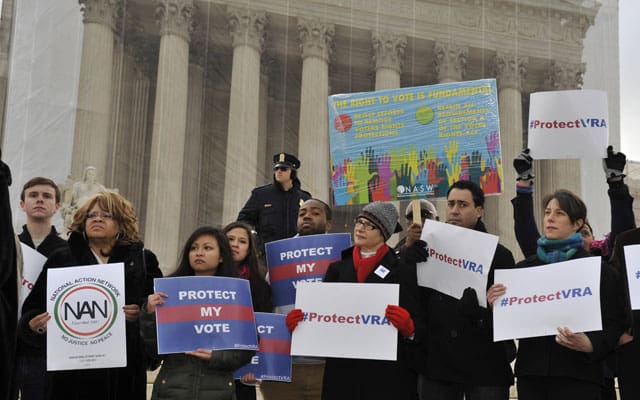
Those were Representative John Lewis’s (D-GA) sad sentiments just hours after the Supreme Court on Wednesday ruled 5-4 that the Act‘s Section 4 was unconstitutional. Section 4 set the formula for which states and districts with histories of racial discrimination were covered by the law, which requires federal oversight for electoral changes in those areas. In writing the majority opinion for the court, Chief Justice Roberts based this ruling on the changing nature of the country: “Our country has changed, and while any racial discrimination in voting is too much, Congress must ensure that the legislation it passes to remedy that problem speaks to current conditions.” This so-called justification for the Supreme Court’s gutting of landmark civil rights legislation points to the logical hypocrisy of some of the justices, and a larger problem within the American mindset.
As civil rights icons like Rep. Lewis, Reverend Al Sharpton, and Bishop Calvin Woods mourn the “revocation” of Martin Luther King’s dream, it’s helpful to put the majority’s reasoning into its double standard context. It’s certainly convenient to reason that the Voting Rights Act is no longer valid because times have changed, while bastions of archaic, revolutionary values go untouched. It’s amazing to think that times have changed sufficiently that federal oversight to protect minorities’ voting rights is no longer needed, but the changes we’ve seen in firearms’ manufacture and development haven’t created enough of a groundswell to reexamine the Second Amendment. I’d argue that the changes measured between revolutionary era muskets and today’s semi-automatic and automatic machine guns are somewhat broader than the changes experienced in our country’s race relations. Yet, the Voting Rights Act was the culprit sent to the guillotine.
It takes a unique bit of political acrobatics to simultaneously destroy our own voting rights while complaining that other countries aren’t doing enough to afford their own citizens an electoral ability. Regarding the previous Iranian election, Congresswoman Ileana Ros-Lehitnen (R-FL) called them “anything but free and fair.” Various conservative figures were quick to criticize the resultant regime changes from the Arab Spring for perceived democratic or electoral disenfranchisement. Yet where are these voices now that Americans themselves have been disenfranchised? Now that the Voting Rights Act has been disemboweled, minority Americans are more susceptible to electoral subterfuge than citizens of the countries we’ve reprimanded for not being democratic enough.
Perhaps what’s most telling (and shows that times really haven’t changed as much as the majority thinks) is how quickly those states previously subject to Section 4 scrutiny have already moved past it. Following the Supreme Court’s decision, Texas moved to immediately enact incredibly harsh voter ID laws and implement a new redistricting plan that a federal court previously said “provided more evidence of discriminatory intent than we have space, or need, to address here.”Sherrilyn Ifill of the NAACP Legal Defense Fund said that the Court’s decision “leaves virtually unprotected minority voters in communities all across this country.” Even the Republican governor of Virginia, Bob McDonnell, was unable to say that his state had outgrown the need for the Voting Rights Act’s oversight.
The Supreme Court did leave the door open for Section 4 to be reinstated, saying that Congress was free to impose the same level of federal oversight over the enumerated states that Section 4 provided. But let’s be serious – how likely is this? Professor Clarence B. Jones probably said it best: “Placing the fate of the voting rights of African-Americans, who have had their voting rights historically denied or curtailed, in the hands of the current Congress, is opening the gate for the fox to go into the chicken coop to protect the hens.”


