
Originally published on the CGS blog on June 23, 2013.
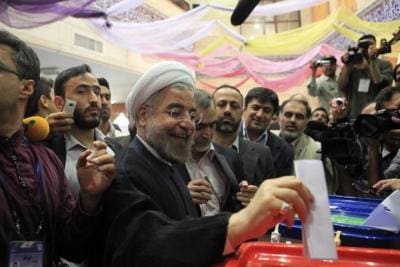
There are few places in the world where you’ll find so many people as in love with democracy and the democratic process as the United States. Congressman wear their love of democracy on their sleeves like a badge of honor, constantly and loudly proclaiming the purity of the system that we’ve come to know and love…domestically, that is. When the democratic process rears its head in a myriad of forms abroad, many American politicians are quick to condemn them as undemocratic or illegitimate. Such is true of the recent Iranian election, in which Hassan Rouhani, former Secretary and Representative of the Supreme National Security Council, won 50.7% of the 36 million votes cast. While many are hailing his victory as a major step forward for Iran and its people, American politicians are the black cloud hovering over the event, raining down droplets of pessimism and mistrust.
In the House Committee on Foreign Affairs’ hearing last week entitled “Elections in Iran: The Regime Cementing Its Control,” members of the committee were quick to dismiss Rouhani’s rise as little more than hollow showmanship on the part of Ali Khameini and the religious establishment. Congresswoman Ros-Lehtinen (R-FL) unabashedly stated that the “West has rushed to anoint Hassan Rouhani as a moderate,” and in doing so, we’ve “quietly lulled ourselves into submission.” According to Ros-Lehtinen, “these elections were anything but free and fair.” Congressman Cotton (R-AR) went so far as to blatantly declare that what transpired was a “sham election in a sham democracy,” and Congressman Kinzinger (R-IL) even lofted the question to the panel of choosing between supporting Rouhani or bombing nuclear facilities in Iran. The irresponsibility and frank shamelessness with which these statements were thrown around the committee room was more than a little disturbing.
Despite the cynicism with which she was met, Dr. Suzanne Maloney, Senior Fellow at the Saban Center for Middle East Policy at the Brookings Institution and one of the panel members, firmly asserted that the campaign and its outcome “does offer the possibility of new momentum in addressing” our concerns and priorities. Elections, Dr. Maloney says, represent “critical junctures in the lifecycle of political systems, and in Iran they have repeatedly sent the revolutionary system careening in new directions.” In the face of American lawmakers’ contempt, Rouhani has declared that he will “enhance mutual trust between Iran and other countries.” Further, Rouhani has promised that Iran, with regard to its nuclear program, is “ready to show greater transparency and make clear for the whole world that the steps… are completely within international frameworks.” Conveniently, in their hurry to bemoan the state of Iran and its president-elect, American politicians have forgotten how Rouhani, in 2005 following Mahmoud Ahmadinejad’s election, resigned his position with the Supreme National Security Council in opposition to Ahmadinejad’s extreme positions.
American politicians are unwilling or unable to paint Rouhani with a moderate or centrist brush because they are simply and unreservedly biased against him. Our definition of a moderate is inapplicable in Iran, just as it’s inapplicable in England or Israel or Egypt. Each state’s political system defines the spectrum upon which its politicians find themselves, and to decry Rouhani for not being an American-defined moderate is ignorant at best and dangerously disingenuous at worst.
As has been shown here and numerous times in the past, American politics lacks a certain institutional memory that would remind politicians that hindsight is 20/20. Congressman Deutch (D-FL) claimed at the committee meeting that the Iranian election was little more than a presentation of Khameini’s handpicked selections. Has Congressman Deutch, and the other skeptical or distrusting members of Congress, forgotten our own electoral history? How can he disparage Rouhani’s election when we have a plethora of shady events of our own, like Tammany Hall, the events preceding the Pendleton Act, or today’s smarmy voting district gerrymandering? The pot shouldn’t call the kettle black. Democracy is a living, breathing organism that changes and evolves as the country in which it operates changes and evolves. Democracies around the world are traveling on their own paths towards true representative governance, and for one democracy to criticize another for not having made enough progress is unfair.
For eight years, Ahmadinejad has been at the helm of the Iranian steamship, and so most of America has accepted the fingers-in-ears, non-engagement approach of our government. But Rouhani’s election signifies a change, a truly historically significant moment, which we would be smart to take advantage of. As Mr. Sadjadpour, one of the panelists, cleverly opined, “after eight years of seeing the Iranian cup eighty percent empty, it’s time to see it twenty percent full.” The interstate status quo between the United States and Iran is no longer acceptable, and if we don’t make real efforts to not only put trust in diplomacy but also lessen both economic and communication sanctions, we will have shirked our responsibility as both a global leader and a democratic role model.


