
Originally published on the CGS blog on June 14, 2013.
If protests happen in Turkey and they rarely appear on the US nightly news, did they even happen? Yes, but they will certainly be less noisy on the international stage.
The protests began on May 28th as a demonstration against a proposal to destroy Taksim Gezi Park in Istanbul to build a touristy shopping mall. The city’s meager 1.5 percent of green space (compare that to New York City’s 17 percent) was being threatened and a small group of environmentalists headed the call.
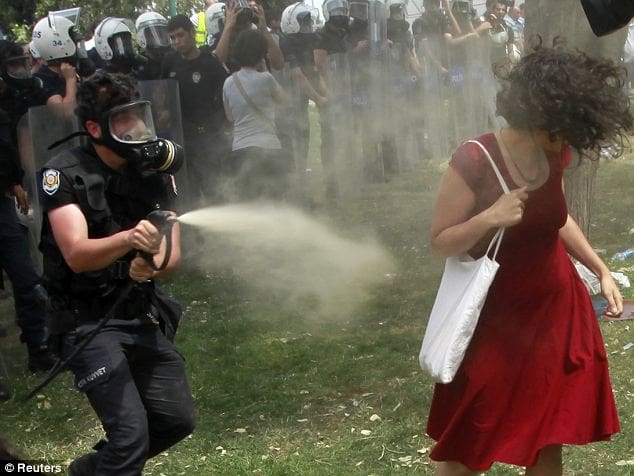
The protests quickly grew throughout the week after police attempted to disband the peaceful protesters with tear gas and water cannons. Soon after, demonstrations popped up in Turkey’s largest cities including Ankara, the country’s capital. On June 3rd, Turkish unions called for strikes on the 4th and 5th and on June 7th, a coalition of Turkish-Americans took out a full page advertisement in the New York Times supporting the protesters.
Their demands are disparate and the government’s response is meager to date. They want what a lot of us want – a free and independent press, green space in their cities, accountable politicians, democratic agency, and fair elections. The one catch-all demand is that Turkey’s prime minister, Recep Tayyip Erdoǧan, resign from his post because they see him as the champion of a relatively new political and social agenda that runs contrary to the country’s secular traditions. In response to the protests, Erdoǧan agreed to meet with opposition leaders, but has continued the violent assault against demonstrators.
In the rush to find an comprehensible equivalent for American audiences, many writers compared these protests with those that happened in 2011 and 2012 during the Arab Spring. However, many strategic elements differ such as the term length of the leader in power, size of demonstrations, demands centralization, and a foreseeable feasible outcome. In some ways, the protest in Turkey initially resembled the Occupy Wall Street protests in New York City considering the significance of Taksim Gezi Park. But, more than two weeks after they began, it’s clear the protests in Turkey belong in their own category. Erdoǧan will have to decide whether he wants to choose a cooperative or combative path as he seeks to silence the reform movement.
To readers of this blog, the information presented above is probably nothing new, but you likely won’t find in-depth coverage, or coverage at all, in the traditional United States media. This is likely because of the deluge of stories emerging about the spy industrial complex, decreased funding for foreign coverage at major newspapers, but most importantly because major news organizations do not see a need to cover the story. The demand is largely lacking and there isn’t a famous villain like Hosni Mubarak or Muammar Gaddafi.
Compare this with mainstream media outlets in Turkey such as CNN Türk that showed a documentary about penguins as the government violently cracked down on protesters. The protests are largely undercovered or not covered at all, partially due to government pressure. Last week, the “global news” segment on CBS’s flagship morning program featured New York, London, and Indiana. Nothing about Turkey, nothing about Syria, and nothing about Sudan. Call it a moral failing, call it a business plan, or call it ignorant bliss.
But we must do more than decry the mainstream media. We can no longer, and perhaps never could, rely on cable news, nightly network news, or even more globally-minded organizations like the BBC. Our world’s most pressing issues – climate change, poverty, inequality, water scarcity, food distribution, etc. – will not be televised. Take a page from the courageous protesters in Turkey that took to Twitter to broadcast footage of police using tear gas and water cannons. There are good media sources in the United States and they are right below the surface. Alternative newspapers, high-quality blogs, Twitter, and long-form websites are a few. The punk rocker Jello Biafra said, “Don’t hate the media, become the media.” It’s easier than ever to curate our own news and express our opinions. If we’re going to solve big problems, we have to consume the right information and produce creative solutions.
Click here for a list of alternative media sources.


