
Originally published on the CGS blog on December 6, 2013.
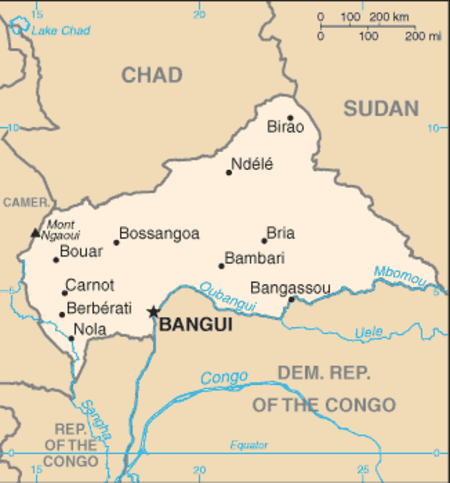
In November 2013, Secretary General Ban Ki-moon warned the UN Security Council that communal violence in the Central African Republic (CAR) was spiralling out of control. He backed the possibility of an armed UN peacekeeping force to complement the civilian UN staff, the Integrated Peacebuilding Office in the Central African Republic (BINUCA).
The UN faces a double task in the CAR. There is the immediate problem of violence among tribal-based militias in the absence of a national army or central government security forces. The militias basically pit the north of the country against the south. In addition, militias from the Democratic Republic of the Congo and segments of the Ugandan Lord’s Resistance Army use the CAR as a “safe haven” and live off the land by looting villages.
In the absence of a standing UN peacekeeping force, UN peacekeepers would have to be redeployed from the eastern areas of the Democratic Republic of Congo, an area also torn by fighting. Moving UN troops away from the Congo however risks the recent progress that they have made on the security situation in recent months.
The longer range task of peacebuilding and creating a national administration which provides services beyond the capital city, Bangui, is the aim of the BINUCA, but its work is largely impossible in the light of the ongoing violence.
The area covered by the current state had no pre-colonial common history and no “state-building” occurred during the French colonial period. Oubangui-Chari, as CAR was then known, was the poor cousin of French Equatorial Africa (AEF). It was used as an “exile post” for African civil servants considered “trouble makers.” Schools were few, and secondary school students were sent away to Brazzaville, the administrative center of AEF.
There was only one political figure of standing who emerged from Oubangui-Chari, Barthelemy Boganda (1910-1959). He was a Roman Catholic priest elected to the French Parliament following the Second World War. Boganda advocated keeping the AEF together as a federation of independent states knowing that Oubangui-Chari was the poorest of the AEF states and most in need of help from its neighbours. Unfortunately, he was killed in a plane crash on the eve of independence, and with him disappeared all enlightened leadership.
Following his death, political power passed to two cousins. First, David Dacko, first President of the independent Central African Republic and then Jean-Bedel Bokasa in 1965. Bokasa changed the name of the country to Central African Empire and (mis)ruled as Bokasa the First. His dreams of being a new Napoleon was ended in 1979 by a French military intervention after Bokasa had too visibly killed young school children who were protesting.
Since Bokasa, all pretext of a unified administration has disappeared. General Kolingba, Ange-Felix Patassé, followed by Francois Bozizé were considered the head of state, but the state had no visible administration. Bozizé was overthrown in March 2013 by Michel Djotodia and his Seleka militia. The Alliance has now been dissolved by Djotodia but replaced by nothing. A fact-finding mission sent by the UN Human Rights Council concluded that “both the forces of the former government of President Bozizé and the Seleke committed serious violations of international humanitarian law and international human rights law during the conflict.”
The pre-colonial tribal structures no longer function and very few inter-tribal mechanisms remain in place to facilitate dispute settlement or a state-building process. As in Somalia, the situation merits close attention and contributions to the UN’s efforts by national governments and NGOs.


