
Originally published on the CGS blog on April 5, 2012.
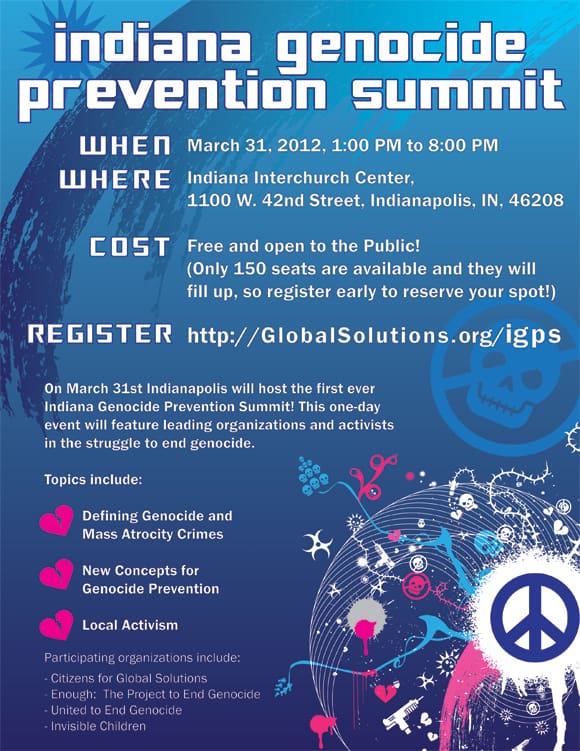
GlobalSolutions.org organized the first ever Indiana Genocide Prevention Summit, held on Saturday, March 31, in Indianapolis. The summit brought organizations, students, teachers, genocide survivors, activists, and concerned citizens from across the state.
Indiana is seemingly far away from the killing fields of Syria, Sudan, and the Democratic Republic of Congo. It is even farther away in time from the mass graves of Rwanda, Bosnia, or Auschwitz. At the Indiana Genocide Prevention Summit though, it was clear that many of us from Indiana had the power and bore the responsibility for genocide prevention.
We could either build a movement to engage our communities and our politicians in genocide prevention. Or let the words “Never Again” be meaningless once again.
Kizito Kalima, a Rwandan genocide survivor, told his story to a captivated audience. He was 14 when he escaped certain death during the 1994 Rwandan genocide. He eventually ended up in Indianapolis where he started the Global Genocide Prevention Alliance, an organization for survivors of genocide to have their voice heard.
Nora Basha, a Syrian American from Carmel, IN presented next. Though she grew up in Michigan and Indiana, Nora’s family is from Hama, Syria. In 1982, Syrian dictator Hafez al-Assad systematically destroyed the town, killing as many as 40,000 people. Nora has family members that she never met because of this crime against humanity. Today, Nora, is a leading activist in the struggle against Bashar al-Assad and his government’s deadly and genocidal crackdown on Syria’s Arab Spring.
Kelly Watson, an 8th grade English teacher who also works with the National Holocaust Museum to train educators to teach about the Holocaust, also spoke at the event. Students in Fishers, Indiana learn from one of the best and renowned educators about the history of the Holocaust, how it started, why it wasn’t stopped until it was too late, and actions to prevent future Holocausts.
Throughout the day, we learned about new tools to prevent genocide. The Responsibility to Protect is a game changer, according to Don Kraus, CEO of GlobalSolutions.org. Henry Dambanemuya, a student at Depauw University, spoke about how the Internet and Internet concepts like crowd sourcing can be used to detect warning signs. We heard from student leaders about the Conflict Free Campus Initiative, a movement in which college students are demanding that the purchasing power of their universities be used to prevent conflict minerals from ending up in cell phones and computers.
Claude Gautebuke, another Rwanda genocide survivor, taught the audience about how lessons from the anti-apartheid movement translate to the genocide prevention movement. Congressman Andre Carson’s office sent a representative to the summit, in which she read a letter of support for genocide prevention legislation. We also heard from religious leaders, including Rev. Lakisha Reed from the Indiana Untied Methodist Church and Sheik Saleh Habinima, the former Grand Mufti of Rwanda. He who flew to Indianapolis from Kigali to be part of the day’s activities.
There at the Indianapolis Interchurch Center on a warm spring day, there was a movement coming together. The biggest lesson learned that day is that that we have the power and bear the responsibility to prevent genocide from occurring on our watch again.


