Originally published on the CGS blog on May 31, 2013.
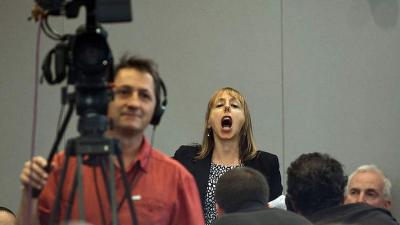
Since interrupting President Obama’s terrorism and drone war speech at National Defense University last week, Medea Benjamin, co-founder of Code Pink, has been on the receiving end of a good deal of criticism. Despite the fact that she objects to being called a heckler, Ms. Benjamin has been largely lambasted by the media for what’s been called a “rude” and “crazy” display. Some publications have even taken to lampooning her, as the Washington Times did here, comparing her to a crazed image of the titular character in Euripides’s Medea. Unfortunately, coverage and commentary of Ms. Benjamin has focused on what she did rather than what she was saying while she did it.
What’s really worth talking about with regard to Medea Benjamin’s part in President Obama’s speech is the fact that she brought up the topic of signature strikes. Signature strikes are, broadly, drone strikes of targets picked by their “intelligence ‘signatures’ – patterns of behavior that are detected through signals intercepts, human sources and aerial surveillance,” but do not require that the identity of the target be acquired or confirmed. According to a jointly-compiled report from the Stanford and NYU law schools, these strikes focus on a “‘pattern of life’ analysis” that oftentimes focuses more on judgment calls and perceptions rather than on actual fact. Further, a Columbia Law Human Rights Clinic report found that the US has used signature strikes to kill suspected terrorists twice as much as they’ve used personality strikes, where the identity of the suspect is confirmed beforehand. Thus, absent a requirement for identity confirmation of targets, civilian casualties of signature strikes, and drone strikes in general, have increased. The New America Foundation has calculated that the civilian drone casualty rate in Yemen is approximately between 3.2% and 8.9%, while the Bureau of Investigative Journalism says that between 411 and 884 civilians have been reported killed in Pakistan since 2004. Medea Benjamin asked President Obama, “Can you stop the signature strikes killing people on the basis of suspicious activities?” This is the question that should be bouncing around the blogosphere and guiding conversations on news networks, but it’s not.
Why is that? Go check out Google’s analytics and trends department, who monitors internet search trends and popular words and phrases that the public is inquiring about. According to Google Trends, on the day of President Obama’s terrorism and drone program speech, what do you think was at the top of the trending charts? President Obama? Drones? Terrorists? Maybe even signature strikes? Nope. Amanda Bynes. The day after? Paul George, a basketball player on the Indiana Pacers. Where was the American public’s interest in the important goings-on of the country? Beats me. Google AdWords, another useful service Google provides for determining search-counts of words and phrases, estimates that for global monthly searches of words and phrases, Justin Bieber was searched 30,400,000 times, while drones were searched for 1,220,000. Signature strike? 2,900 times. Even a search for “dancing cats” vastly outpaced searches for signature strikes, coming in at 33,100 hits. The American public is not simply uninformed about signature strikes and our drone program – they’re willfully ignorant of it. And what responsibility do we bear for not making a bigger deal over this?
On a separate point, while we may argue back and forth about drones use as opposed to other methods, I wonder what our drone program means for the future. According to my international law professor, one of the most important things in the international community is the maintenance of stability. The danger of going ahead with potentially destabilizing actions in the international arena is the danger of reciprocity; the domino effect of responsive action is a dangerous specter looming on the horizon. Earlier this month, Iran unveiled its “most advanced” drone yet, the Epic. The acceptance of drone use as the status quo of today’s new type of warfare is a scary indicator for the future.
At one point in his speech, President Obama said of Ms. Benjamin, “The voice of that woman is worth paying attention to.” So let’s do just that: in a follow-up article on Common Dreams after the speech, Medea defended and explained her actions. Medea shot back at the detractors that labeled her actions rude, saying, “[T]errorizing villages with Hellfire missiles that vaporize innocent people is rude. Violating the sovereignty of nations like Pakistan is rude. Keeping 86 prisoners in Guantanamo long after they have been cleared for release is rude. Shoving feeding tubes down prisoners’ throats instead of giving them justice is certainly rude.” I certainly couldn’t have said it better myself.
Don’t get me wrong. Do I think Medea Benjamin could have pursued a less disruptive option for making her opinions known? Sure. Do I think there are certain avenues that might have been more appropriate? Perhaps. But would we be talking about Medea Benjamin, Code Pink and signature strikes if she’d done that? Probably not. As Laurel Thatcher Ulrich famously noted, “well-behaved women seldom make history.”
So do I wish she’d just sat down and kept quiet? Not a bit.