by Ronald Glossop | Nov 24, 2017 | Global Cooperation, World Federation
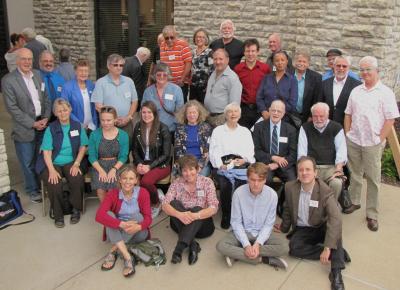
The 2017 national convention of Citizens for Global Solutions in St. Louis October 20-22 marked a new focus in its efforts to bring about a democratically governed world. “Just Security 2020: Citizen Action for an Effective and Inclusive UN” was the theme of the convention. The featured speaker, Dr. Richard Ponzio, Director of the Just Security 2020 Program at the Stimson Center in Washington DC, explained how broad institutional reforms at the UN are designed to culminate in a 2020 summit on the UN’s 75th anniversary. The specific recommendations of the Albright-Gambari Commission on Global Security, Justice and Governance can be found on the CGS website http://globalsolutions.org/issues/commission-global-security-justice-governance
David Lionel used videos in an interactive session to encourage discussion about what local groups can do to raise awareness of the Just Security 2020 effort and how to educate them about its specific recommendations. The challenge is to find ways of generating local enthusiasm for this project for global justice and knowing how to bring other non-governmental organizations into a collaborative effort.
The World Federalist Institute’s Friday meeting began with a report via Skype with Andreas Bummel in Germany about how a UN Parliamentary Assembly is needed to make the UN more democratic. After that, the first topic discussed was what WFI’s role should be in CGS in emphasizing global governance messaging and outreach. The next topic was why WFI should be promoting a UN Parliamentary Assembly and how to do that. The third topic was how WFI could and should promote World Federation Education and how such education is critical for the kind of social change we want to implement.
During the convention the two CGS boards approved a new Strategic Plan. The plan details goals and objectives to guide the organization through the next 5 years. Work has already begun to implement these goals and objectives. The Saturday evening banquet was followed by a “Lifetime Achievement Award” presentation to Ronald Glossop for his long-time commitment to CGS and World Federation. There was a fund raising event for CGS in Ron’s honor. If you are interested in participating, please click here to donate. Saturday evening also included a talk by Tad Daley about his energizing meeting with the Young European Federalists in Italy.
Sunday morning we held a lively discussion about framing our message based on George Lakoff’s book Don’t Think of an Elephant: Know your Values and Frame the Debate. There is much more work to be done in this area. If you are interested in helping please send an e-mail to dpark@globalsolutions.org.
Sunday afternoon the convention concluded with the viewing of “The World Is My Country” a captivating film directed by Arthur Kanegis about the life of world citizen, Garry Davis. David Gallup, Executive Director of Garry Davis’ World Service Authority, was present to accept applications for a World Passport, a simple way to affirm your global citizenship and declare your allegiance to humanity and the earth.
Participants are looking forward to another national convention, maybe in California in 2019.
by Tad Daley | Oct 9, 2017 | Global Cooperation, World Federation
America first. Russia first. China first.
The United States of America puts American interests first. Just as every other nation in the world puts its own interests first. President Donald Trump was right about that in his first speech before the United Nations, on Sept. 19. Few world leaders have so nakedly expressed the essence of the Westphalian state system, established by treaty in 1648, and under which every human being dwells today.
“As president of the United States,” Trump said, “I will always put America first, just like you, as the leaders of your countries, will always, and should always, put your countries first.” This is controversial? Every undergraduate learns this on the first day of International Relations 101. It is the first principle of the realpolitik practiced by Henry Kissinger, Winston Churchill and Otto von Bismarck.
Virtually every other American president has made the same point. President Barack Obama, expressing his conception of larger interests during his final speech before the United Nations in 2016, returned in the end to his own primary obligation—and that of his counterparts. “Sometimes I’m criticized in my own country for professing a belief in international norms and multilateral institutions. But I am convinced that in the long run, giving up some freedom of action — not giving up our ability to protect ourselves or pursue our core interests, but binding ourselves to international rules over the long term — enhances our security. And I think that’s not just true for us.”
Similarly, at the Rio Earth Summit in 1992, President George H.W. Bush—who didn’t even agree to show up until the last minute—declared, “I’m the president of the United States. I’m not the president of the world. And while I’m here, I’m going to do what best serves the interests of the American people.”
So what reason is there to believe that a couple of hundred sovereign nations pursuing their separate national interests will produce optimal outcomes for the whole of the human community? “The nation-state remains the best vehicle for elevating the human condition,” Trump declared to the U.N. But he did not make a case for why that might be so. We live in a world whose crises interconnect us more than ever before. The runaway climate change that may have just produced three “thousand-year storms” in the space of three weeks. Genocide. Terror. Pandemic. The digital economy. An ever-increasing chasm of inequality, both within and among nations. An endless river of refugees generated by economic hopelessness—and global population totals that only go up. “Failed states” where national governments disintegrate and disappear. And most of all, succeeding generations not yet saved from the scourge of war.
All of these challenges are quintessentially transnational in nature. So is it anyone’s job today—as primary responsibility, not just when it happens to coincide with a national interest—to discern and pursue the transnational interest, the common human interest, the global public good?
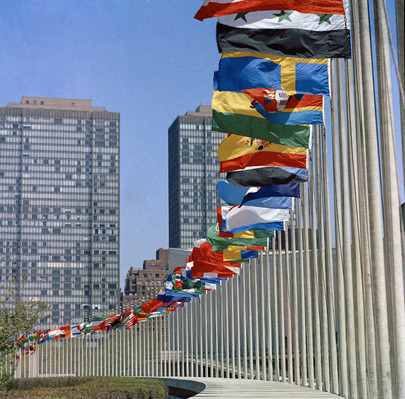
One answer, which could provide at least one small step for humanity tomorrow, is the proposal to establish a new international body called a United Nations Parliamentary Assembly. At the U.N., national “ambassadors” are currently appointed by executive branches of national governments. It is as if all 535 members of the United States Congress—House and Senate alike—were appointed by the governors of the 50 states. But on every lower level of governance—cities, states or provinces, and countries—we take for granted that the bedrock of democracy is some kind of legislature, whose individual members are selected by citizens at the ballot box. Why in the world can’t this exist on the global level as well?
A UNPA would seat individuals who had already been elected to national parliaments—the Japanese Diet and the U.S. Congress and the British House of Commons. It could be created by a simple vote of the U.N. General Assembly under Article 22 of the U.N. charter. This would, for the first time in history, provide a direct voice on the global level not just for governments, but for people. Most importantly, its members would not answer to national governments, or articulate solely the interests of their national communities. They would be free to articulate the larger, collective interest of humankind—and to manifest not just the national patriotism of their voters, but a larger, planetary patriotism.
Some see the establishment of a UNPA as the first step on the road to democratizing our global institutions and representing our common humanity. One next step would be having UNPA members selected not from national parliaments, but elected directly by voters. Imagine going into the booth on Election Day in Chicago, for example, and casting your vote for candidates you believe will best represent your views in the Chicago City Council, the Illinois House and Senate, the U.S. House and Senate and the United Nations Parliamentary Assembly.
Over time, the intangible authority that would emanate from resolutions passed by a UNPA—the international organization that would embody the collective views of all “citizens of the world” more than any other—would evolve into a more tangible authority. The U.N. General Assembly, the U.N. Security Council and national governments would find it increasingly difficult to take actions that directly contradicted opinions and debates and outcomes at the UNPA. Perhaps this new body might eventually provide the seeds for establishing what Alfred Tennyson envisioned in his poem “Locksley Hall” 180 years ago—a genuine Parliament of Humanity.
….click here to read Tad’s complete article posted on TruthDig
by Lawrence Wittner | Sep 19, 2017 | Global Justice, World Federation
Has nationalism captured the hearts and minds of the world’s people?
It certainly seems to have emerged as a powerful force in recent years. Trumpeting their alleged national superiority and hatred of foreigners, political parties on the far right have made their biggest political advances since the 1930s. After the far right’s startling success, in June 2016, in getting a majority of British voters to endorse Brexit―British withdrawal from the European Union (EU)―even mainstream conservative parties began to adopt a chauvinist approach. Using her Conservative Party conference to rally support for leaving the EU, British Prime Minister Theresa May declared contemptuously: “If you believe you are a citizen of the world, you are a citizen of nowhere.”
The tilt toward an aggressive nationalism was particularly evident in the United States, where Donald Trump―amid chants of “USA, USA” from his fervent supporters―promised to “make America great again” by building a wall to block Mexicans, barring the entry of Muslims to the United States, and expanding U.S. military might. Following his surprise election victory, Trump told a rally in December 2016: “There is no global anthem. No global currency. No certificate of global citizenship. We pledge allegiance to one flag and that flag is the American flag.” After wild cheering from the crowd, he added: “From now on it is going to be: America First. Okay? America first. We’re going to put ourselves first.”
But the nationalists suffered some major setbacks in 2017. In elections that March in the Netherlands, the xenophobic Party for Freedom, though given a chance at victory by political pundits, was soundly defeated. Much the same happened in France, where, that May, a political newcomer, Emmanuel Macron, trounced Marine Le Pen, the candidate of the far right National Front, in an election for the presidency by a 2-to-1 vote. A month later, in parliamentary elections, Macron’s new party and its allies won 350 seats in the 577-member National Assembly, while the National Front won only 9. In Britain, Theresa May, confident that her new, hard line on Brexit and divisions in the opposition Labour Party would produce huge gains for her Conservative Party, called for a snap election in June. But, to the shock of observers, the Tories lost seats, as well as their parliamentary majority. Meanwhile, in the United States, Trump’s policies produced a vast wave of public resistance, his approval ratings in opinion polls sank to levels unprecedented for a new President, and he was forced to purge Steve Bannon―the top nationalist ideologue in his election campaign and in his administration―from the White House.
Although a variety of factors contributed to the nationalist defeats, widespread internationalist views certainly played a role. During Macron’s presidential campaign, he repeatedly assailed the narrow-minded nationalism of the National Front, projecting instead an internationalist vision of a united Europe with open borders. In Britain, May’s fervent support for Brexit backfired among the public, especially internationally-minded youth.
Indeed, over the centuries cosmopolitan values have become a strong current in public opinion. They are usually traced to Diogenes, a philosopher of Classical Greece, who, asked where he came from, replied: “I am a citizen of the world.” The idea gained increased currency with the spread of Enlightenment thinking. Tom Paine, considered one of America’s Founding Fathers, took up the theme of a loyalty to all humanity in his Rights of Man (1791), proclaiming: “My country is the world.” Similar sentiments were expressed in later years by William Lloyd Garrison (“My country is the world; my countrymen are all mankind”), Albert Einstein, and a host of other globalist thinkers. After the Second World War brought the nation-state system to the brink of collapse, a massive social movement developed around the idea of “One World,” with world citizenship campaigns and world federalist organizations attaining substantial popularity around the globe. Although the movement declined with the onset of the Cold War, its core assumption of the primacy of the world community persisted in the form of the United Nations and of worldwide campaigns for peace, human rights, and environmental protection.
As a result, even as a nationalist frenzy has erupted in recent years, opinion surveys have reported a very strong level of support for its antithesis: world citizenship. A poll of more than 20,000 people in 18 countries, conducted by GlobeScan for the BBC World Service from December 2015 through April 2016, found that 51 percent of respondents saw themselves more as global citizens than as citizens of their own countries. This was the first time since tracking began in 2001 that a majority felt this way.
Even in the United States, where slightly fewer than half of the respondents identified themselves as global citizens, Trump’s hyper-nationalist campaign attracted only 46 percent of the votes cast for President, thus providing him with almost three million fewer votes than secured by his Democratic opponent. Furthermore, opinion polls before and since the election revealed that most Americans opposed Trump’s best-known and most vehemently-supported “America First” program―building a border wall between the United States and Mexico. When it came to immigration issues, a Quinnipiac University survey taken in early February 2017 found that 51 percent of American voters opposed Trump’s executive order suspending travel to the United States from seven predominantly Muslim countries, 60 percent opposed suspending all refugee programs, and 70 percent opposed indefinitely barring Syrian refugees from emigrating to the United States.
Overall, then, most people around the world―including most people in the United States―are not zealous nationalists. In fact, they display a remarkable level of support for moving beyond the nation-state to world citizenship.
By Lawrence Wittner [Dr. Lawrence Wittner (http://www.lawrenceswittner.com) is Professor of History emeritus at SUNY/Albany and the author of Confronting the Bomb (Stanford University Press).]
by Ronald Glossop | May 26, 2017 | Global Justice, World Federation
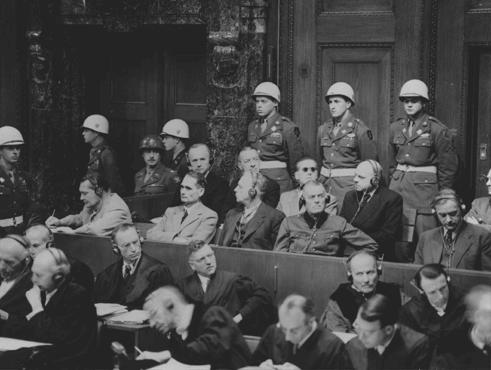
“60 MINUTES” on Sunday evenings is a very popular weekly TV news programs. The second segment of the May 7, 2017 program focused on Ben Ferencz, a prosecutor for the Nuremberg Trials after World War II. In those trials Nazi leaders were convicted for the killing of millions of Jews and others in what became known as “the Holocaust.” Fortunately you can see Leslie Stahl’s wonderful interview of Ben again and again at <http://www.cbsnews.com/news/what-the-last-nuremberg-prosecutor-alive-wants-the-world-to-know/>.
An important part of the interview comes near the end when Ferencz clearly makes the point that war turns generally good people into murderers. His goal during much of his 97 years has been to end war by means of the use of law. The disaster of wars exists because the world of nation-states with unlimited national sovereignty still lacks a system of law and government at the global level.
The interview very briefly mentioned the work of Ferencz to help create the International Criminal Court (ICC) which can prosecute leaders who disobey international laws against genocide and committing crimes against humanity. In addition to his crucial role in the development of the ICC and teaching international law for decades, Ben has authored many important books such as New Legal Foundations for Global Survival: Security through the Security Council (1994) and the more popular-oriented A Common Sense Guide to World Peace (1985). That book became the basis for the even more popular Planethood: The Key to Your Future (1991) co-authored by Ken Keyes, Jr.
Our thanks to Ben Ferencz for his life dedicated to “world peace through world law” and to CBS for calling attention to it.
by Ronald Glossop | Apr 15, 2017 | Global Cooperation, World Federation
Citizens for Global Solutions is very indebted to many activists who contributed much to making the World Federalist Association (WFA) and the Campaign for U.N. Reform CUNR) influential organizations that flourished from the end of World War II until 2003 when they were merged to form Citizens for Global Solutions (CGS). CGS regrets that we probably have not sufficiently honored many of these now deceased members from the past.
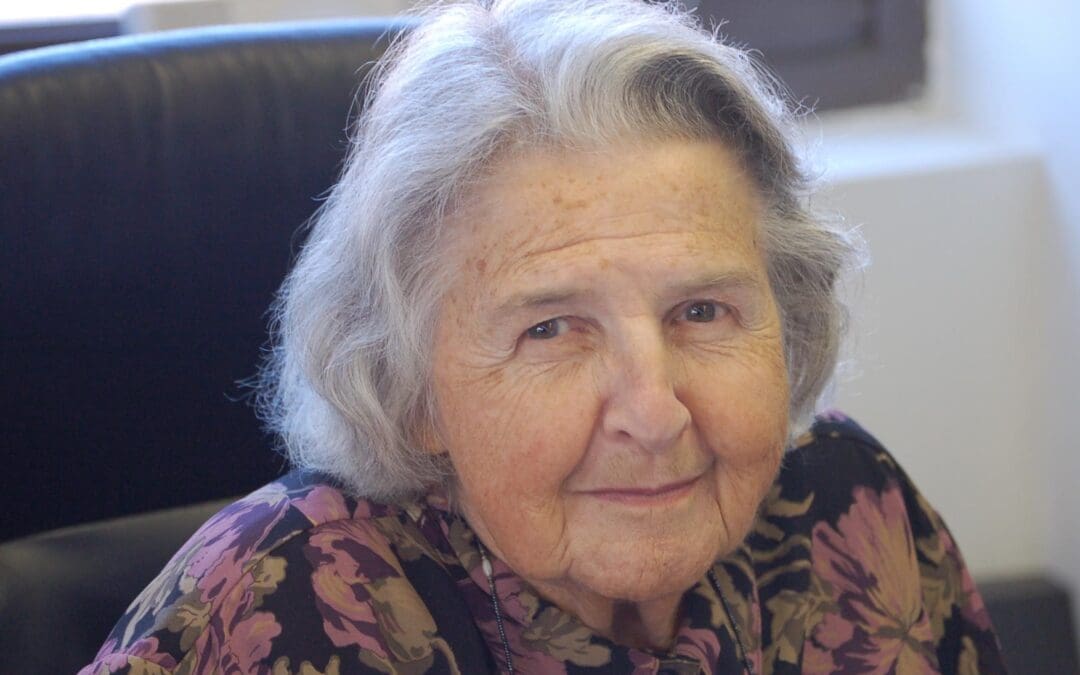
Nevertheless we are glad now to honor two of them, Betty and Howard Taylor of Akron/Stow, Ohio on the occasion of Betty’s death April 10, 2017 at the age of 93. Howard died September 16, 2006. Married in 1944, they had three children–Bruce, Susan, and Karen. From the beginning of the world federalist movement in 1947 they became leaders locally and nationally. Betty was Akron WFA chapter president for decades. Both were active in the Campaign for U.N. Reform and worked with elected officials friendly to our aims. Betty later served on the Steering Committee of the World Federalist Institute (WFI).
Betty was also active in the local UN Association, the Akron Peace Council, and the League of Women Voters as well as doing her volunteer work on behalf of local artists. Howard and Betty were honored with the “Arts Alive” Volunteer Award by the Akron Area Arts Alliance in 2003.
In lieu of flowers, the family suggests that memorial donations in Betty’s name be made to Summit Artspace (which Betty and Howard helped to found), 140 East Market Street, Akron, Ohio 44308, or to Citizens for Global Solutions Education Fund, Memorial Gift Program, PO Box 15256, Washington, DC 20003.
by Tad Daley | Mar 26, 2017 | Global Justice, World Federation
In his speeches before both CPAC and the U.S. Congress, President Trump described with pinpoint accuracy the sovereign state system of today. But might we see a global anthem tomorrow, and a world flag, and even a United Earth? This posting is a short version of Tad’s longer article posted on AlterNet on March 10, 2017. Click here to read his full article and join in the discussion taking place there.
“We will serve the citizens of the United States of America, believe me,” said President Donald Trump at the Conservative Political Action Conference (CPAC) on February 24th. “There is no such thing as a global anthem, a global currency, or a global flag.” Four days later, in his first speech before a joint session of Congress, he continued, “My job is not to represent the world. My job is to represent the United States of America.”
But someday, is it possible that people around the world might actually sing a global anthem together? And hoist a global flag? And dwell together as citizens of a United Earth?
Our world grows smaller and more interconnected every day. No grand historical development is more defining of the modern age. Can we imagine the same feelings of camaraderie, kindred spiritedness, and tribal solidarity about our single human community? Can our loyalty to the world as a whole — as it does for many for one’s nation — make our blood rush a little more quickly through our veins? Might our allegiance to our nations be accompanied by an allegiance to humanity?
There’s no reason why people cannot declare right now that they see themselves as both citizens of their countries and citizens of the world. That their national patriotism is for them transcended by their planetary patriotism. And that all of us on this fragile planet must now consider ourselves, in the science fiction author Spider Robinson’s memorable phrase, to be “crewmates on Spaceship Earth.”
These ideals of larger loyalty have been promulgated by some of the greatest figures in the human heritage. It’s what Voltaire called “the party of humanity.” It’s what Victor Hugo meant when he said, “I belong to a party which does not yet exist — the party of revolution and civilization.” It’s what the signatories of the 1955 “Einstein-Russell Manifesto” were describing when they claimed to speak “not as members of this or that nation, continent, or creed, but as human beings, members of the species Man, whose continued existence is in doubt.”
Who Does “Represent the World?”
President Trump is not wrong about who he “represents.” It’s that way for every president. There’s nothing unusual or unprecedented or groundbreaking about it. The oath an American president swears is about protecting the United States of America and its constitution — nothing else!
But this leads to a rather severe problem in our ever shrinking world. Some 200 separate sovereign units, each pursuing their own individual national interests, can hardly guarantee optimal outcomes for the common human interest. And we see this in cold, hard realities, from the massive displacement and refugee flows generated by economic hopelessness, to transborder cyberattacks and runaway climate change. Stronger multilateralism, robust support for international institutions and enhanced mechanisms of global governance are the optimal policy tools.
So who, today, which individuals in which elected offices, can we identify whose raison d’etre is to serve the larger collectivity, the whole of the human community, the global public good?
The answer is no one. It’s not Donald Trump’s job … but it’s no one else’s either. There is no supranational authority that stands above the nation state. There is no institution, no elected official anywhere, whose job it is to “represent” the human race.
It’s hardly self-evident that what political scientists call the “Westphalian state system” (originating in the peace treaty of 1648 that ended Europe’s calamitous wars of religion) will endure as a permanent feature of human history.
We can imagine a redesigned and democratized and empowered United Nations. Former U.S. Secretary of State Madeleine Albright recently co-chaired a “Commission on Global Security Justice and Governance.” It proposed a “World Summit on Global Governance” during the UN’s 75th anniversary year in 2020. Further down the road it’s not impossible to envision that the same basic structures of governance long established almost universally at city, state, and national levels worldwide — a legislature and an executive and a judiciary — might someday be fashioned and founded at the global level as well.
This vision too — not just the intangible ideal of global citizenship but the tangible idea of a world state — has been put forth by some of the greatest figures in the human heritage. “I dipt into the future, far as human eye could see, Saw the vision of the world, and all the wonders that would be … Till the war-drum throbbed no longer, and the battle flags were furl’d, In the Parliament of Man, the Federation of the World.” That’s Alfred Lord Tennyson, Poet Laureate to Queen Victoria, in his 1842 masterpiece Locksley Hall. “The Earth is but one country, and mankind its citizens.” That’s Baha’u’llah, the founder of the Baha’i Faith, in 1857. (By most accounts it’s the first or second fastest growing religion in the world today.) “Without some effective world supergovernment … the prospects of peace and human progress are dark … (But) if it is found possible to build a world organization of irresistible force and inviolable authority … there are no limits to the blessings which all men may enjoy and share.” That’s conservative hero Winston Churchill in 1949.
These kinds of possible future developments might someday give tangible content and historical meaning to the planetary patriotism that, perhaps, more and more Earthlings might over time declare. Perhaps this hypothetical future entity might be established, some distant day, by a duly negotiated and legally enacted world constitution. They might call it an “Earth Union,” or the “Federal Republic of the World,” or a “United Earth.” In the fictional future history of STAR TREK, after all, the “United Federation of Planets” in the galaxy was preceded by a “United Federation of Nations” on Earth. Hundreds of science fiction novels contain similar depictions of a politically unified human race. If writers can make such a future seem so plausible and believable, is it really so ridiculous simply to ask whether we can aspire to it as an actual historical goal?
“We are one people with one destiny,” said President Trump toward the end of his speech to Congress — addressing himself, of course, exclusively to Americans. But perhaps it is not too much to suppose that someday, some political leader will sit in a position, and maintain the responsibility, and show a sufficient elevation of the human spirit, to say not just to the citizens of one particular country but to all the people of Planet Earth, “We are one people with one destiny.”
The Road to One World
So which comes first? A sentiment of planetary patriotism or an actually politically unified planet? It’s sort of like the proverbial question about the chicken and the egg — only prospective instead of retrospective. It may be that we’ll never see any kind of tangible progress toward world political unity until a substantial number of people feel, deep in their bones, something like an ethic of human unity. Or it may be instead that we’ll never have a great many people who see themselves primarily as citizens of the world until every living human being has in fact become a citizen — with both rights and responsibilities — of a United Earth.
Tad Daley, author of APOCALYPSE NEVER: Forging the Path to a Nuclear Weapon-Free World from Rutgers University Press, is a fellow with the Center for War/Peace Studies. He’s currently writing his second book, on the extraordinary history and possible future of the idea of a world republic. Follow him on Twitter @TheTadDaley.