Originally published on the CGS blog on June 27, 2011.
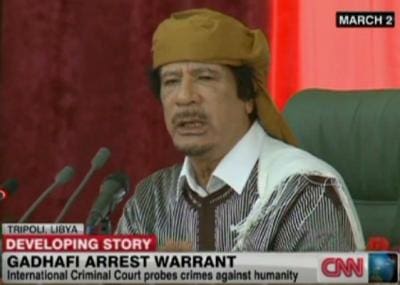
It was not unexpected, but nonetheless, today marks another milestone on the road toward international justice. For only the second time in the history of the International Criminal Court, the ICC has issued an arrest warrant for a sitting head of state. Arrest warrants were issued for Libyan leader Muammar Gaddafi, his son Saif Al-Islam Gaddafi and Abdullah Al-Sanousi, the Head of the Military Intelligence, for crimes against humanity after Prosecutor Luis Moreno-Ocampo’s request was approved by the Court’s Pre-Trial Chamber.
Prosecutor Ocampo had requested the warrants for Gaddafi and the others on May 16th. The situation in Libya, stemming from the violence towards civilians in that country that began last winter, was unanimously referred to the ICC by a vote of the United Nations Security Council (UNSC) in February. Prosecutor Ocampo opened an investigation into events in Libya in March.
The Court’s decision illustrates that no one in the world today, not even a head of state, is immune from the reach of international justice. However, issuing arrest warrants is one thing; actually enforcing them is another. United Nations Security Council Resolution 1970 requires Libya to cooperate with the Court, but its leaders have already indicated they will not do so. All ICC member states around the world are now obligated to turn Gaddafi and his allies in to the Court if he should step foot on their soil, which greatly limits their ability to travel outside Libya. However, Sudanese President Bashir was also indicted by the ICC in 2009 and has since visited several ICC state parties, including Chad, Kenya, and most recently Djibouti.
Some have also raised the point that the ICC warrant might isolate Gaddafi in Libya and therefore make it less likely for a peaceful settlement to be reached to end his rule in that country, since his ability to go into exile abroad would be limited. However, since Gaddafi has made clear his determination to fight to the bitter end prior to the warrants being issued, it seems unlikely that this latest turn of events would have a strong impact on the situation. In any case, it’s important that the need for justice for Libyan victims be considered a separate issue from the military campaign currently being waged in Libya. Ending the conflict in Libya and seeking justice and redress for Gaddafi’s victims should not be seen as mutually exclusive goals. The ICC must be allowed to do its work.
All in all, today was a good day for both the victims of crimes against humanity in Libya, and for the concept of international justice. I hope that the Court’s decision will indeed result in real justice for Gaddafi and his cohorts very soon.