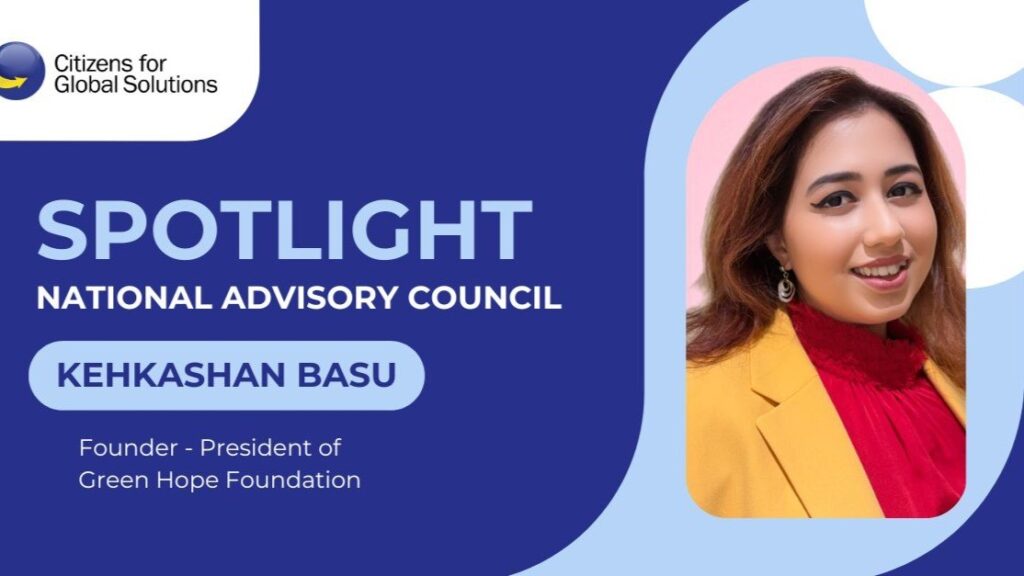
Citizens for Global Solutions (CGS) is proud to welcome Kehkashan Basu, M.S.M., MBA as the newest member of our National Advisory Council (NAC). An internationally recognized environmentalist, human rights champion, and youth advocate, Kehkashan brings a powerful combination of grassroots leadership, global policy engagement, and visionary thinking to the CGS community.
Kehkashan is the recipient of Canada’s Meritorious Service Medal and remains the only Canadian to win the International Children’s Peace Prize. Named to Forbes 30 Under 30, she has emerged as one of the most influential young voices in sustainability, climate justice, and human rights. Her work spans multiple global platforms: she is a United Nations Human Rights Champion, National Geographic Explorer, UNCCD Land Hero, and UN Habitat Young City Champion, among many other roles.
As the Founder-President of the Green Hope Foundation, Kehkashan leads a global social innovation enterprise that operates in 29 countries, empowering more than half a million young people and women, particularly those from vulnerable communities. Through Green Hope, education for sustainable development is transformed into tangible action, harnessing clean energy technologies and community-led initiatives to drive environmental and social change at the grassroots level.
In addition to her grassroots leadership, Kehkashan plays a critical role in global governance conversations. She currently serves as Co-President of the World Federalist Movement/Institute for Global Policy, is a Trustee of the Parliament of the World’s Religions, and is a Co-Lead of UN Women’s Generation Equality Forum Action Coalition on Feminist Action for Climate Justice. She has addressed more than 500 United Nations and international forums, advocating for climate justice, nuclear disarmament, and the empowerment of youth and women.
Kehkashan’s work has earned her numerous international honors, including the Spirit of the United Nations Award, World Literacy Award for Significant Contribution to Literacy by a Young Person, and Canada’s Global Energy Show Emerging Leader Award. She was also named among the Top 100 SDG Leaders in the World and recognized as Innovator of the Year at the HundrEd Innovation Summit for her pioneering work in sustainability education.
She holds an MBA from Cornell University and an Honours BA with High Distinction in Environmental Studies from the University of Toronto.
As she joins the Citizens for Global Solutions National Advisory Council, Kehkashan brings a unique perspective shaped by youth leadership, global advocacy, and deep community engagement. In the following conversation, she shares her insights on global cooperation, youth-led sustainability efforts, and how the next generation can take meaningful collective action.
In this conversation, we sat down with Kehkashan Basu to talk about her inspiring journey and the work that continues to drive her forward. From founding the Green Hope Foundation to shaping global policy conversations, she reflects on the importance of youth leadership, collaboration, and turning passion into meaningful action.
Question 1:
Global cooperation is increasingly essential to address challenges that transcend national borders. As Co-President of the World Federalist Movement/Institute for Global Policy, what role do you believe stronger global institutions and cooperation can play in advancing peace, climate action, and human rights?
Stronger global cooperation is indispensable in addressing the transboundary challenges of our time, but its effectiveness depends on how well global governance connects with realities on the ground. From a world federalist perspective, the priority is not just more cooperation, but more coherent and structured cooperation: institutions that can align global ambition with national implementation and local impact. Whether in advancing peace through coordinated multilateral mechanisms, driving climate justice through enforceable and equitable frameworks, or upholding human rights through universal standards and accountability, strong global institutions are essential to moving beyond fragmented responses toward collective progress. At the same time, bridging the gap between global frameworks and their implementation remains critical. This is where a world federalist approach that is grounded in coordination, subsidiarity, and shared responsibility can strengthen the system as a whole. I speak to this as a feminist, environmentalist, and peacebuilder, perspectives that underscore the need for governance structures that are not only effective, but also inclusive and just. Ultimately, I firmly believe that global institutions must function as connectors, ensuring that international commitments translate into meaningful, real-world outcomes for people and communities everywhere.
Question 2:
Through the Green Hope Foundation, you have empowered over half a million young people and women across 28 countries to turn sustainability education into real action. What inspired you to found Green Hope Foundation, and what have you learned about the power of grassroots youth leadership in driving environmental and social change?
I founded Green Hope Foundation out of a deep sense of urgency that began at a very young age. At the age of 7, I came across an image of a dead bird with its belly full of plastic, which was deeply disturbing to me. Around the same time, I attended a lecture by environmentalist Robert Swan. His words “The greatest threat to our planet is the belief that someone else will save it,” made me realize that I had to make a difference on my own. Thus, on my 8th birthday, I planted my first tree, and from there, my work continued to grow through hands-on action in my community. After working on the ground for many years, I was invited to speak at my first United Nations conference at the age of 11 to share my ground-level actions. However, it was the following year in 2012, when I was 12 years old, that I was invited to speak at the Rio+20 Earth Summit in Brazil, which proved to be a turning point in my life. As one of only 5 people under the age of 18 at the then-largest sustainability conference, I became increasingly aware of a disconnect between policy and action. This is because as I looked around, it was clear that women, youth, and underserved communities were not adequately represented in conversations shaping our future. Thus, on my return home, I founded Green Hope Foundation to create a platform where education is not passive, but transformative – where it empowers people, especially those from marginalized communities, to take meaningful action on the ground. What I have learned since then is that grassroots youth leadership is both impactful and essential. When young people are equipped with knowledge, skills, and a sense of purpose, they take concrete action. They design solutions rooted in their own realities, whether in climate resilience, water access, or sustainable livelihoods, and in doing so, they bring entire communities with them. Youth leadership is about ownership – and when that ownership exists, change becomes not only possible, but lasting.
Question 3:
Many young people care deeply about issues such as climate justice, peace, and global cooperation, but may not know how to get involved. What advice would you give to youth who want to move from concern to collective action, and how can organizations and communities better support them as changemakers?
For young people, the shift from concern to action begins with a simple realization: it is not about waiting for the perfect moment or platform, it is about starting where you are, with what you have. Sustainability is not one defined path – it is broad, intersectional, and deeply personal. My advice has always been to take that extra step, to walk that extra mile. Volunteer at a food bank or a women’s shelter, organize a local cleanup, grow your own food and share it with others, run for office – these are the foundations of real change. It is easy to speak about problems, especially on social media, but lasting impact comes from walking the talk. What comes from the heart, stays. At the same time, young people cannot and should not do this alone. Organizations and communities have a responsibility to create enabling environments where youth are not just participants, but leaders. This means moving beyond tokenism and providing access to education, mentorship, resources, and decision-making spaces. It means trusting young people with responsibility and recognizing their lived experiences as expertise. When we invest in youth not just as voices, but as changemakers, we unlock a powerful force for collective action – one that is rooted in empathy, driven by purpose, and capable of transforming both communities and systems.
Citizens for Global Solutions looks forward to deepening our collaboration with Kehkashan Basu through her role on the National Advisory Council. Even prior to joining the NAC, Kehkashan has already been actively engaged with CGS, serving as a mentor to participants in the Global Governance Fellows program and contributing her experience and insights to support emerging youth leaders. Her continued involvement will strengthen CGS’s youth programming and help inspire the next generation of advocates working toward more effective global governance, climate justice, and human rights. The CGS National Advisory Council provides guidance and counsel regarding our pursuit of world citizenship, a democratized and empowered United Nations, and enduring world peace through enforceable world law.