
Originally published on the CGS blog on September 6, 2013.
“When people eat chocolate, they are eating my flesh.”
This is what Amadou, a former child laborer on a cocoa farm, said in an interview with Free the Slaves.
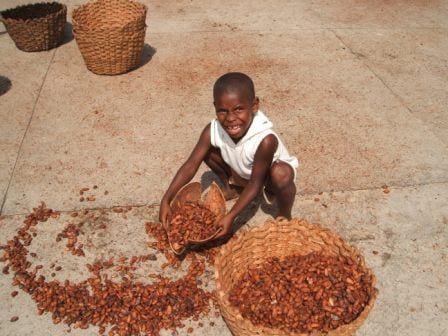
Amadou was one of an estimated 109,000 children exploited by cocoa farmers in the Ivory Coast, a West African nation that produces almost half of the world’s cocoa. Collectively, farms in West Africa are the source of about 75 percent of all chocolate, including products made by Hershey, Nestlé, Mars, and Cadbury.
One problem with the cocoa industry is its long supply chain. The middlemen between farmers and manufacturers frequently take advantage of the farmers’ lack of industry knowledge and use ploys to buy their cocoa for lower than market value. In order to stay afloat and keep their prices competitive, cocoa farmers may resort to irresponsible labor practices, including the use of child labor. The children they employ typically are impoverished and have no other recourse; are sold to the farmer by their relatives; or are abducted and trafficked from neighboring countries like Mali.
Over the course of the workday, child and adult laborers alike spend long hours in grueling heat, use dangerous tools such as machetes, and are exposed to harmful pesticides. Their accommodations are often substandard; they are housed in small windowless buildings, fed cheap food, and given no access to clean water. Journalists Sudarsan Raghavan and Sumana Chatterjee documented several cases in which workers were held on farms against their will, forced to work, and locked in at night. Sometimes they were whipped for working too slowly or for trying to escape.
Situations like these are defined and addressed in the International Labor Organization (182) concerning the Prohibition and Immediate Action for the Elimination of the Worst Forms of Child Labour. However, its provisions are not being enforced. In 2001 the US signed into law the Cocoa Protocol, calling upon major chocolate companies, labor unions, consumer groups, and anti-slavery groups to solve the exploitation problem in the cocoa industry. The companies pledged to certify their products as child-labor free by 2005, which was then extended to 2008, and ultimately unsuccessful.
Until anti-slavery policies are adequately enforced, it is up to consumers to promote social responsibility. Chocolate manufacturers will not change their practices and purchase ethically sourced cocoa for fair prices unless it is in their economic interest—unless they stand to lose business from consumers who make it clear they will not buy the products of slave labor.
Suggestions:
- Read labels before you buy chocolate. Chocolate is more likely to be slavery-free when it is:
- Fair Trade-certified or “direct trade”
- “Bean-to-bar,” or from a single origin
- Organic
- Sourced from someplace other than Africa
For further guidance on shopping for ethical chocolate, including relevant brand names, check out:
http://vision.ucsd.edu/~kbranson/stopchocolateslavery/main.html#Table
http://www.slavefreechocolate.org/SFC-Directory.html
http://grist.org/food/a-guide-to-ethical-chocolate/
2. Contact other chocolate companies to let them know you’d like to see more ethical sourcing efforts.
Check out some of these campaigns:
http://www.raisethebarhershey.org/take-action/
http://www.thepetitionsite.com/takeaction/229/288/148/
http://www.change.org/petitions/girl-scouts-of-u-s-a-commit-to-use-ethical-cocoa-in-your-cookies


