Originally published on the CGS blog on July 27, 2009.
The United Nations General Assembly’s debate on the Responsibility to Protect [R2P], held on July 23, showed conflicting beliefs about the role of nations intervening in cases of genocide, war crimes, and mass atrocities.
A week before the debate, Nicaraguan Reverend Miguel D’Escoto Brockmann, who is president of the UN General Assembly as well as a Catholic priest, issued a panel discussion and presented a position paper suggesting that R2P was essentially colonialism in disguise. “Recent and painful memories related to the legacy of colonialism give developing countries strong reasons to fear that laudable motives can end up being misused, once more, to justify arbitrary and selective interventions against weak states,” he said. “We must take into account the prevailing lack of trust from most of the developing countries when it comes to the use of force for humanitarian reasons.” Panelist Noam Chomsky reiterated this, saying that “virtually every use of force in international affairs has been justified in humanitarian terms, even the worst monsters.”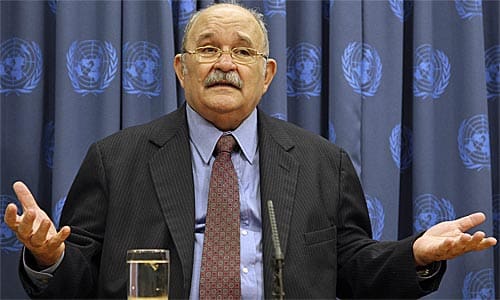
According to Reverend D’Escoto, the true means to end genocide and mass atrocities involve world finanical reform, Security Council reform, and following a lesson from Jesus – he said in his note that “Jesus’ emphasis on the redistribution of wealth to the poor and on nonviolence reinforces the right perspective on responsibility to protect.”
While Revered D’Escoto’s remarks elicited both support and shock from the Assembly, Secretary General Ban Ki-moon and his special adviser on R2P, Edward Luck, addressed the issues raised during his panel discussion. “The responsbility to protect does not alter the legal obligation of member states to refrain from the use of force except in conformity with the Charter. Rather it reinforces this obligation,” Luck quoted Ban as saying. Furthermore, in a speech he delivered on Tuesday before the debate, Ban urged member states to “resist those who try to change the subject or turn our common effort to curb the worst atrocities in human history into a struggle over ideology, geography, and economics.”