
Originally published on the CGS blog on February 28, 2014.
It’s easy to focus on North Korea’s nuclear program, its constant antagonism with South Korea and the United States, or the long-standing cult of personality built up around the Kim family.
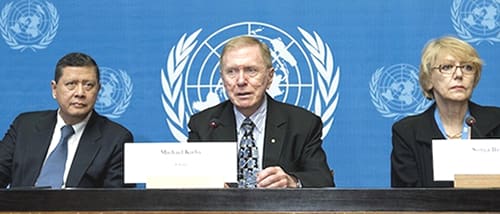
But as last week’s report by a commission of inquiry on human rights in the Democratic People’s Republic of Korea makes plain, we can no longer ignore the plight of ordinary North Koreans. The key concept in their daily life is often terror: fear that they will say or do the wrong thing and end up in one of four massive political prison camps (kwanliso), currently housing an estimated 80,000 to 120,000 political prisoners.
That’s an entire city’s worth of people disappeared (without trial or judicial order), often never to be heard from, or heard of, ever again, just because they are suspected of having spoken or acted in a way detrimental to the Workers’ Party of Korea. Once imprisoned, these people can expect to be starved, tortured, raped, and/or executed arbitrarily, with punishments not dependent upon the severity of the alleged crime.
But if fear of arbitrary detention and execution were the only kind of terror in North Koreans’ lives, perhaps life would be bearable: in a society highly stratified according to songbun, a kind of caste system, the further you are from the top of the system, the less likely you are to receive even the most minimal of necessities. As North Korea experienced famine in the late ‘80s and into the ‘90s, the regime did not apportion food according to humanitarian principles: if you were politically pure and of a desired caste, you were fed. If not, you went hungry, and in many cases, people starved to death.
This discrimination reaches not just to the songbun system but also to gender and race. Sexual and gender-based violence is prevalent at all levels of society, and victims have no recourse to the state. Women have no realistic economic opportunities, making up less than 10 percent of central government employees. Further, women can experience forced abortion and the infanticide of their children when they have relationships with undesirable men, usually non-Koreans, and these horrors occur to women incarcerated in political prisons as well. Most often cast out are the potential children of non-Korean men, illustrating the North Korean state’s xenophobia of all things outside its borders. These forms of discrimination help keep anyone from ever acting, speaking, or even thinking in a way that isn’t pre-approved.
But one of the saddest findings of the report is that those who do find a way out of North Korea into neighboring China are often captured and repatriated. The Chinese refuse to treat those fleeing as political refugees and instead call them economic migrants and immediately return them to North Korea, where they are viewed as having committed political crimes.
The report goes on in further detail than I have remarked upon here, but these are some of the findings that stand in sharpest relief to decades of human rights practice. In North Korea, the state and its leaders comes before all considerations of individual human beings and their wellbeing.
In responding to this immense tragedy, to these crimes against all of humanity, we need to remember the very human victims at the core of the North Korean state’s subjugation and dehumanization of its people. While the international community can and often will focus on how to handle these issues at the state level, whether China’s response, the effectiveness of sanctions, or whether to refer Kim Jong Un to the International Criminal Court, we also cannot forget that all action taken should be in service of ending the conditions experienced sometimes for the entire lifetimes of ordinary North Koreans. These people are no different than we are except by accident of birth. They deserve our support.


