
Originally published on the CGS blog on June 12, 2015.
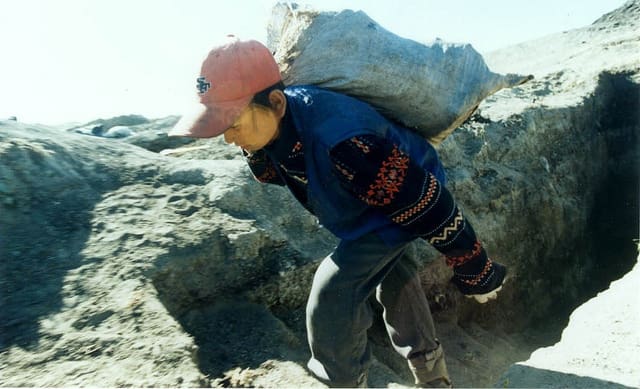
June 12 is a red-letter day on the UN agenda of events as the World Day Against Child Labor. It marks the June arrival in 1998 of hundreds of children in Geneva, part of the Global March against Child Labour that had crossed 100 countries to present their plight to the International Labour Organization (ILO).
“We are hurting, and you can help us,” was their message to the assembled International Labour Conference, which meets each June in Geneva. One year later, the ILO had drafted ILO Convention No. 182 on child labor, which 165 States have now ratified — the fastest ratification rate in the ILO’s history.
ILO Convention No.182 sets out in article 3 the worst forms of child labor to be banned:
-
all forms of slavery or practices similar to slavery, such as the sale and trafficking of children, debt bondage and serfdom and forced or compulsory labor, including forced or compulsory recruitment of children for use in armed conflict;
-
the use, procuring or offering of a child for prostitution, for the production of pornography or for pornographic performances;
-
the use, procuring or offering of a child for illicit activities, in particular for the production and trafficking of drugs as defined in the relevant international treaties;
-
work which, by its nature or the circumstances in which it is carried out, is likely to harm the health, safety or morals of children.
NGOs within the UN system as a whole played an important role in highlighting children working in circumstances that put their physical, mental and social development at risk, where they are exploited, mistreated and denied basic human rights. Today, millions of children, especially those living in extreme poverty, have no choice but to accept exploitive employment to ensure their own and their family’s survival. However, the ILO has often been an avenue for “unheard voices” to be heard, usually through the trade union representatives; less often, employer representatives have played a progressive role.
Child labor did not have a high profile on the long agenda of pressing labour issues until the end of the 1990s. At the start of the decade, there was only one full-time ILO staff member assigned to child labor issues; now there are 450, 90 percent of whom are in the field.
Child labor was often hidden behind the non-exploitive help children bring to family farms. However, such help often keeps children out of school and thus limits their opportunities to join the modern sector of the economy. The ILO estimates that of the 200 million child laborers in the world, some 70 percent are in agriculture, 10 percent in industry/mines, and the others in trade and services—often as domestics or street vendors in urban areas.
Globally, Asia accounts for the largest number of child workers—122 million; Sub-Saharan Africa, 50 million; and Latin America and the Caribbean, 6 million. Young people under 18 make up almost half of humanity, a half which is virtually powerless relative to the other half. To ensure the well-being of children and adolescents in light of this imbalance of power, we must identify attitudes and practices that cause invisibility.
Statistics are only one aspect of the story. It is important to look at what type of work is done and for whom. The image of the child helping his parents on the farm can hide widespread bonded labour in Asia. Children may be “farmed out” to others for repayment of a debt with interest. As the interest rates are too high, the debt is never paid off and “bonded labor” is another term for a form of slavery.
In Africa, children can live at great distances from their home, working for others with no family ties and thus no restraints on the demands for work. Girls are particularly disadvantaged, as they often undertake household chores following work in the fields. Schooling for such children can be non-existent or uneven at best. There is often a lack of rural schools and teachers. Rural school attendance is erratic even where children are not forced to work. Thus, there is a need for better coordination between resources and initiatives for rural education and the elimination of exploitive child labor.
There is still a long way to go to eliminate exploitive child labor. Much of it takes place in the non-formal sector of the economy, where there are no trade unions. Child labor is often related to conditions of extreme poverty and marginalization, including many tribal societies in Asia, the Roma in Europe, or migrant workers in general.
The task of both governments and NGOs is to understand better the scope of exploitive child labor, its causes, the possibility of short-term protections for children, and the longer-term efforts to overcome exclusion and poverty.


