
Originally published on the CGS blog on April 20, 2012.
When Iran is discussed in conversation, it’s typically associated with two phrases: military action or nuclear proliferation. While obviously these are important issues to discuss, especially in light of the current nuclear negotiations between Iran and the six world powers, there seems to be another issue which is continually overlooked. According to the 2010 United Nation Report on Iranian human rights, written by U.N. Secretary General Ban Ki-moon, the Iranian government is guilty of, “excessive use of force, arbitrary arrests and detentions, unfair trials and possible torture and ill-treatment of opposition activists in relation to the post-election unrest in 2009.” While the events in 2009 were terrible acts for a government to inflict upon its own people, these atrocities have not stopped since 2010 and existed for decades. These issues were recently discussed in an event hosted by the Carnegie Endowment for International Peace, an event which honored the sacrifice of Iranian journalist and film critic Siamak Pourzand.
During his life, Pourzand was an accredited journalist and film critic who criticized the Iranian leadership in numerous articles. Pourzand was the manager of a cultural center for writers, artists, and intellectuals and also wrote cultural commentary for several reformist newspapers. In 2001, Pourzand was forcibly kidnapped by Iranian government agents and was denied legal representation at his trial. He was sentenced to eleven years imprisonment and a flogging of 74 lashes, but was transferred to house arrest in 2006 due to health concerns (which were allegedly ignored by prison officials). The actions against Pourzand, which brought him to the brink of death on several occasions, are incredibly inhumane as his only crime was criticizing the Iranian government in certain articles. Last April, Pourzand took his own life by jumping from the sixth floor of his apartment in Tehran, his last act of defiance against the Iranian government.
Pourzand’s suicide was his way to demonstrate the fate of Iranian writers and artists under a government that doesn’t tolerate free speech. The Carnegie Endowment event discussed the current situation of civil rights violations in Iran and what must be accomplished in order to provide Iranians with guaranteed social rights, less censorship over information and artistic expression, and a legitimate democracy. The event was divided into three different panel discussions: the first panel discussed culture and human rights in Iran; the second panel discussed information, communications, and media in Iran; and the final panel discussed Iran’s main obstacles to democracy, whether they be political or cultural.
There were a total of nine speakers included in these discussions, including journalists, filmmakers, activists, and representatives who have personal experience with the Iranian Government and are knowledgeable of its practices and violations. Important panelists included Mehrangiz Kar, an established Iranian attorney, journalist, human rights activists, and the wife of Siamak Pourzand; Roberto Toscano, former Italian ambassador to Iran; and Henry Wooster, the deputy director for the Office of Iranian Affairs at the U.S. Department of State. Each panelist brought their own views about how the Iranian government is suppressing the social rights of its citizens and what needs to be done in order to help alleviate civil rights violations. While some opinions differed, the panelists agreed the Iranian government needs to be held accountable for its civil rights violations, and sought to educate the audience on the truth behind the actions of the Iranian government.
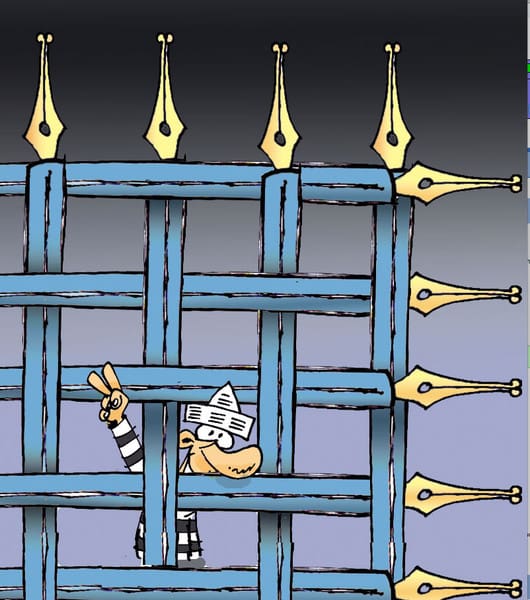
One of the more prominent issues discussed was information and cultural censorship. Many journalists and cultural artists are unable to freely express themselves due to high levels of censorship from the government. Journalists and artists are able to slip past the system in order to convey the message they want, but this usually involves making a statement so outrageous that it distracts censors from realizing the true objective. Unfortunately, this is only the best case scenario. In the most extreme cases, such as Siamak Pourzand, those who defy the government through speech are unfairly tried and imprisoned for numerous years. There have even been bloggers or journalists who were executed based on “obscene information.”
While these are the best and worst circumstances of government censorship for writers and artists, the Iranian government is responsible for censoring information from their citizens on a regular basis. People cannot truly express their opinions or belief for fear of government repercussion by agents known as “cyber officers,” who regularly hack email accounts and monitor, delete, or report any internet activity of which the government disapproves.
The lack of information is not a lack of technology, as some may believe, for many Iranians have Facebook or Twitter accounts and can regularly access the internet. The government also censors education in both grade schools and universities, which damages both Iranian students and the education system itself. Students are more than likely to be expelled from a university they attend if they have differing political or social opinions from the Iranian government. If Iranian students with differing opinions are expelled, productive discussion and debate is prohibited. The Iranian government also prevents integration of Iranian culture into the educational system, which creates another major obstacle for the education system. If Iranian schools cannot integrate Iranian culture, then it’s considered illegal to teach Iranian history, literature, or art. Part of learning history, literature, and art is to help teach students how to learn efficiently; therefore it would be difficult to be educated without having knowledge in these subjects. Censorship is also a problem faced by most cultural artists, including film makers and political cartoonists, as their works are often censored as well. In cases where an Iranian film has won a prestigious award, it’s more than likely the film will be banned in Iran by the government. The restrictions placed by the Iranian government damage the freedoms of the Iranian people and damage the Iranian culture in general. This restriction of information damages the legitimacy of the Iranian democracy because it denies access for citizens to correct information regarding political leaders or action. The government is allowed to act as it does because the people are afraid to speak out for fear of being censored or arrested. Recently, more Iranians are finding the courage to speak out against the Iranian government, hopefully reaching the point where the government won’t be able to ignore the civil rights violations it commits.
This may still take some time, as many Iranian citizens feel as if they have something to lose if they protest the government. But the longer Iranians don’t protest the government for its actions, the longer the government will be able to get away with making civil rights violations. The life of Siamak Pourzand was sacrificed for the Iranian people to have a government that respects their human rights. The people of Iran should be free to acquire accurate information and express their opinion in any form, without fear of repression or repercussion.


