Originally published on the CGS blog on July 11, 2012.
In a development sure to spark renewed tensions between the Chinese government and the Vatican, a Catholic bishop has reportedly been detained by Chinese authorities after announcing his resignation from the state-sponsored Chinese Patriotic Catholic Association (CPCA).
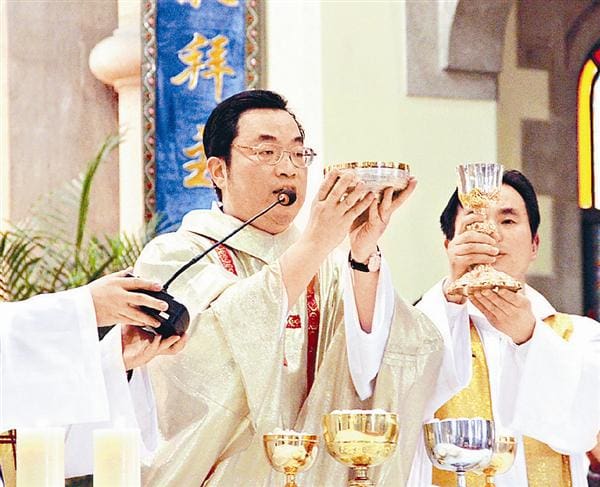
The bishop, Thaddeus Ma Daqin (pictured above), is reportedly being held in a seminary near Shanghai, where he is barred from contact with the outside world. During his Saturday ordination ceremony, Ma announced that he was resigning from the CPCA, declaring that “once you assume your pastoral job…your body and heart should be completely focused on pastoral things and evangelization.” This resignation was apparently perceived as a threat to the authority of the Chinese government, which exercises official supervision over China’s Catholic population through the CPCA.
Of course, Ma’s detainment should not come as a complete surprise to followers of Chinese affairs. After all, the Communist government has long had an uneasy relationship with organized religion, believing that it both contradicts the Communist principle of atheism, and poses a threat to the state’s power. Despite this, however, the Chinese government has largely tolerated the presence of religion, albeit on its own terms. All religious organizations are subject to supervision from the State Administration for Religious Affairs, which officially recognizes only five religions (Buddhism, Daoism, Islam, Catholicism, and Protestantism), and, in the case of Catholicism, oversees the CPCA. In turn, the CPCA serves as Chinese Catholicism’s central organizational body, and, among other things, is responsible for appointing bishops and other members of the clergy.
Essentially, then, the CPCA acts as sort of quasi-Vatican within China, a reality which, naturally, does not sit well with the Holy See. Relations between China and the Vatican have been strained since the Communist takeover of China in 1949, and have been repeatedly aggravated by the CPCA’s insistence on unilaterally appointing bishops without authorization from Rome. However, Ma’s appointment was actually approved by the Pope, which is likely to heighten the negative impact of his detainment on China-Vatican relations.
In a broader sense, Ma’s detainment serves to highlight the tenuous nature of the relationship between the Chinese government and organized religion. At the core of this relationship is a tension between the government’s desire to tightly control Chinese society, and the reality that religion does not easily lend itself to such state supervision. For instance, despite the government’s best attempts to regulate Catholicism through bodies such as the CPCA, so-called “underground” churches continue to flourish, splitting the Chinese Catholic population into two camps: those loyal to the Pope, and those loyal to the CPCA.
Ultimately, Ma’s detainment will come as a disappointment to those hoping for a softening of the Chinese government’s stance towards organized religion. Even more unfortunate for religious-freedom advocates is the reality that such a shift is unlikely to occur at any point in the near future. Quite simply, religion does have the potential to undermine authoritarian governments, and China’s regime is no exception. Moreover, given the fact that it is currently struggling to maintain stability in two regions (Tibet and Xinjiang) with prominent religious minorities, the Chinese government is surely aware of religion’s potential to act as a conduit for anti-government sentiment. In this context, with the regime doing everything it can to maintain its own power, religious leaders who refuse to toe the Party line, such as Ma, are unlikely to be tolerated.