Originally published on the CGS blog on June 15, 2010.
Until a week or so ago, most Americans probably couldn’t locate the nation of Kyrgyzstan on a map. However, ethnic violence has now broken out in the country in dramatic fashion, following a coup in early April, and the small Central Asian republic is now dominating the news.
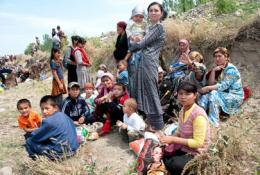
What exactly is behind the recent upheaval? Violence, concentrated primarily in the nation’s second-largest city, Osh, has been directed against ethnic Uzbeks, who make up a minority of Kyrgyzstan’s population but have a strong presence in the southern region where Osh is located. As of Monday, the Kyrgyz government claims that at least 124 people have been killed, with more than 1,600 wounded; however, the numbers may well be higher. At least 150,000 ethnic Uzbeks from Kyrgyzstan have fled across the border to neighboring Uzbekistan, leading to the potential for a humanitarian crisis.
The Kyrgyz government, which appears to have little or no control over the situation in the southern part of the country, has appealed to neighboring Russia to send peacekeeping troops to help quell the violence. However, at this time the Collective Security Treaty Organization, a regional organization composed of former Soviet states and led by Russia, had not yet reached a decision on sending troops to Kyrgyzstan.
The reasons behind the violence remain unclear. One theory is that Kyrgyzstan’s former president, Kurmanbek Bakiyevpotentia, who was deposed in a coup on April 7th and is now in exile in Belarus, is attempting to provoke tensions between Kyrgyz and Uzbeks in order to destabilize the fragile new government. However, Bakiyevpotentia has denied this charge. Looking back further into history, the Economist describes the violence in Kyrgyzstan as “Stalin’s harvest,” pointing out that the Soviet dictator was responsible for arbitrarily dividing up the former Soviet Union into states which did not correspond to ethnic divisions, thus leading to tensions which exploded after the U.S.S.R collapsed in the early 1990s.
Whatever the cause, the violence continues. CGS is concerned about the potential for genocide and a humanitarian crisis in Kyrgyzstan, and will continue to watch developments in the region as they occur.