Originally published on the CGS blog on July 13, 2015.
There are two important dates in July for globally minded Americans. The 4th of July is an important date for our country, and the 17th of July is an important day for our whole world community.
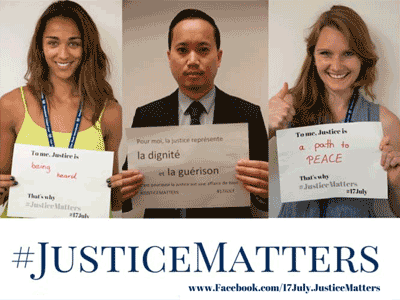
The Rome Statute establishing the International Criminal Court (ICC) was adopted on July 17, 1998. Five years ago the UN designated July 17th as “International Criminal Justice Day.” The day will be celebrated by advocates for justice around the world, many of whom will post on social media using a hashtag #JusticeMatters to draw attention to this rather new world holiday.
The International Criminal Court is a permanent court with jurisdiction over individuals who commit genocide, war crimes, or crimes against humanity (enumerated in the Rome Statute) when they are not held accountable by their own government. The word “criminal” in the name of the Court and the holiday is crucial. In contrast to the International Court of Justice (or “World Court”), the International Criminal Court focuses on holding individuals accountable for violating international law. The ICJ deals only with national governments. Its rulings are non-binding. Furthermore trying to punish a country requires fighting a war such as the Korean War in 1950-1953 and First Gulf War in 1991.
The precedent of holding individuals accountable for violating international law emerged after World War II with the Nuremberg and Tokyo Trials. It continued with the creation of ad hoc international tribunals by the UN Security Council in the 1990s to prosecute individual perpetrators of genocide and war crimes in the former Yugoslavia and Rwanda.
The Rome Statute has now been ratified by 123 countries, with the notable exceptions of China, Russia, and the United States.
Despite criticism from some corners, the Court is succeeding. Individual criminals are being prosecuted. Two individuals have been found guilty and are now in the ICC’s jail in The Hague. Eight others are in custody awaiting trial.
After several years of opposing the Court as a vital institution, the United States is now cooperating with the ICC, sending observers to meetings of its governing body, and has even supported a resolution in the UN Security Council to refer the situation in Libya to the ICC.
The ICC is exactly what the world community needs to establish the rule of law and thus put an end to war. This year, almost a quarter of all UN member states have ratified amendments to the Rome Statute that will make aggression a prosecutable criminal act. For this reason alone, every American and every globally minded world citizen should celebrate International Criminal Justice Day this Friday.