
by Sovaida Maani Ewing | Feb 8, 2024 | Peace & Disarmament
Like it or not, our world has become so interconnected and interdependent that events that have hitherto been regarded as regional in nature now threaten our well-being everywhere. The Ukraine war triggered global food and energy crises, global inflation, exacerbated the worldwide refugee crisis, and renewed the specter of a nuclear war. The war in Gaza has added to these woes by sparking reactions that threaten global shipping through the Suez Canal, putting a further dent in our global economy by raising consumer prices. We must act swiftly and effectively now to stem the cancerous spread of violence before we find ourselves engulfed in a global conflagration.
The international community must step up and shoulder a responsibility it has, for too long, abdicated: to maintain and restore peace in the world. We can begin by going beyond mere words and adopting mechanisms to operationalize and implement a principle known as the Responsibility to Protect, adopted unanimously by 193 nations at the UN Summit of world leaders in 2005. It provides that if a government is unable or unwilling to protect its people, it falls to the international community to step in and shoulder that responsibility.
A mechanism that is worth considering along these lines is that of making Gaza an international trust for a limited period of time until it is ready for self-governance. Even if there is no appetite to revive the Trusteeship Council, an organ of the United Nations which was suspended (though not dismantled) in 1994, we can revive and apply its attributes to create this trust as a stepping-stone for peace in the Middle East. We should urge the UN General Assembly to create an ad hoc Trusteeship Council that would act as a time-limited cocoon (say of 5 years) around Gaza, allowing it to heal at all levels until it is able to take up its role as a mature member of the international community of nations. The case of South West Africa’s evolution to becoming Namibia provides us with a useful precedent for setting up such an ad hoc Council and warns us of pitfalls to avoid.
Many benefits flow from this approach: first, Gaza would be under the direct administration and control of the UN, which would appoint an ad hoc Trusteeship Council for Gaza (and possibly parts of the West Bank) composed of a mix of countries from the region (such as Jordan, Egypt, and Saudi Arabia) and beyond (like Canada, Germany, France, the UK and Australia) on condition that they are committed to the well-being of all parties to the conflict and to establishing peace in the region. Having such a Council frees Israel from the burden of administering these territories and affords the Palestinians the space to recover, develop and grow into an independent self-governing entity.
Second, Gaza could be demilitarized, thereby ensuring the security of both its people and its neighbors. Here again, we can turn to the successful experiences of Northern Ireland and East Timor for lessons in how best to achieve this.
Third, an economic recovery and reconstruction plan akin to the Marshall Plan could be developed for Gaza. Moreover, the administering authority should be able to monitor all funds coming into Gaza and ensure that they will be used solely for constructive and peaceful purposes and not diverted for the purchase of weapons or instruments of war that can threaten the peace.
Fourth, a system of education that is rooted in teaching coexistence and peace and is coupled with the provision of training in good governance should be introduced, allowing for a cadre of potential leaders representative of the people of Gaza to emerge.
Last, the UN can arrange for free and fair elections to be held, as it did in Namibia.
It is time to take bold steps to spare our world from the ravages of war and establish a lasting peace.
This article was originally published in PeaceVoice.
Image Credits: Stepping stones across the R.Mole below Box Hill by Jonathan Hutchins, CC BY-SA 2.0, via Wikimedia Commons
by Lawrence Wittner | Jan 31, 2024 | Peace & Disarmament
Although, according to the UN Charter, the United Nations was established to “maintain international peace and security,” it has often fallen short of this goal. Russia’s ongoing military invasion of Ukraine and the more recent Israeli-Palestinian war in Gaza provide the latest examples of the world organization’s frequent paralysis in the face of violent international conflict.
The hobbling of the Security Council, the UN agency tasked with enforcing international peace and security, bears the lion’s share of the responsibility for this weakness. Under the rules set forth by the UN Charter, each permanent member of the Security Council has the power to veto Security Council resolutions. And these members have used the veto, thereby blocking UN action.
This built-in weakness was inherited from the UN’s predecessor, the League of Nations. In that body, a unanimous vote by all member nations was required for League action. Such unanimity of course, proved nearly impossible to attain, and this fact largely explains the League’s failure and eventual collapse.
The creators of the United Nations, aware of this problem when drafting the new organization’s Charter in 1944-45, limited the number of nations that could veto Security Council resolutions to the five major military powers of the era―the United States, the Soviet Union, Britain, China, and France.
Other nations went along with this arrangement because these “great powers” insisted that, without this acceptance of their primacy, they would not support the establishment of the new world organization. The Charter’s only restriction on their use of the veto was a provision that it could not be cast by a party to a dispute―a provision largely ignored after 1952. Fortifying the privileged position of these five permanent Security Council members, the Charter also provided that any change in their status required their approval.
In this fashion, the great powers of the era locked in the ability of any one of them to block a UN Security Council resolution that it opposed.
Not surprisingly, they availed themselves of this privilege. By May 2022, Russia (which took the seat previously held by the Soviet Union), had cast its veto in the Security Council on 121 occasions. The United States cast 82 vetoes, Britain 29, China 17, and France 16.
As the Council’s paralysis became apparent, proponents of UN action gravitated toward the UN General Assembly. This UN entity expanded substantially after 1945 as newly-independent countries joined the United Nations. Moreover, no veto blocked passage of its resolutions. Therefore, the General Assembly could serve not only as a voice for the world’s nations, but as an alternative source of power.
The first sign of a shift in power from the Security Council to the General Assembly emerged with the General Assembly’s approval of Resolution 377A: “Uniting for Peace.” The catalyst was the Soviet Union’s use of its veto to block the Security Council from authorizing continued military action to end the Korean War. Uniting for Peace, adopted on November 3, 1950 by an overwhelming vote in the General Assembly, stated that, “if the Security Council, because of lack of unanimity of the permanent members, fails to exercise its primary responsibility for the maintenance of international peace and security . . . the General Assembly shall consider the matter immediately with a view to making appropriate recommendations to members for collective measures.” To facilitate rapid action, the resolution created the mechanism of the emergency special session.
Between 1951 and 2022, the United Nations drew upon the Uniting for Peace resolution on thirteen occasions, with eleven cases taking the form of the emergency special session. In addition to dealing with the Korean War, Uniting for Peace resolutions addressed the Suez confrontation, as well as crises in Hungary, Congo, Afghanistan, Palestine, Namibia, and Ukraine. Although, under the umbrella of Uniting for Peace, the General Assembly could have recommended “armed force when necessary” against violators of international peace and security,the Assembly adopted that approach only during the Korean War. On the other occasions, it limited itself to calls for peaceful resolution of international conflict and the imposition of sanctions against aggressors.
These developments had mixed results. In 1956, during the Suez crisis, shortly after the General Assembly held a Uniting for Peace session calling for British and French withdrawal from the canal zone, both countries complied. By contrast, in 1980, when a Uniting for Peace session called for an end to the Soviet invasion of Afghanistan, Moscow ignored the UN demand. It could do so thanks to the fact that General Assembly resolutions are mere recommendations and, as such, are not legally binding.
Even so, global crises in recent years have heightened pressure to provide the United Nations with the ability to take effective action. In April 2022, shortly after the Russian government vetoed a Security Council resolution calling for Russia’s unconditional withdrawal from Ukraine, the General Assembly voted that, henceforth a Security Council veto would automatically trigger a meeting of the Assembly within ten days of the action to cope with the situation.
Meanwhile, numerous nations have been working to restrict the veto in specific situations. In July 2015, the UN Accountability, Coherence, and Transparency Group proposed a Code of Conduct against “genocide, crimes against humanity, or war crimes” that called upon all Security Council members to avoid voting to reject any credible draft resolution intended to prevent or halt mass atrocities. By 2022, the Code had been signed by 121 member nations. France and Mexico have taken the lead in proposing the renunciation of the veto in these situations.
These reform initiatives are likely to be addressed at the September 2024 UN Summit of the Future.
Clearly, as the history of the United Nations demonstrates, if the world organization is to maintain international peace and security, it must be freed from its current constraints.
This article was originally published in PeaceVoice.
by Jerry Tetalman | Jan 19, 2024 | Peace & Disarmament
The war in Ukraine has destabilized and polarized the international order. It pits two nuclear-armed superpowers, the United States and Russia, against each other. Any miscalculation can take all of us to nuclear Armageddon. This war has created untold human misery. Ending this war should be a top priority for humankind. How can the war be ended and on what terms?
Conventional wisdom holds that wars end in one of two ways. Either one side wins and the other loses or they negotiate a peace agreement by coming to an understanding that both sides can live with. The Russian invasion of Ukraine currently looks like a stalemate, with little territory being won or lost in the last year and both sides seemingly adhering to a position requiring total victory.
Russia seems to be playing the long game, of waiting out the resolve of the West to fund and support Ukraine. Sanctions on Russia have had an effect, but it still sells oil to China, India, and much of the world.
Ukraine’s goal is to regain its lost territory, maintain its current territory, and achieve security against future invasions. Russia wants to control all of Ukraine and wants to prevent it from joining NATO. The question is, can a peace agreement be made that both sides can live with?
Countries at war start to look for alternatives when victory is no longer assured or even likely. This war has reached that point. Negotiations give countries options in a no-win situation. Are the parties ready to negotiate?
Peace agreements are reached by making a win-win deal where both sides get something they want out of it. Of course, they need to compromise and give up some things as well.
Russian President Vladimir Putin is a key to any peace deal, for he must be willing to negotiate and implement any agreement reached. But the other key is Ukraine, whose territory has been invaded, occupied, and annexed by Russia.
The “deciders” will be Russia (essentially Putin) and Ukraine (the Zelensky administration). They will be the ones with representatives at the negotiating table.
Beyond “the table,” there are other influencers, such as those who support Ukraine with arms and funding–the European Union and the US. Some tacitly support Russia by continuing commerce with Putin and by not voting in the UN to sanction Russia.
If an understanding and peace settlement is to be reached between Ukraine and Russia, we must consider what institution is most capable of facilitating the necessary negotiations. The United Nations which is the world’s largest and most important international peace organization is the logical party, for this task, according to its charter, its goal is to “prevent the scourge of war.” Unfortunately, the UN Security Council is hobbled by the fact that Russia and the other great powers that emerged victorious in World War II―the United States, France, the United Kingdom, and China―exercise veto power. And Russia has vetoed Security Council action in connection with the Ukraine war.
Another option is for UN Secretary-General Antonio Guterres to organize serious peace negotiations. The role of the Secretary-General is that of chief diplomat for all nations. That official is charged with mediation and appointment of envoys to broker peace agreements. In getting such negotiations off the ground, he might find it useful to draw upon countries such as China or Turkey, both of which have a rapport with Putin.
The International Court of Justice was foreseen by the UN Charter as the primary method of resolution of disputes between Countries, offering law as an alternative to war. The law needs enforcement, and the ICJ is limited in this area. Its preliminary ruling against Russia, nearly two years ago, was ignored by Putin. The International Court of Justice has resolved the majority of the cases they hear through a voluntary agreement. If we are to move from an international system based on war and military force to a system based on law and justice, we need to empower and expand the International Court of Justice to include all nations in the UN.
We must also move forward with reform of the UN Security Council, thereby ending its paralysis when it comes to enforcing world peace and security. A more democratic United Nations, with greater funding and enforcement power, is necessary if we hope to survive this dangerous time. We can move from war to law by reforming and strengthening the United Nations, but it will take some creative thinking and action by all of us.
This article was originally published in Black Star News.
Image Credits: UN Photo/Manuel Elías
by Lawrence Wittner | Dec 14, 2023 | Peace & Disarmament
Although the unfolding humanitarian catastrophe in Gaza has captured the world’s horrified attention, the war in Ukraine has had even more terrible consequences. Grinding on for nearly two years, Russia’s massive military invasion of that country has taken hundreds of thousands of lives, created millions of refugees, wrecked Ukraine’s civilian infrastructure and economy, and consumed enormous financial resources from nations around the world.
And yet, despite the Ukraine War’s vast human and economic costs, there is no sign that it is abating. Russia and Ukraine are now bogged down in very bloody military stalemate, with about a fifth of Ukraine’s land occupied and annexed by Russia.
Meanwhile, polls show that an overwhelming majority of Ukrainians remain determined to continue the struggle to free all of Ukraine from Russian captivity. Indeed, an opinion survey in the fall of 2023 found that 80 percent of Ukrainians polled believed that under no circumstances should Ukraine give up any of its territory.
Similarly, in Russia, polls have found that a majority of the public appears content with the Putin regime’s military conquest of Ukraine and is opposed to any peace settlement that would relinquish Russian control of conquered Ukrainian land. Of course, the accuracy of Russian polls on the Ukraine War remains deeply suspect, for professing opposition to the war could easily lead to arrest, as it did for 20,000 Russians in 2022. Perhaps for this reason, numerous Russians polled refused to answer the question of where they stood on the war. One participant responded: “Thank you for the opportunity not to testify against myself.” In any case, in increasingly authoritarian Russia, public sentiment against war seems unlikely to alter the Putin administration’s determination to triumph on the battlefield.
Admittedly, in the United States, the major supplier of military and economic aid to beleaguered Ukraine, some developments point to declining enthusiasm for that role. The Republican Party has revived its 1930s policy (once termed “isolationism”) of appeasing military aggression by rightwing dictatorships, while leftists with an anti-American slant see a Russian victory as a useful way of somehow destroying “U.S. imperialism.” Nonetheless, unless Donald Trump and his MAGA followers sweep into power in 2024, it seems unlikely that the U.S. government or its NATO partners will entirely abandon Ukraine to a future under the jackboot of Russian military occupation.
Given these obstacles, is there a way to secure a just settlement of the Ukraine War?
There is, but it will take some creative action by the United Nations, the global organization that has been authorized to enforce international security.
Since the beginning of the Russian invasion of Ukraine on February 24, 2022, the overwhelming majority of the world’s nations have repeatedly used their participation in the UN General Assembly to condemn the Russian invasion and to call for a just peace in Ukraine. For example, on the eve of the one-year anniversary of the war, the General Assembly, by a vote of 141 nations to 7 (with 32 abstentions), demanded that Russia “immediately, completely, and unconditionally” withdraw its military forces from Ukraine and called for a “cessation in hostilities” and a “comprehensive, just and lasting peace” based on the principles enshrined in the UN Charter. The UN Charter, of course, constitutes international law and bans “the threat or use of force against the territorial integrity or political independence of any State.”
Even so, it is the UN Security Council that is tasked with enforcing international security, and Russia has used its veto in that UN entity to block UN action to end the Ukraine War.
The paralysis of the UN Security Council, however, need not continue. As Louise Blais, Canada’s ambassador to the United Nations from 2017 to 2021, has recently pointed out, Article 27 (3) of the UN Charter states that a party to a dispute before the Security Council shall abstain from voting in connection with the dispute. But, when it came to the Security Council’s votes on the Ukraine War, as Blais noted, “none of the 10 elected Security Council members had the courage, vision or backing to put forward a resolution” demanding abstention. According to Blais, the unwillingness of the four other veto-wielding members (Britain China, France, and the United States) to avoid a crippling Russian veto and, thereby, empower the Security Council to act, reflected their “zero interest in supporting such a move for fear it would limit their own power in the future.”
But there is ample precedent for limiting the veto in this fashion. The United Nations has a history of veto-wielding nations abstaining from Security Council voting when they are parties to a dispute. As Blais observes, between 1946 and 1952, Security Council members “regularly adhered to the obligatory abstention rule.” Only in later years did the five permanent Security Council members curtail the application of this practice.
In short, based on both international law and precedent, the UN Security Council has the authority to impose a settlement of the disastrous Ukraine War. What kinds of international action this would require would need to be determined by the world organization, just as the final terms of a peace agreement would ultimately need to be accepted by the contending parties. But, given the overwhelming support in the UN General Assembly for the withdrawal of Russian military forces from Ukraine and for a lasting peace agreement, such a peace settlement is likely to be a just one.
At the least, this would be a far better method of dealing with international conflict than the current full-scale war currently raging in Ukraine. And it could serve as a model for resolving other intractable disputes, such as the brutal Israel-Palestine conflict, as well.
This article was originally published in International Physicians for the Prevention of Nuclear War’s Peace and Health Blog
Image Credits: UN Photo/Evan Schneider
by Lawrence Wittner | Oct 25, 2023 | Peace & Disarmament
In December 1934, Arthur Henderson, a leader of the British Labour Party, declared in his speech accepting the Nobel Peace Prize that the immense human suffering caused by World War I “led to the very clear realization that international anarchy must be abandoned if civilization was to survive.”
Unfortunately, that realization did not go very far or very deep. Although, since that time, international law has been refined, nations remain far from adhering to its provisions or accepting its enforcement by the United Nations.
The Arab-Israeli Conflict
The lengthy, bloody conflict between the Israelis and their Arab neighbors provides a dramatic illustration of this point.
On November 29, 1947, the UN General Assembly adopted a plan to replace the British Mandate in Palestine with a partition of that land between a Jewish state and a Palestinian state. The UN decision was fiercely resented by the surrounding Arab nations, which launched a war against the new Jewish state, Israel—a war from which Israel emerged victorious in 1948.
This victory did not end the violence, however, or the violations of international law. Having fled abroad from the fighting in 1948, over 700,000 Palestinians, in contravention of international law, were denied the right to return to their homes in Israel. Egypt, which, in 1956, had agreed under UN pressure to the demilitarization of the Sinai Peninsula, expelled UN observers in 1967, massed its troops on Israel’s border, and together with Jordan, readied itself to invade Israel. In turn, Israel launched devastating attacks on Egyptian, Jordanian, Syrian, and Iraqi military forces. Victorious in this Six-Day War, Israel gained control of the Sinai Peninsula, the Gaza Strip, the West Bank, and the Golan Heights.
Over the ensuing decades, numerous violent clashes followed, with Israel, now the dominant military power in the region, defeating Arab and Palestinian resistance. Meanwhile, Israel defied international law by continuing to occupy the territory conquered in 1967, colonizing it with Jewish settlements, and violating the human rights of its Palestinian residents. For their part, Hamas terrorists, dedicated to unremitting war against Israel, committed horrendous war crimes against noncombatants in clear violation of the 1949 Geneva Conventions. When the Israeli government deprived Gaza’s civilian population of food, water, and other essentials of survival, it, too, defied international law.
The Russia-Ukraine War
The Russian invasion of Ukraine provides another clear example of flouting international law. Article 2, Section 4 of the UN Charter prohibits the “use of force against the territorial integrity or political independence of any state.” Ukraine had been an independent, sovereign nation since 1991, when the Soviet Union authorized a referendum on whether it wanted to become part of the new Russian Federation or to become independent. In the balloting, 90 percent voted for independence, which was formally accepted. Three years later, in the Budapest Memorandum, the Russian government pledged to “respect the independence and sovereignty and the existing borders of Ukraine” and to “refrain from the threat or use of force” against that nation.
Nevertheless, in 2014 the Putin regime drew upon Russian military power to seize and annex Crimea in southern Ukraine and to arm pro-Russian separatists and unleash its own thinly-disguised military forces in eastern Ukraine. In February 2022, the Russian government, determined to seize full control of Ukraine, launched a massive military invasion. Although fierce resistance by the Ukrainians prevented a complete Russian takeover, that September Putin announced the annexation of four additional regions of Ukraine, declaring that Russia would never surrender them.
Most of the world’s nations assailed this behavior as a flagrant violation of international law. In March 2014, after a Russian veto blocked a UN Security Council rebuke, the UN General Assembly voted by an overwhelming margin to condemn the Russian action that year. In March 2022, amid a new Russian veto of UN Security Council action, the UN General Assembly roundly condemned the full-scale Russian invasion by a vote of 141 to 5 (with 35 abstentions), while the International Court of Justice, the world’s highest judicial authority, voted by 13 to 2 (with Russia’s judge casting one of the negative votes) that Russia should “immediately suspend” its invasion. That October, the UN General Assembly, by a vote of 143 nations to 5 (with 35 abstentions), called on all nations to refuse recognition of Russia’s “attempted illegal annexation” of Ukrainian territory.
The Renewed Nuclear Arms Race
Perhaps the most chilling manifestation of international anarchy is the renewed nuclear arms race. Recognizing the potential for worldwide destruction in a nuclear war and pressed for action by an uneasy public, the nations of the world did, eventually, sign nuclear arms control treaties. Among these agreements was the nuclear Nonproliferation Treaty of 1968, in which non-nuclear nations pledged to forgo building nuclear weapons, while the nuclear nations agreed to divest themselves of their nuclear arsenals. Nevertheless, in recent decades, additional nations have become nuclear powers, while existing nuclear powers have scrapped previous nuclear disarmament agreements. Symptomatically, the nuclear powers oppose the UN Treaty on the Prohibition of Nuclear Weapons, which became international law in 2021.
Indeed, all the nuclear nations are currently engaged in nuclear weapons buildups―planning and developing new, more efficient weapons of mass destruction. Some government officials, among them Vladimir Putin, publicly threaten to launch nuclear war against nations opposing their international policies.
The planet faces a perilous future, indeed, particularly when one considers that, as of early 2023, it was undergoing the largest number of violent conflicts since World War II.
Global Governance
Against this backdrop, it’s tempting to conclude that, thanks to the apparently ungovernable nature of the world, the annihilation of civilization is inevitable. But is the world ungovernable―or merely lacking an effective government?
Given the fact that the United Nations was created to guarantee international security, a logical solution to the problem of effective governance is to strengthen the ability of the world organization to enforce international law. By curbing international anarchy, this action would prevent marauding nations and armed bands alike from indulging their worst impulses. It would also significantly enhance the prospects for peace, justice, and human survival.
Image Credits:
Håkan Dahlström from Malmö, Sweden, CC BY 2.0, via Wikimedia Commons
by Lawrence Wittner | Sep 14, 2023 | Peace & Disarmament
This September is the sixtieth anniversary of U.S. and Soviet ratification of the world’s first significant nuclear arms control agreement, the Partial Test Ban Treaty. Thus, it’s an appropriate time to examine that treaty, as well as to consider what might be done to end the danger of nuclear annihilation.
The Rise of Public Pressure
Although the use, in 1945, of atomic bombs to destroy Hiroshima and Nagasaki unleashed a wave of public concern about human survival in the nuclear age, it declined with the emergence of the Cold War. But another, even larger wave developed during the 1950s and early 1960s as the nuclear arms race surged forward. At the time, the governments of the United States, the Soviet Union, and Britain engaged in testing a new nuclear device, the H-bomb, with a thousand times the power of the atomic bomb.
Many people found this situation alarming. Not only did the advent of H-bombs point toward universal doom in a future war, but the testing of the weapons sent vast clouds of radioactive “fallout” into the atmosphere, where it drifted around the planet until it descended upon the populace below. In 1957, Professor Linus Pauling, a Nobel Prize winner in chemistry, predicted that, thanks to the nuclear tests already conducted, a million people would die early, and 200,000 children would be born with serious mental deficiency or physical defects.
In reaction to this growing menace, millions of people around the world began to resist nuclear weapons. They formed new, activist organizations, including the National Committee for a Sane Nuclear Policy (better known as SANE) and Women Strike for Peace (in the United States), the Campaign for Nuclear Disarmament (in Britain, Canada, Australia, and New Zealand), the Japan Council Against A & H Bombs and the Japan Congress Against A & H Bombs (in Japan), and the Struggle Against Atomic Death (in West Germany). Even in the Soviet bloc, concerned scientists pressed for an end to the nuclear arms race.
Governments Reluctantly Begin to Alter Public Policy
Government officials in nuclear-armed nations, troubled by the rising agitation, as well as by opinion polls showing widespread popular distaste for nuclear testing, nuclear weapons, and nuclear war, gradually began to adapt their policies to the demands of the public. Meeting with top scientists in the U.S. nuclear weapons program, U.S. President Dwight Eisenhower told them that the U.S. government was “up against an extremely difficult world opinion situation” and that the country “could not permit itself to be ‘crucified on a cross of atoms.’” If U.S. nuclear testing continued, U.S. Secretary of State John Foster Dulles warned the president, “the slight military gains” would be “outweighed by the political losses.”
Accordingly, in 1958, the Soviet, American, and British governments halted nuclear testing while beginning negotiations for a test ban treaty. Failing to secure an agreement, they resumed nuclear tests in 1961, which led to nuclear testing remaining a very hot political issue for people and governments alike.
Into this controversy stepped Norman Cousins, the editor of a widely-read public affairs magazine, the Saturday Review and, also, ardent world federalist and founder and co-chair of SANE. During a lengthy meeting at the White House with President John F. Kennedy in November 1962, Cousins inquired if the president would like him to meet with Soviet Premier Nikita Khrushchev to try to smooth the diplomatic path toward a nuclear test ban treaty. Kennedy responded affirmatively and, in the following months, Cousins shuttled back and forth between the two world leaders. Ultimately, Cousins overcame Khrushchev’s suspicions of Kennedy and, then, convinced Kennedy to deliver a major speech with “a breathtaking new approach” to Soviet-American relations.
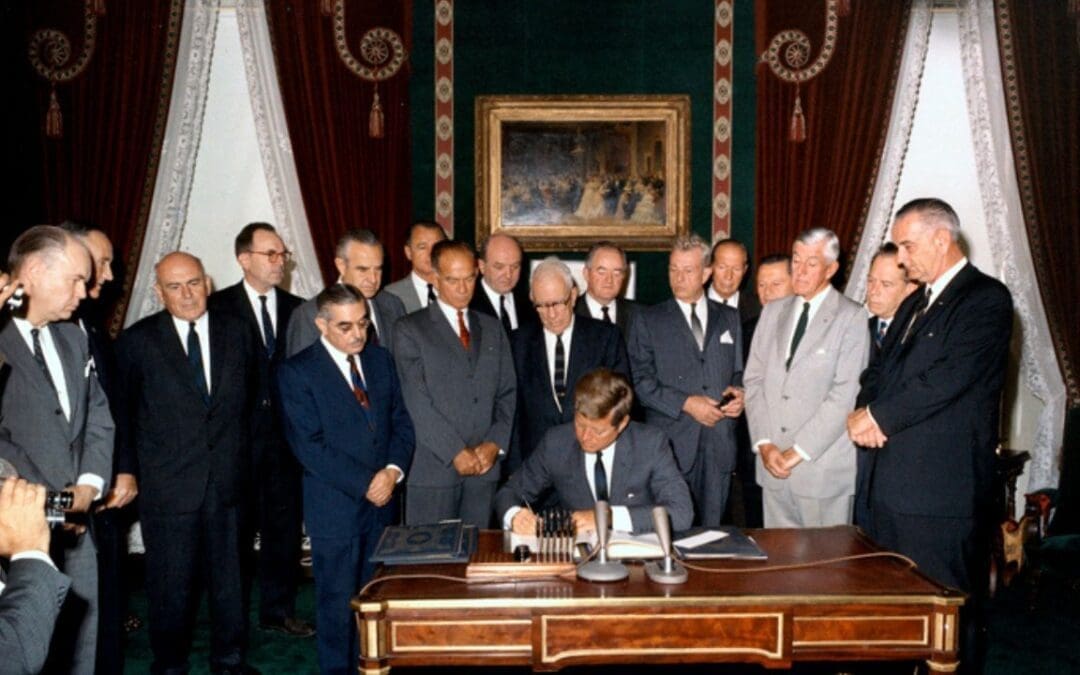
This American University address, partially written by Cousins, proved an immediate success with Khrushchev. Test ban negotiations commenced in Moscow during July 1963, resulting in the Partial Test Ban Treaty―banning nuclear testing in the atmosphere, in outer space, and under water.
The Significance of the Treaty and Its Successors
From the standpoint of ending the nuclear arms race, the treaty had its limitations. Because the treaty left unaddressed the issue of nuclear testing underground, the nuclear powers and aspiring nuclear powers simply shifted nuclear tests to this new locale. Furthermore, with nuclear fallout no longer a major public concern, popular pressure to halt nuclear testing―and, thereby, choke off the arms race―declined.
Nevertheless, the Partial Test Ban Treaty proved a turning point in world history. Together with the nuclear disarmament campaign that produced the treaty, it reduced Cold War hostility and ushered in a period of détente between the U.S. and Soviet governments. Furthermore, widespread nuclear proliferation, which seemed imminent at the time, failed to materialize. Even today, sixty years later, there are only nine nuclear powers.
Most important, the treaty demonstrated that nuclear arms control and disarmament were feasible. And so a host of treaties followed that substantially reduced nuclear dangers. These included the Nonproliferation Treaty, Strategic Arms Limitation Treaties, the Intermediate-Range Nuclear Forces Treaty, Strategic Arms Reduction Treaties, and the Comprehensive Test Ban Treaty. Through these treaties, as well as through unilateral action―both spurred on by popular pressure―the number of nuclear weapons in the world dropped sharply, from 70,000 to roughly 12,500. Meanwhile, nuclear war became increasingly unthinkable.
Nuclear Revival and Resistance
Of course, in recent years, with the decline of popular pressure against nuclear weapons, the prospect of nuclear annihilation has revived. Disarmament treaties have been scrapped, a new nuclear arms race has begun, and reckless leaders of nuclear nations have publicly threatened nuclear war. Although a UN Treaty on the Prohibition of Nuclear Weapons entered into force in 2021, the nine nuclear powers have resisted signing it.
Even so, it remains possible to get nations back on track toward international security. Citizens for Global Solutions has signed on to a joint statement for the forthcoming Nonproliferation Treaty conference that calls for a Common Security framework approach as an alternative to nuclear deterrence. The statement was presented at the recent NPT preparatory conference by the chair of the World Federalist Movement and has been endorsed by 170 organizations. In a few weeks, CGS will also co-host a parliamentary delegation from Japan and the Republic of Korea that will be welcomed by U.S. Senator Ed Markey (D-MA), one of the staunchest congressional advocates of nuclear disarmament.
Furthermore, the treaty process provides a useful route toward a nuclear-free world. As the Partial Test Ban Treaty and its successors show us, arms control and disarmament treaties have helped to curb the nuclear arms race and prevent nuclear war. The revived march toward nuclear catastrophe can be halted and reversed by a treaty finally banning nuclear weapons―if people will demand it.



















.jpg)