
Originally published on the CGS blog on April 28, 2016.
It has been two years since the abduction of 267 schoolgirls in Chibok, Nigeria. The tragedy initially shocked the world. Since 2014, the coverage of continuing kidnappings has dwindled, and the international community has seemed to remove itself from immediate concern.
However, the relative ease at which Boko Haram was able to carry out the kidnapping in Chibok has only led to an increase in abductions over the past two years. In order to educate the international community on the tragedies occurring in Nigeria, the female victims of Boko Haram deserve the ability to share their stories with the public both through peace negotiations and the media.
Beginning in 2012, schools became Boko Haram’s central target for abductions, which only worsened the already drastic education indices in northeastern Nigeria. The group has since destroyed almost 1,000 schools and targeted thousands of teachers and students.
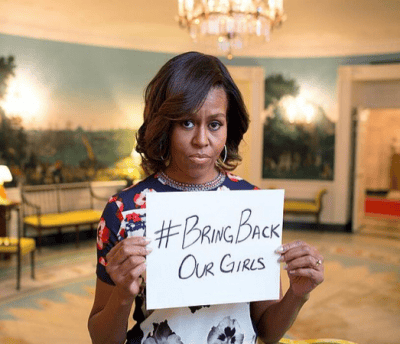
The tragedies endured by the Chibok schoolgirls, which sparked the #BringBackOurGirls campaign, has been endured by thousands of young women in northeastern Nigeria over the past six years. Unfortunately, many of the victims continue to remain invisible to the world’s eye. According to the International Organization for Migration, the number of displaced people, or IDPs, in northeastern Nigeria has skyrocketed to 2.6 million, along with 17,000 people killed due to the six-year insurgency by Boko Haram.
Boko Haram continues to rampantly oppress women and children as a tool of misogyny and degradation. Young girls are subjected to psychological abuse, forced labor, forced participation in suicide bombings and military operations, and forced marriages to their capturers–on top of sexual abuse and rape.
As UN Secretary General Ban Ki-moon asserted in 2015, rape is not a byproduct of the chaos of war in Nigeria, but a “calculated tactic of terror,” which is part of a larger strategy of domination and self-perpetuation led by Boko Haram. As part of an initiative to create a generation of their own, Boko Haram has waged a full-out war on women’s physical, sexual, and reproductive rights.
After months of being held captive by “one of the world’s deadliest terror groups,” young women emerge into Nigerian communities and realize that they are now suspects of terror.
Unlike most refugee camps, which are administered by the United Nations, many of the surviving women and children of Boko Haram are held in camps monitored by the Nigerian military. The women are often referred to as “Boko Haram wives,” and are deemed to be untrustworthy by the Nigerian government. The suspicion is due to the fact that 39 of the 89 Boko Haram suicide bombings over the last year have been carried out by women, in mosques, markets, and displacement camps. As for the children, top Nigerian military official Maj. Gen. Lucky Irabor believes they have been “more or less brainwashed” and have “become a useful tool” for Boko Haram.
To date, the Chibok schoolgirls is the extent at which the international community is aware of Boko Haram’s deadly actions in Nigeria. As a whole, the Nigerian government and the international community should be doing more to ensure that the widespread violence against women is not only recognized, but also combatted in an appropriate manner.
To begin with, NGOs should be pursuing additional medical and psychological treatment for the victims of Boko Haram kidnappings held in government-controlled areas. Secondly, the Nigerian government should be encouraged to include female victims in national and international efforts to promote security. The failure of the Nigerian government to include women in its delegation to the Paris Summit on Security in Nigeria in 2013 and again to the London Ministerial on Security in 2014 was disgraceful.
Truly combatting violence against women can only be accomplished with the involvement of women who have lived through such tragedies. International organizations such as Human Rights Watch urge Nigeria to include women in any negotiations for peace.
The neglect from the international community and the mistreatment of the victims by the Nigerian government is only exacerbating the horrendous crimes committed by Boko Haram. It’s time to shine a light on the everyday realities occurring in Nigeria, beginning with the incorporation of victims stories’ into the peacemaking process for the international community to hear.


