
by Lawrence Wittner | Feb 20, 2024 | Climate Justice, Peace & Disarmament
For some time, it’s been apparent that the world’s nations are not meeting the growing challenges to human survival.
A key challenge comes from modern war.
Over the centuries, as military weapons have grown ever more destructive, war-related devastation has grown accordingly. World War II was the deadliest military conflict in human history, with an estimated 70-85 million people perishing from the war directly or through war-caused disease, famine, and other indirect factors. Most of the dead were civilians. In addition, many millions of people were wounded―blinded, crippled, driven mad, or otherwise ravaged by the vast carnage. Large portions of the globe had become a charnel house, with the battered survivors left to desperately scavenge for food amid the burnt-out rubble and ruin.
Although some scholars have pointed out that warfare has declined since then, and especially since the end of the Cold War, there was a sharp turnabout in 2022, when the wars in Ethiopia and Ukraine contributed to more battle-related deaths than in any year since 1994. By late 2023, Russia’s military invasion of Ukraine alone had produced an estimated 315,000 killed or injured Russian troops, while the number of casualties among Ukrainian troops and civilians, though unknown, is certainly enormous. Among these and the many other wars currently raging―in Sudan, Myanmar, Ethiopia, the Sahel, and Syria, to name only a few―the recent one in Gaza, with the fastest daily death rate of the 21st century, is particularly alarming, having already led to nearly 30,000 deaths and nearly 70,000 injuries.
And then, of course, there’s nuclear war, which emerged in 1945 with the utter annihilation of Hiroshima and Nagasaki, and which now has the capacity to end virtually all life on earth. Amid public threats from leaders of nuclear-armed nations to launch a nuclear war, the editors of the Bulletin of the Atomic Scientists have set their “Doomsday Clock” at its closest ever to apocalypse.
War―particularly nuclear war―is probably the fastest way to extinguish the human race, but there are other crises underway that, on a longer-range basis, seem likely to accomplish the same task.
The most serious of these crises is environmental. In recent decades, there has been a rapid loss of biodiversity, with the sixth mass extinction of wildlife clearly accelerating. Pollution has grown dramatically. This includes pollution of land and water caused by chemicals and by plastic (which takes 400 years to decompose) and of the air caused by industrial, motor vehicle, and other emissions (leading to an estimated 4.2 to 7 million human deaths annually). Damage to the soil, caused especially by use of toxic chemicals and other pollutants, as well as by deforestation, has become particularly severe. The United Nations has estimated that some 40 percent of the planet’s soil is now degraded.
A key element in the environmental collapse is the growing climate catastrophe, caused primarily by the burning of fossil fuels. Melting icecaps and rising sea levels, unprecedented hurricanes, floods, and wildfires, and ocean acidification are all well underway. Together with unsustainable farming practices, rising temperatures have produced growing food and water scarcity. UN Secretary General Antonio Guterres declared that, unless immediate action is taken, there will be a “global food emergency that could have long term impacts on hundreds of millions of adults and children.” Furthermore, it is estimated that, by 2025, two-thirds of the world’s people might face water shortages. Commenting on the deteriorating climate situation, Guterres declared gloomily in September 2023 that “humanity has opened the gates to hell.”
The rise of rightwing nationalism provides yet another challenge to human survival. In recent years, rightwing political movements―headed by authoritarian demagogues such as Donald Trump (United States), Jair Bolsonaro (Brazil), Vladimir Putin (Russia), Narendra Modi (India), Recep Tayyip Erdogan (Turkey), Marine Le Pen (France), Benjamin Netanyahu (Israel), Viktor Orban (Hungary), and their counterparts in other lands―have transformed the landscape of world politics. Appealing to xenophobia, militarism, racism, and religious prejudice, they have made great strides toward stirring up longstanding hatreds in their ruthless quest for power. A key to their success along these lines has been their call to revive the ostensible glory of their own nations by purging their internal enemies and triumphing over other, ostensibly inferior, countries abroad. Redolent of the fascist movements of the 1930s, this Radical Right approach portends worldwide turmoil, violence, and destruction.
Of course, it might not be too late to head off these developments. After all, in the twentieth century, humanity did manage to defeat the drive of the rightwing maniacs who established fascist regimes and launched vast wars to rule the world. In the aftermath of the chaos and destruction of World War II, humanity did manage to create the United Nations and to extend the range of international law. And, still later, as the planet stood on the brink of nuclear war, humanity did manage to roll back the nuclear menace and, for a time, halt the nuclear arms race and curb the prevalence of war.
Moreover, there are a great many efforts underway―by social movements and some far-sighted governments―to address the contemporary crises. Peace, environmental, and political action movements have flourished and brought forth demands for sweeping changes in public policy. In addition, some social movements, recognizing the global nature of the problems facing humanity, have called for enhanced global governance to cope with the severe threats posed by war, environmental devastation, and violations of human rights. The Summit of the Future on the horizon in September 2024 has been hailed as a “once in a generation” opportunity for meaningful reform of the global governance architecture. This watershed moment could be seized as a chance to correct course and avert disaster for humanity and the planet.
Even so, as the world once again veers toward destruction, it’s clear that it’s getting late―very late―to avert catastrophe.
Image Source: Doomsday Clock சஞ்சீவி சிவகுமார், CC BY-SA 4.0, via Wikimedia Commons
by Lawrence Wittner | Jan 31, 2024 | Peace & Disarmament
Although, according to the UN Charter, the United Nations was established to “maintain international peace and security,” it has often fallen short of this goal. Russia’s ongoing military invasion of Ukraine and the more recent Israeli-Palestinian war in Gaza provide the latest examples of the world organization’s frequent paralysis in the face of violent international conflict.
The hobbling of the Security Council, the UN agency tasked with enforcing international peace and security, bears the lion’s share of the responsibility for this weakness. Under the rules set forth by the UN Charter, each permanent member of the Security Council has the power to veto Security Council resolutions. And these members have used the veto, thereby blocking UN action.
This built-in weakness was inherited from the UN’s predecessor, the League of Nations. In that body, a unanimous vote by all member nations was required for League action. Such unanimity of course, proved nearly impossible to attain, and this fact largely explains the League’s failure and eventual collapse.
The creators of the United Nations, aware of this problem when drafting the new organization’s Charter in 1944-45, limited the number of nations that could veto Security Council resolutions to the five major military powers of the era―the United States, the Soviet Union, Britain, China, and France.
Other nations went along with this arrangement because these “great powers” insisted that, without this acceptance of their primacy, they would not support the establishment of the new world organization. The Charter’s only restriction on their use of the veto was a provision that it could not be cast by a party to a dispute―a provision largely ignored after 1952. Fortifying the privileged position of these five permanent Security Council members, the Charter also provided that any change in their status required their approval.
In this fashion, the great powers of the era locked in the ability of any one of them to block a UN Security Council resolution that it opposed.
Not surprisingly, they availed themselves of this privilege. By May 2022, Russia (which took the seat previously held by the Soviet Union), had cast its veto in the Security Council on 121 occasions. The United States cast 82 vetoes, Britain 29, China 17, and France 16.
As the Council’s paralysis became apparent, proponents of UN action gravitated toward the UN General Assembly. This UN entity expanded substantially after 1945 as newly-independent countries joined the United Nations. Moreover, no veto blocked passage of its resolutions. Therefore, the General Assembly could serve not only as a voice for the world’s nations, but as an alternative source of power.
The first sign of a shift in power from the Security Council to the General Assembly emerged with the General Assembly’s approval of Resolution 377A: “Uniting for Peace.” The catalyst was the Soviet Union’s use of its veto to block the Security Council from authorizing continued military action to end the Korean War. Uniting for Peace, adopted on November 3, 1950 by an overwhelming vote in the General Assembly, stated that, “if the Security Council, because of lack of unanimity of the permanent members, fails to exercise its primary responsibility for the maintenance of international peace and security . . . the General Assembly shall consider the matter immediately with a view to making appropriate recommendations to members for collective measures.” To facilitate rapid action, the resolution created the mechanism of the emergency special session.
Between 1951 and 2022, the United Nations drew upon the Uniting for Peace resolution on thirteen occasions, with eleven cases taking the form of the emergency special session. In addition to dealing with the Korean War, Uniting for Peace resolutions addressed the Suez confrontation, as well as crises in Hungary, Congo, Afghanistan, Palestine, Namibia, and Ukraine. Although, under the umbrella of Uniting for Peace, the General Assembly could have recommended “armed force when necessary” against violators of international peace and security,the Assembly adopted that approach only during the Korean War. On the other occasions, it limited itself to calls for peaceful resolution of international conflict and the imposition of sanctions against aggressors.
These developments had mixed results. In 1956, during the Suez crisis, shortly after the General Assembly held a Uniting for Peace session calling for British and French withdrawal from the canal zone, both countries complied. By contrast, in 1980, when a Uniting for Peace session called for an end to the Soviet invasion of Afghanistan, Moscow ignored the UN demand. It could do so thanks to the fact that General Assembly resolutions are mere recommendations and, as such, are not legally binding.
Even so, global crises in recent years have heightened pressure to provide the United Nations with the ability to take effective action. In April 2022, shortly after the Russian government vetoed a Security Council resolution calling for Russia’s unconditional withdrawal from Ukraine, the General Assembly voted that, henceforth a Security Council veto would automatically trigger a meeting of the Assembly within ten days of the action to cope with the situation.
Meanwhile, numerous nations have been working to restrict the veto in specific situations. In July 2015, the UN Accountability, Coherence, and Transparency Group proposed a Code of Conduct against “genocide, crimes against humanity, or war crimes” that called upon all Security Council members to avoid voting to reject any credible draft resolution intended to prevent or halt mass atrocities. By 2022, the Code had been signed by 121 member nations. France and Mexico have taken the lead in proposing the renunciation of the veto in these situations.
These reform initiatives are likely to be addressed at the September 2024 UN Summit of the Future.
Clearly, as the history of the United Nations demonstrates, if the world organization is to maintain international peace and security, it must be freed from its current constraints.
This article was originally published in PeaceVoice.
by Lawrence Wittner | Dec 14, 2023 | Peace & Disarmament
Although the unfolding humanitarian catastrophe in Gaza has captured the world’s horrified attention, the war in Ukraine has had even more terrible consequences. Grinding on for nearly two years, Russia’s massive military invasion of that country has taken hundreds of thousands of lives, created millions of refugees, wrecked Ukraine’s civilian infrastructure and economy, and consumed enormous financial resources from nations around the world.
And yet, despite the Ukraine War’s vast human and economic costs, there is no sign that it is abating. Russia and Ukraine are now bogged down in very bloody military stalemate, with about a fifth of Ukraine’s land occupied and annexed by Russia.
Meanwhile, polls show that an overwhelming majority of Ukrainians remain determined to continue the struggle to free all of Ukraine from Russian captivity. Indeed, an opinion survey in the fall of 2023 found that 80 percent of Ukrainians polled believed that under no circumstances should Ukraine give up any of its territory.
Similarly, in Russia, polls have found that a majority of the public appears content with the Putin regime’s military conquest of Ukraine and is opposed to any peace settlement that would relinquish Russian control of conquered Ukrainian land. Of course, the accuracy of Russian polls on the Ukraine War remains deeply suspect, for professing opposition to the war could easily lead to arrest, as it did for 20,000 Russians in 2022. Perhaps for this reason, numerous Russians polled refused to answer the question of where they stood on the war. One participant responded: “Thank you for the opportunity not to testify against myself.” In any case, in increasingly authoritarian Russia, public sentiment against war seems unlikely to alter the Putin administration’s determination to triumph on the battlefield.
Admittedly, in the United States, the major supplier of military and economic aid to beleaguered Ukraine, some developments point to declining enthusiasm for that role. The Republican Party has revived its 1930s policy (once termed “isolationism”) of appeasing military aggression by rightwing dictatorships, while leftists with an anti-American slant see a Russian victory as a useful way of somehow destroying “U.S. imperialism.” Nonetheless, unless Donald Trump and his MAGA followers sweep into power in 2024, it seems unlikely that the U.S. government or its NATO partners will entirely abandon Ukraine to a future under the jackboot of Russian military occupation.
Given these obstacles, is there a way to secure a just settlement of the Ukraine War?
There is, but it will take some creative action by the United Nations, the global organization that has been authorized to enforce international security.
Since the beginning of the Russian invasion of Ukraine on February 24, 2022, the overwhelming majority of the world’s nations have repeatedly used their participation in the UN General Assembly to condemn the Russian invasion and to call for a just peace in Ukraine. For example, on the eve of the one-year anniversary of the war, the General Assembly, by a vote of 141 nations to 7 (with 32 abstentions), demanded that Russia “immediately, completely, and unconditionally” withdraw its military forces from Ukraine and called for a “cessation in hostilities” and a “comprehensive, just and lasting peace” based on the principles enshrined in the UN Charter. The UN Charter, of course, constitutes international law and bans “the threat or use of force against the territorial integrity or political independence of any State.”
Even so, it is the UN Security Council that is tasked with enforcing international security, and Russia has used its veto in that UN entity to block UN action to end the Ukraine War.
The paralysis of the UN Security Council, however, need not continue. As Louise Blais, Canada’s ambassador to the United Nations from 2017 to 2021, has recently pointed out, Article 27 (3) of the UN Charter states that a party to a dispute before the Security Council shall abstain from voting in connection with the dispute. But, when it came to the Security Council’s votes on the Ukraine War, as Blais noted, “none of the 10 elected Security Council members had the courage, vision or backing to put forward a resolution” demanding abstention. According to Blais, the unwillingness of the four other veto-wielding members (Britain China, France, and the United States) to avoid a crippling Russian veto and, thereby, empower the Security Council to act, reflected their “zero interest in supporting such a move for fear it would limit their own power in the future.”
But there is ample precedent for limiting the veto in this fashion. The United Nations has a history of veto-wielding nations abstaining from Security Council voting when they are parties to a dispute. As Blais observes, between 1946 and 1952, Security Council members “regularly adhered to the obligatory abstention rule.” Only in later years did the five permanent Security Council members curtail the application of this practice.
In short, based on both international law and precedent, the UN Security Council has the authority to impose a settlement of the disastrous Ukraine War. What kinds of international action this would require would need to be determined by the world organization, just as the final terms of a peace agreement would ultimately need to be accepted by the contending parties. But, given the overwhelming support in the UN General Assembly for the withdrawal of Russian military forces from Ukraine and for a lasting peace agreement, such a peace settlement is likely to be a just one.
At the least, this would be a far better method of dealing with international conflict than the current full-scale war currently raging in Ukraine. And it could serve as a model for resolving other intractable disputes, such as the brutal Israel-Palestine conflict, as well.
This article was originally published in International Physicians for the Prevention of Nuclear War’s Peace and Health Blog
Image Credits: UN Photo/Evan Schneider
by Lawrence Wittner | Oct 25, 2023 | Peace & Disarmament
In December 1934, Arthur Henderson, a leader of the British Labour Party, declared in his speech accepting the Nobel Peace Prize that the immense human suffering caused by World War I “led to the very clear realization that international anarchy must be abandoned if civilization was to survive.”
Unfortunately, that realization did not go very far or very deep. Although, since that time, international law has been refined, nations remain far from adhering to its provisions or accepting its enforcement by the United Nations.
The Arab-Israeli Conflict
The lengthy, bloody conflict between the Israelis and their Arab neighbors provides a dramatic illustration of this point.
On November 29, 1947, the UN General Assembly adopted a plan to replace the British Mandate in Palestine with a partition of that land between a Jewish state and a Palestinian state. The UN decision was fiercely resented by the surrounding Arab nations, which launched a war against the new Jewish state, Israel—a war from which Israel emerged victorious in 1948.
This victory did not end the violence, however, or the violations of international law. Having fled abroad from the fighting in 1948, over 700,000 Palestinians, in contravention of international law, were denied the right to return to their homes in Israel. Egypt, which, in 1956, had agreed under UN pressure to the demilitarization of the Sinai Peninsula, expelled UN observers in 1967, massed its troops on Israel’s border, and together with Jordan, readied itself to invade Israel. In turn, Israel launched devastating attacks on Egyptian, Jordanian, Syrian, and Iraqi military forces. Victorious in this Six-Day War, Israel gained control of the Sinai Peninsula, the Gaza Strip, the West Bank, and the Golan Heights.
Over the ensuing decades, numerous violent clashes followed, with Israel, now the dominant military power in the region, defeating Arab and Palestinian resistance. Meanwhile, Israel defied international law by continuing to occupy the territory conquered in 1967, colonizing it with Jewish settlements, and violating the human rights of its Palestinian residents. For their part, Hamas terrorists, dedicated to unremitting war against Israel, committed horrendous war crimes against noncombatants in clear violation of the 1949 Geneva Conventions. When the Israeli government deprived Gaza’s civilian population of food, water, and other essentials of survival, it, too, defied international law.
The Russia-Ukraine War
The Russian invasion of Ukraine provides another clear example of flouting international law. Article 2, Section 4 of the UN Charter prohibits the “use of force against the territorial integrity or political independence of any state.” Ukraine had been an independent, sovereign nation since 1991, when the Soviet Union authorized a referendum on whether it wanted to become part of the new Russian Federation or to become independent. In the balloting, 90 percent voted for independence, which was formally accepted. Three years later, in the Budapest Memorandum, the Russian government pledged to “respect the independence and sovereignty and the existing borders of Ukraine” and to “refrain from the threat or use of force” against that nation.
Nevertheless, in 2014 the Putin regime drew upon Russian military power to seize and annex Crimea in southern Ukraine and to arm pro-Russian separatists and unleash its own thinly-disguised military forces in eastern Ukraine. In February 2022, the Russian government, determined to seize full control of Ukraine, launched a massive military invasion. Although fierce resistance by the Ukrainians prevented a complete Russian takeover, that September Putin announced the annexation of four additional regions of Ukraine, declaring that Russia would never surrender them.
Most of the world’s nations assailed this behavior as a flagrant violation of international law. In March 2014, after a Russian veto blocked a UN Security Council rebuke, the UN General Assembly voted by an overwhelming margin to condemn the Russian action that year. In March 2022, amid a new Russian veto of UN Security Council action, the UN General Assembly roundly condemned the full-scale Russian invasion by a vote of 141 to 5 (with 35 abstentions), while the International Court of Justice, the world’s highest judicial authority, voted by 13 to 2 (with Russia’s judge casting one of the negative votes) that Russia should “immediately suspend” its invasion. That October, the UN General Assembly, by a vote of 143 nations to 5 (with 35 abstentions), called on all nations to refuse recognition of Russia’s “attempted illegal annexation” of Ukrainian territory.
The Renewed Nuclear Arms Race
Perhaps the most chilling manifestation of international anarchy is the renewed nuclear arms race. Recognizing the potential for worldwide destruction in a nuclear war and pressed for action by an uneasy public, the nations of the world did, eventually, sign nuclear arms control treaties. Among these agreements was the nuclear Nonproliferation Treaty of 1968, in which non-nuclear nations pledged to forgo building nuclear weapons, while the nuclear nations agreed to divest themselves of their nuclear arsenals. Nevertheless, in recent decades, additional nations have become nuclear powers, while existing nuclear powers have scrapped previous nuclear disarmament agreements. Symptomatically, the nuclear powers oppose the UN Treaty on the Prohibition of Nuclear Weapons, which became international law in 2021.
Indeed, all the nuclear nations are currently engaged in nuclear weapons buildups―planning and developing new, more efficient weapons of mass destruction. Some government officials, among them Vladimir Putin, publicly threaten to launch nuclear war against nations opposing their international policies.
The planet faces a perilous future, indeed, particularly when one considers that, as of early 2023, it was undergoing the largest number of violent conflicts since World War II.
Global Governance
Against this backdrop, it’s tempting to conclude that, thanks to the apparently ungovernable nature of the world, the annihilation of civilization is inevitable. But is the world ungovernable―or merely lacking an effective government?
Given the fact that the United Nations was created to guarantee international security, a logical solution to the problem of effective governance is to strengthen the ability of the world organization to enforce international law. By curbing international anarchy, this action would prevent marauding nations and armed bands alike from indulging their worst impulses. It would also significantly enhance the prospects for peace, justice, and human survival.
Image Credits:
Håkan Dahlström from Malmö, Sweden, CC BY 2.0, via Wikimedia Commons
by Lawrence Wittner | Sep 27, 2023 | United Nations
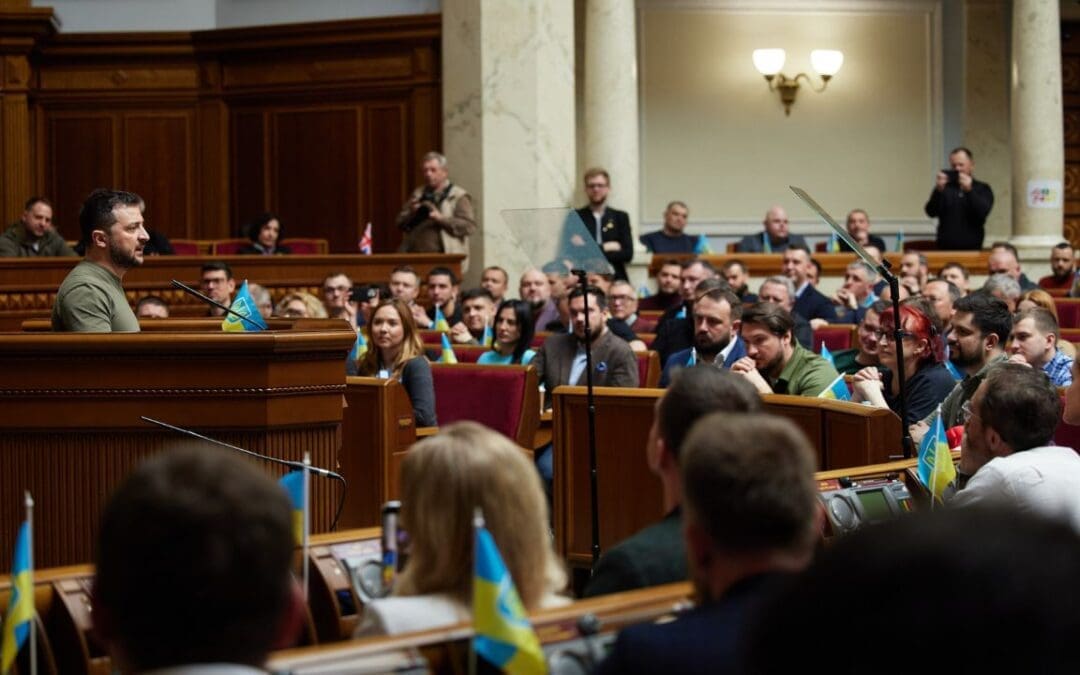
Addressing the UN Security Council on September 20, 2023, Ukrainian President Volodymyr Zelensky delivered a heartfelt plea “to update the existing security architecture in the world, in particular, to restore the real power of the UN Charter.”
This call for strengthening international security under the aegis of the United Nations makes sense not only for Ukraine―a country suffering from brutal military invasion, occupation, and annexation by its much larger, more powerful neighbor, the Russian Federation―but for the nations of the world.
The Rise of the United Nations
For thousands of years, competing territories, nations, and empires have spilled rivers of blood and laid waste to much of the world through wars and plunder. Hundreds of millions of people have died, while many more have been horribly injured or forced to flee their shattered homelands in a desperate search for safety. World Wars I and II, capped off by the use of nuclear weapons to annihilate the populations of entire cities, brought massive suffering to people around the globe.
In 1945, this mad slaughter and devastation convinced far-sighted thinkers, as well as many government leaders, that human survival was dependent upon developing a framework for international security: the United Nations. The UN Charter, adopted in a conference in the spring of that year in San Francisco by 50 Allied nations, declared that a key purpose of the new organization was “to maintain international peace and security.”
The UN Charter, which constitutes international law, included provisions detailing how nations were to treat one another in the battered world emerging from the Second World War. Among its major provisions was Article 2, Section 4, which declared that “all members shall refrain in their international relations from the threat or use of force against the territorial integrity or political independence of any state.” Furthermore, Article 51 declared that “nothing in the present Charter shall impair the inherent right of individual or collective self-defense if an armed attack occurs against a member of the United Nations.”
The Role of the Security Council
Although the UN Charter provided for a General Assembly in which all member nations were represented, action to maintain international peace and security was delegated primarily to a UN Security Council with fifteen members, five of whom (the United States, the Soviet Union, China, Britain, and France) were to be permanent members with the right to veto Security Council resolutions or action.
Not surprisingly, the right of any of these five nations to block Security Council peace efforts, a right they had insisted upon as the price of their participation in the United Nations, hamstrung the world organization from enforcing peace and international security on numerous occasions. The most recent instance has occurred in the case of the Ukraine War, a conflict in which, as Zelensky lamented, “all [Security Council] efforts are vetoed by the aggressor.” As a result, the United Nations has all too often lacked the power to enforce the principles of international law confirmed by its members and enshrined in its Charter.
Some people are perfectly content with the weakness of the United Nations. Fierce nationalists, including some Right-Wing actors, are contemptuous of this or any international security organization, and many would prefer its abolition. Others have little use for the United Nations but, instead, place their hopes for the maintenance of international peace and stability upon public and governmental acceptance of great power spheres of influence. Meanwhile, a segment of the international Left ignores the United Nations and insists that world peace will only be secured by smashing “U.S. imperialism.”
Sadly, those forces opposing international organization and action fail to recognize that their proposals represent not only a return to thousands of years of international strife and mass slaughter among nations, but, in today’s world, an open door to a nuclear holocaust that will end virtually all life on earth.
Proposals to Strengthen the United Nations
Compared to this descent into international chaos and destruction, proposals to strengthen the United Nations are remarkably practical and potentially effective. Zelensky has suggested empowering the UN General Assembly to overcome a Security Council veto by a vote of two-thirds or more of the Assembly’s nations. In addition, he has proposed expanding the representation of nations in the Security Council, temporarily suspending membership of a Security Council member when it “resorts to aggression against another nation in violation of the UN Charter,” and creating a deterrent to international aggression by agreeing on the response to it before it occurs.
Of course, there are numerous other ways to strengthen the United Nations as a force for peace and to help ensure that it works as an effective international agency for battling the onrushing climate catastrophe, combating disease pandemics, and cracking down on the exploitative practices of multinational corporations. Its member nations could also rally behind the UN Treaty on the Prohibition of Nuclear Weapons (still unsigned by the nuclear powers), agree on a UN program to handle the burgeoning international refugee crisis, and provide the world organization with substantially greater financial resources to reduce global poverty and mass misery than it currently receives.
Indeed, the horrific Ukraine War is but the latest canary in the coal mine―the danger signal that people of all nations should recognize as indicating the necessity for moving beyond national isolation and beginning a new era of global responsibility, cooperation, and unity.
Image source: Wikimedia Commons





















.jpg)
