Mondial Article (Summer 2026)
Reflections on the UN’s 80th Anniversary:
Celebrate! Innovate! Dream!
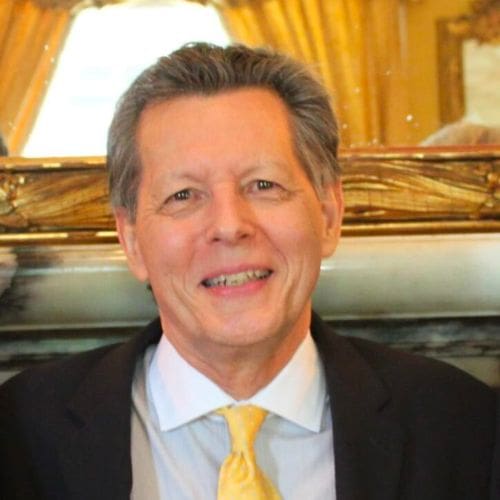
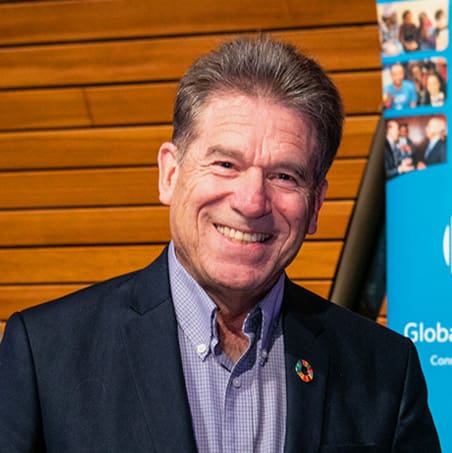
David R. Woollcombe
Founder of Peace Child International. He has championed youth engagement for more than 40 years.
A common refrain from UN officers and diplomats on the UN’s 80th Anniversary has been: “There’s nothing to celebrate here.” Challenging as the UN’s circumstances are, that attitude is wrong. I am about the same age as the UN and, 80 years in, I see much to celebrate.
Start with the very fact that the UN has survived for 80 years! The League of Nations only managed 17! While it is right to worry about the state of the UN, and the international system more broadly, any sober reflection on the role the UN plays in our lives would remind us that we, the peoples of the human family, could not function without it. The fact that you can post a letter in Birmingham, UK and it gets to Bangkok, Thailand is a function of the UN’s Universal Postal Union. The fact that one hundred thousand planes fill our skies every day and don’t bump into each other is thanks to the UN’s collaboration with the International Civil Aviation Organization. The fact that ships don’t either is thanks to the International Maritime Organization. For the rarity of nuclear incidents, thank the International Atomic Energy Agency. For the concepts of Sustainable Development and Peace-keeping, thank the UN Secretariat’s thought leadership. For calling out genocides and government failures in tackling the climate emergency, thank the International Court of Justice. And for supporting countless millions of people just to survive, thank the thousands of selfless UN servants who work for the World Food Programme, UNDP, UNICEF, UNHCR and many other UN programs. Just to rehearse the numbers―the millions of lives saved, the millions of refugees housed, the millions of hungry fed―is to understand the jaw-dropping scale of the UN’s service to our human family.
We must also remember that this service is not just bought with dollars and cents. It has cost the lives of some 4,400 UN servants and soldiers who have died in the service of the UN since 1945. In the last two years alone, 376 UNRWA staff have died in Gaza, bringing essential services to the people caught up in that appalling conflict. It is shameful for UN member governments not to honor those lives, that sacrifice. In its 80th Anniversary year, all of us should pay homage to them―and the work of all those UN servants who devote their lives to the service of humanity.
The brickbats of the current US administration and the ease with which senior UN Member States breach the UN Charter or fail to pay their assessed contributions on time, or at all, is―of course– a terrible slap in the face to the UN. The slashing of aid budgets by many of its richest members and the accompanying increase in military expenditure are a huge threat to the UN’s values and its core mandates to stop wars and end poverty. But, rather than cowing us into defeat and resignation, these reverses should spur “We the Peoples,” in whose name the UN was founded, to re-double our efforts to support and celebrate those values for which the UN stands, and give greater urgency to our efforts to support it to implement its core mandates.
Lest we forget, many of the aid and climate investment cuts are economically illiterate and are being ignored by clear-headed business and philanthropic leaders. American sustainability consultant, Andrew Winston, reports that there were over 1,000 business and civil society events during Climate Week in New York this year with over 100,000 people attending, many more than last year. He commented: “Down the street [at the UN], the U.S. president was calling [the] climate [emergency] a hoax. But maybe the right reaction is, ‘so what? ’” The U.S. is roughly 15% of global trade and emissions; the other 85% are pressing ahead with Climate Action. $2 trillion a year flows into clean tech vs $1 trillion into old energy as renewables are cheaper and much faster to build.
At the 2025 World Health Summit in Berlin, the head of the Global Fund to Fight Aids, Tuberculosis and Malaria, Peter Sands, told delegates that the $10 billion a year required to reach the UN agreed target of cutting malaria cases by 90% by 2030 would save 1.86 million lives and add $231 billion to the GDP. The severe cuts proposed by some governments would add a million more deaths to the global total and cause an $86 billion drop in the GDP. Malaria prevention thus offers a huge return on investment.
One would think that UN Member State governments would see the economic sense in that, but apparently they do not. Instead they are doing their best impression of a rabbit trapped in the headlights of a climate-denying, aid-eviscerating, military-industrial, fossil-fuel-funded complex. Given UN member governments’ silence and paralysis, we the peoples need to think cunningly about innovative ways to give the UN and its agencies the adulation its achievements deserve.
It has become a truism to say that the climate emergency is not so much an environmental problem but a global governance problem. Almost every national government has countless environmental regulations that protect its national parks, individual species of animals, forests, sites of special scientific interest, UNESCO World Heritage sites etc. etc. The world has no such protections. Oceans, outer space, the atmosphere, river systems―the entire biosphere―is a wild west! As Sir Partha Dasgupta wrote in the introduction to his Biodiversity Review: “Our planet lacks the institutional arrangements to protect the global commons.” But, though some imperially-minded nation states like it this way and are not about to allow any global organization like the UN to tell them what to do, research by Focaldata for the Rockefeller Foundation shows that, globally, 75% of us support global action to deal with global problems, like the climate crisis and pandemic prevention and also effective humanitarian aid.
Sadly that research also shows falling trust in the UN’s ability to lead those global initiatives. We have to admit, current leadership at the UN has been feeble―and it is likely to continue to be so unless we can find a way to prevent the imperially-minded nations from appointing another Secretary-General that is compliant to their diktats. So we must all support the 1 for 8 billion Campaign, which seeks to ensure that an effective Secretary-General is appointed next year. But―whoever s/he is―that will not be enough to restore the UN’s effectiveness. We must also support the Article 109 Coalition for UN Charter review. For the fact is, we have to re-invent the UN so that it does more than save lives and provide a convenient conference center for governments to meet and shoot the breeze. We require a UN that works, not only to “save succeeding generations from the scourge of war,” but to save humanity from the very real threat of extinction.
One of the UN’s greatest successes was to relieve the world from the scourge of imperialism. Between 1945 and 1995, it oversaw the dismantling of the British, French, Belgian, Portuguese and Soviet empires. As a result, its membership grew from 51 to 193 member states. Now, as some member states re-discover their imperial instincts with Russia’s invasion of Ukraine, US claims on Canada and Greenland, Israel’s imperial project in the Middle East, and China’s repeated claims on Taiwan, the UN should fight back by welcoming more nations―not just Taiwan and Palestine, but first nations like the Cherokees and Navajos, Sami Peoples and Inuits, Maoris and Aborigines, and the many other unrepresented peoples and nations from whom the human family can learn so much.
This year has seen UN leaders inundated by ideas for innovation and reform. The Secretariat has formalized this into its own UN80 Reform process, which focuses on three pillars: efficiency and effectiveness improvements; structural changes and program realignment; and review of the UN’s 4,000 active mandates, to reduce costs and avoid duplication.
Two more radical innovations should be added into the mix to ensure that “We the Peoples” have a UN that can deliver those “institutional arrangements to protect the global commons” for our own―and future generations’―survival.
First, we should look to reorganize the taxation system of our planet to ensure that our treasure ends up helping those most in need on our planet. A Study by the London School of Economics and Carbon Tracker found that fossil fuel companies and petro-states have made $2.8 billion a day in profits since 1970 from their products that threaten to asphyxiate the entire human family! Oxfam’s Global Wealth Report goes further, revealing the shocking statistic that global billionaire wealth increased by $2 trillion in 2024―almost 70 times the annual amount required to end extreme poverty as calculated by UN University researchers. It also reports that $30 million per hour is transferred from the Global South to the Global North through debt service payments and other financial system obligations. Consequently, so much of the world’s money ends up lining the pockets of those who already have more than they need. That is both immoral and inexcusable. A system of world wealth taxation must be inaugurated to tackle the litany of global challenges we face and pay for a UN System capable of delivering those solutions.
Second: we should seek to replace “imperial thinking” with what Martin Luther King called “World House thinking.” In his Nobel Prize acceptance speech, and in the final chapter of his last book, Where do we go from here?―Chaos or Community, King imagines “a great ‘world house’ in which, because we can never again live without each other, we must learn, somehow, to live with each other.” Pursuing King’s metaphor, try to imagine the UN serving a big family, living together in one big World House, where everyone cares for each other, cooks and feeds each other, ensures that everyone’s kids are educated, that the sick and the elderly are cared for, that the trash is emptied regularly, and that the plumbing, ventilation and fabric of the house is carefully maintained for future residents. The Residents’ Association of such a house (“We the Peoples”) would never give the rich residents in the penthouse apartments the power to veto the agreements of all the other residents, would it? Neither would it allow any residents to pack the basement with nuclear weapons and threaten to blow the whole place up if they didn’t get their way! In the World House of King’s imagination, the other residents would throw such rowdy, rule breaking residents out, and only let them back in when they learned to behave like good, caring World House citizens.
Could the UN do that to its rowdy, Charter-breaking, nuclear-armed Security Council members? In your dreams! But King famously had a dream! And as we reflect on the 80th anniversary of our indispensable UN, it is right to imagine what the UN might look like 80 years hence. King also said: “We must learn to live together as friends, or we shall die together as fools.” The young people passing through our schools today require a UN to save them from the scourge of extinction. So our governments, and the UN itself, must encourage more young people, especially from the P5 and other nuclear states, to meet and craft new stories of how their generation will achieve the collaboration that our world desperately needs if life on earth is to survive another 80 years.
The UN was born as a result of bloody conquest by nations with perverse imperial instincts. As we watch the re-emergence of those imperial instincts, let all of us who work to support the UN, locally, nationally, and globally, re-double our efforts to resurrect a vision of a UN system capable of creating a world that works for everyone.

Mondial is published by the Citizens for Global Solutions (CGS) and World Federalist Movement — Canada (WFM-Canada), non-profit, non-partisan, and non-governmental Member Organizations of the World Federalist Movement-Institute for Government Policy (WFM-IGP). Mondial seeks to provide a forum for diverse voices and opinions on topics related to democratic world federation. The views expressed by contributing authors herein do not necessarily reflect the organizational positions of CGS or WFM-Canada, or those of the Masthead membership.