
The Future in the Past:
Reconstructing Article 109(3) of the U.N. Charter — Towards the San Francisco Promise to Constitutionalize the United Nations and International Law
by S.M. Sharei
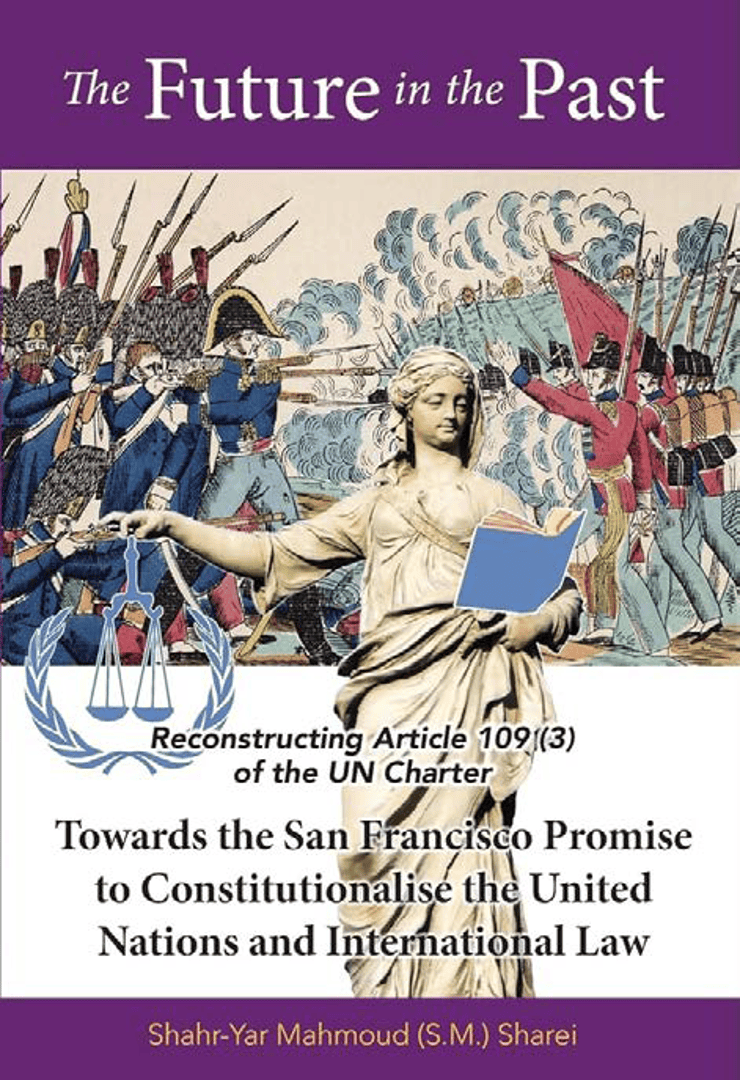
“The Future in the Past: Reconstructing Article 109(3) of the U.N. Charter — Towards the San Francisco Promise to Constitutionalize the United Nations and International Law” by S.M. Sharei
Recommended by
Joseph Preston Baratta
Professor emeritus of history and international relations at Worcester State University.
This important new book on UN reform is a work of international law. The actors in it are states, not individuals, until the very end, when the author Dr. Mahmud (“Shahr’Yar”) Sharei concludes with an envisaged General Conference of the Members of the United Nations to review the UN Charter, in accordance with Article 109(3) of the Charter, at which diplomats from nations large, medium, and small — pressed by federalists and others in civil society — struggle to “constitutionalize” our global international organization.
The thesis of the book contains a history of the founding of the UN and the diplomatic record behind the scenes, yet is very relevant to the causes of the world federalist movement. It also contains a kind of primer on how the goals of peace and security, human rights, preservation of the environment, economic justice, and the like can be practically achieved.
Sharei explains that originally, in1945, the UN Charter was more than a peace treaty or world security pact in which the UN Security Council was vested with “primary responsibility for the maintenance of international peace and security.” It was a “multilateral global governance system of law,” a “quasi-world government.” The UN was not deliberately given powers of law-making, court-making, and legislative functions, but they evolved. The turning point came with the First Iraq War (Persian Gulf War) of 1990, which U.S. Secretary of State James Baker described as coming at a “defining moment” in the post-Cold War era. We had come to the end of settling conflicts by appeals to force.
What has evolved is international law — by reference to the ICJ Statute Art. 38 — not by treaty, but by custom and principles like subsidiarity, proportionality, and direct effect on persons subject to international law. Sharei describes it in legal terms as not ultra vires (beyond delegated power), but intra vires (within the scope of authority recognized by member states), though he never quite decides this question. What was new after 1990 was that the five permanent members of the Security Council (the P5) began to restrain themselves from use of the veto. Resolutions began to pass with the concurrence of 9/15, including all the five permanent members. A common interest in what Sharei calls “quasi-global government” began to take shape.
Following the First Iraq War (Persian Gulf War) in 1990, the UN Security Council assumed new powers of legislating, adjudicating, and even taxation (without representation) of individuals found guilty of crimes like supporting Saddam Hussein’s conquest of Kuwait. Iraq, one of the poorest countries in the world, was made to pay reparations, drawn from oil revenue, to other states, corporations, and individuals. This, conceivably, is what a world government might do for the suppression of war or for the common good, such as the preservation of the climate and the diversity of life.
What is instructive for us throughout this book is how some of the UN reforms we contemplate might be translated into law. Sharei shows, apart from current injustices, how the states — particularly the United States, Russia, and China — might be induced to accept proposed reforms. World federalists have written excellent proposals, like the Global Governance Forum’s A Second United Nations Charter, but they are simply laid before the great powers as on a silver platter, as if to persuade them by so much sweet reasoning. This is no way to effect change in international relations. We often say that we are forming world public opinion to pressure the great powers, but they ignore us. World affairs are so desperate, the public so divided, and democratic legislatures so often paralyzed that responsible policy makers remain seized of traditional methods of peace through strength.
Sharei shows how progress is possible by supporting the evolution of imperfect international law. Short of world revolution, we are not going to impose laws on great powers without their consent. “Great power unanimity” (the veto) must be maintained until the people are ready for a global parliament and precedents accumulate that states can find safety in representative world assemblies.
In the latter half of the book (Chapters 4–9), Sharei provides a very instructive examination of how the public could assist in a process of “UN Constitutionalism.” This time, the medium and small states might act, as they did not dare in 1945, to exercise the still live Article 109(3) to convene a Charter review conference, implying its amendment. The aim would be to produce a limited world government, without great power veto, on the principle, expressed in 1945 by Eelco van Kleffens, minister of foreign affairs of the Netherlands, that granting the Security Council “quasi-judicial” functions and at the same time “executive” powers to enforce them, in cases where one of the five permanent members of the UN Security Council was a party to a dispute, which violates the guarantee of elementary impartiality, would produce a legal dilemma. (161)
Sharei lays out three legal strategies, still involving the people only at the highest levels: 1. ICJ contentious cases (one or more states vs. the five permanent veto holding members of the security council); 2. ICJ advisory opinions (requested by UN organs or agencies); 3. A decision of the General Assembly (members reactivate the Arrangements Committee).
Sharei foresees a climactic struggle by the states over global government, making the people citizens of the world, and sharing sovereignty between the states and the people.
ABOUT THE AUTHOR
S.M. Sharei
S.M. Sharei, PhD in International Law, is a principal in the UN Charter, Global Governance, and International Constitutional Law. Sharei co-founded the Center for United Nations Constitutional Research, specializing in research and policy recommendations on international legislation-driven governance of AI, climate change, the Security Council and UN reform.