
My Life in Politics
by Lloyd Axworthy
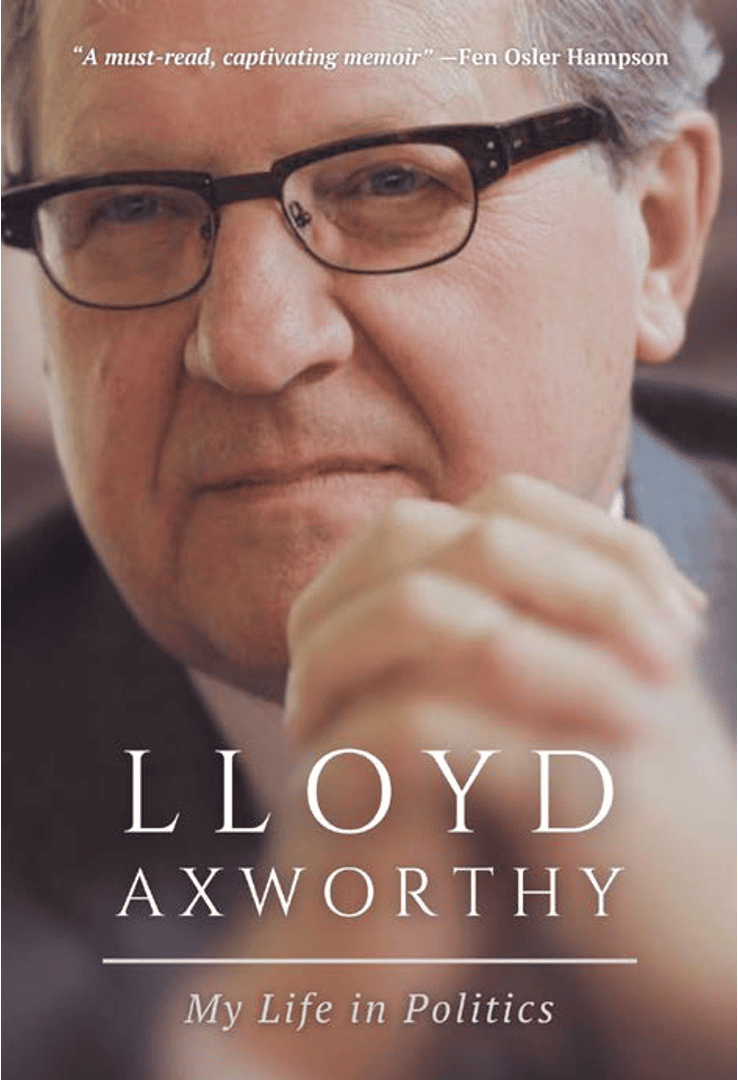
“My Life in Politics” by Lloyd Axworthy
Recommended by
Rev. Dr. Karen Hamilton
President of the The World Federalist Movement – Canada, former General Secretary of the Canadian Council of Churches and a former Co-Chair of the 2018 Parliament of the World’s Religions.
In this stirring and beautifully written memoir, Lloyd Axworthy tells the unlikely story of a Canadian prairie boy, raised in the Social Gospel tradition, who studied politics at Princeton at the height of John F. Kennedy’s Camelot, marched for civil rights in Alabama, and returned to Canada to embark on an illustrious political career of his own at the height of Trudeaumania.
On pages xvii and xviii of this memoir, Dr. Axworthy states, “One reason for writing this book, is, I hope, to rekindle the spirit of R2P [Responsibility to Protect] as the world faces evermore dangerous risks to ordinary people. …one’s personal evolution is important in statecraft and politics. The influences of the ideas, people, and experiences that shaped my upbringing and education were what I brought to the table in making, literally, life-and-death decisions.”
Those of us of World Federalist persuasion, including those of us who have passionately committed our work and lives to the ideals and concrete realities of World Federalism, might, initially, be disappointed in reading our way through this book. It does not overtly mention the World Federalist Movement, of which Dr. Axworthy was International Co-President for three years. However, reading more carefully, we realize that so many of the issues that Dr. Axworthy was deeply involved in and deeply influenced by World Federalist issues. His aforementioned quote on the rekindling of R2P as one of the reasons for writing the book will immediately resonate with World Federalists.
R2P is one of the issues that World Federalism has heavily engaged with, in addition to the International Criminal Court, the Landmines Treaty, and many others. To read through this book is to read the making of, the commitments and engagements of, and the passions and persistent actions of someone who lives and breathes World Federalism. Furthermore, several prominent World Federalists appear in the book because of their significant influence on his formation and life-and-death decision-making.
Rev. Dr. James Christie, Professor Emeritus, long-term WFM-C Council Chair and President, and member of the international World Federalist Executive, is profiled on pages xiii, xiv, xv, and xvi as a key influence on Axworthy’s thinking about Canada’s response to the Kosovo crisis. As violence and ethnic cleansing intensified under Slobodan Milosevic’s regime, Christie applied Just War principles to the unfolding events, arguing that Kosovo was a critical test of international action at “a time when the international community had a duty and moral obligation to protect the basic rights of people to be free from fear.”
My Life in Politics spends substantive time detailing Dr. Axworthy’s early life and how his roots in the north end of Winnipeg, his family, his education – with its concrete experiences and social justice actions – and his faith influenced the ideologies and practicalities of his life as a political leader. He also relates, in fascinating detail, the joys and challenges of a political career engaging in crucial Canadian issues, such as the Charter of Rights and Freedoms. What may be of most interest to World Federalists are the latter chapters of the book which detail the processes and procedures of defining Canadian and World Federalist issues such as as the Landmines Treaty, the International Criminal Court, and the Responsibility to Protect doctrine under, what he calls, “The Human Security Agenda.”
Dr. Axworthy is deeply and actively concerned with the reality of child soldiers, the strengths and weaknesses of the United Nations, and Indigenous rights. Dr. Axworthy also speaks passionately about the need for participatory democracy in several places throughout the book. On page 175, he connects national and international issues in a way that resonates with federalism, and he continues to be thoroughly committed to service as a way to a just society. He is earnest about all the ways he feels Canada has fallen short of its ideals, mandates, and capabilities on the global stage, particularly in world federalist areas such as peacekeeping.
Dr. Axworthy concludes this book with what he calls “A Proposition for Canada,” which is based on the true creation of “a third pillar of governance, a marked demonstration of First Nations and non-First Nations working together.” (page. 287) He issues a very timely call, “With another election on the horizon, the time is ripe for the launching of a bold proposition of deliberative democracy, leading to a definition and redesign of Canada’s democracy based on the full recognition of the rights of First Nations, Inuit and Metis people.” (page 288) In good World Federalist methodology, he then lays out the concrete steps to achieving it.
“By confronting our past with courage and conviction, we can forge a future defined by justice, inclusion, and prosperity for all Canadians. The path forward may be challenging, but the rewards of success will be immense- not just for our country, but for the global community of which we are a part.” (page 305)
Allons-y World Federalists!
ABOUT THE AUTHOR
Lloyd Axworthy
Lloyd Axworthy is a Canadian politician, elder statesman, and academic. He served as minister of Foreign Affairs in the cabinet, chaired by Prime Minister Jean Chretien. In 2000, he retired from politics, returning to western Canada where he served as president of University of Winnipeg for ten years. In December 2015, he was promoted to Companion of the Order of Canada. He now chairs the World Refugee and Migration Council and lives with his wife, Denise, in Ottawa.