

Originally published on the CGS blog on March 30, 2012.
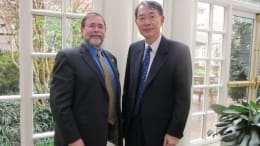
This morning I attended an event at the Brookings Institution, “The Contribution of The Hague’s International Courts: Dispute Settlement in Complex Conflicts.” It featured the heads of the various international courts and tribunals located in The Hague, including International Criminal Court (ICC) President Sang-Hyun Song.
The event began with opening remarks by The Hague Mayor Jozias Van Aartsen. He noted that the international community is moving from a system prioritizing state sovereignty above all to one focused on human dignity, where the obligation of the world to protect civilians is considered paramount. He cited Libya as an example of this trend, and said that a moral obligation exists with regard to the situation in Syria as well. Mayor Van Aartsen said that the ICC’s recent verdict in the case of Thomas Lubanga Dyilo, its first conviction at the end of its first completed trial, is an example of the crucial work the courts in The Hague are doing to promote global stability and punish those who disregard the world’s values with respect to human rights. He finished his remarks by noting that the Responsibility to Protect-long a concept that Citizens for Global Solutions has championed-is really about, in the worlds of U.S. President Franklin D. Roosevelt, “freedom from fear.”
President Song provided the audience with a background on the ICC’s creation, its work, and the recent Lubanga trial and verdict. He emphasized that the Court respects national sovereignty and follows territorial and nationality rules, unless a case has been referred by the U.N. Security Council for action.
Song noted that for countries who have not yet ratified the Rome Statute and become ICC state parties, “lack of information and misconceptions” are often major obstacles to their doing so. As a result, President Song said he always emphasizes the idea of complementarity-that national courts have primary jurisdiction to prosecute crimes such as genocide, war crimes, and crimes against humanity and the ICC only takes on such cases if states are unable or unwilling to do so. States, he said, should be equipped to be the primary deterrent to such crimes, and the ICC should serve only as a “safety net” if they fail. He also stressed that, since the ICC has no police force, it relies on states to help with enforcements of arrest warrants and this cooperation from states is essential to the Court’s success.
Finally, President Song discussed the U.S. relationship with the ICC. Although the U.S. is not a state party to the ICC, over the past few years it has been engaging more with the Court. He said he hopes U.S.-ICC ties continue to deepen in the future.


