by Lawrence Wittner | Dec 14, 2023 | Peace & Disarmament
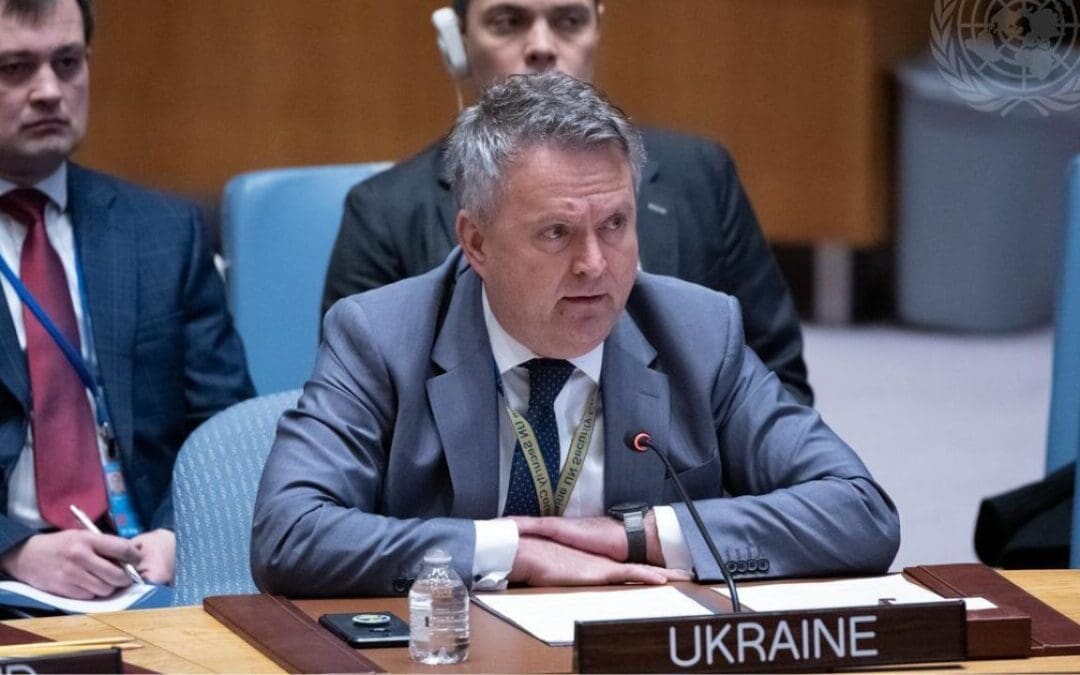
Although the unfolding humanitarian catastrophe in Gaza has captured the world’s horrified attention, the war in Ukraine has had even more terrible consequences. Grinding on for nearly two years, Russia’s massive military invasion of that country has taken hundreds of thousands of lives, created millions of refugees, wrecked Ukraine’s civilian infrastructure and economy, and consumed enormous financial resources from nations around the world.
And yet, despite the Ukraine War’s vast human and economic costs, there is no sign that it is abating. Russia and Ukraine are now bogged down in very bloody military stalemate, with about a fifth of Ukraine’s land occupied and annexed by Russia.
Meanwhile, polls show that an overwhelming majority of Ukrainians remain determined to continue the struggle to free all of Ukraine from Russian captivity. Indeed, an opinion survey in the fall of 2023 found that 80 percent of Ukrainians polled believed that under no circumstances should Ukraine give up any of its territory.
Similarly, in Russia, polls have found that a majority of the public appears content with the Putin regime’s military conquest of Ukraine and is opposed to any peace settlement that would relinquish Russian control of conquered Ukrainian land. Of course, the accuracy of Russian polls on the Ukraine War remains deeply suspect, for professing opposition to the war could easily lead to arrest, as it did for 20,000 Russians in 2022. Perhaps for this reason, numerous Russians polled refused to answer the question of where they stood on the war. One participant responded: “Thank you for the opportunity not to testify against myself.” In any case, in increasingly authoritarian Russia, public sentiment against war seems unlikely to alter the Putin administration’s determination to triumph on the battlefield.
Admittedly, in the United States, the major supplier of military and economic aid to beleaguered Ukraine, some developments point to declining enthusiasm for that role. The Republican Party has revived its 1930s policy (once termed “isolationism”) of appeasing military aggression by rightwing dictatorships, while leftists with an anti-American slant see a Russian victory as a useful way of somehow destroying “U.S. imperialism.” Nonetheless, unless Donald Trump and his MAGA followers sweep into power in 2024, it seems unlikely that the U.S. government or its NATO partners will entirely abandon Ukraine to a future under the jackboot of Russian military occupation.
Given these obstacles, is there a way to secure a just settlement of the Ukraine War?
There is, but it will take some creative action by the United Nations, the global organization that has been authorized to enforce international security.
Since the beginning of the Russian invasion of Ukraine on February 24, 2022, the overwhelming majority of the world’s nations have repeatedly used their participation in the UN General Assembly to condemn the Russian invasion and to call for a just peace in Ukraine. For example, on the eve of the one-year anniversary of the war, the General Assembly, by a vote of 141 nations to 7 (with 32 abstentions), demanded that Russia “immediately, completely, and unconditionally” withdraw its military forces from Ukraine and called for a “cessation in hostilities” and a “comprehensive, just and lasting peace” based on the principles enshrined in the UN Charter. The UN Charter, of course, constitutes international law and bans “the threat or use of force against the territorial integrity or political independence of any State.”
Even so, it is the UN Security Council that is tasked with enforcing international security, and Russia has used its veto in that UN entity to block UN action to end the Ukraine War.
The paralysis of the UN Security Council, however, need not continue. As Louise Blais, Canada’s ambassador to the United Nations from 2017 to 2021, has recently pointed out, Article 27 (3) of the UN Charter states that a party to a dispute before the Security Council shall abstain from voting in connection with the dispute. But, when it came to the Security Council’s votes on the Ukraine War, as Blais noted, “none of the 10 elected Security Council members had the courage, vision or backing to put forward a resolution” demanding abstention. According to Blais, the unwillingness of the four other veto-wielding members (Britain China, France, and the United States) to avoid a crippling Russian veto and, thereby, empower the Security Council to act, reflected their “zero interest in supporting such a move for fear it would limit their own power in the future.”
But there is ample precedent for limiting the veto in this fashion. The United Nations has a history of veto-wielding nations abstaining from Security Council voting when they are parties to a dispute. As Blais observes, between 1946 and 1952, Security Council members “regularly adhered to the obligatory abstention rule.” Only in later years did the five permanent Security Council members curtail the application of this practice.
In short, based on both international law and precedent, the UN Security Council has the authority to impose a settlement of the disastrous Ukraine War. What kinds of international action this would require would need to be determined by the world organization, just as the final terms of a peace agreement would ultimately need to be accepted by the contending parties. But, given the overwhelming support in the UN General Assembly for the withdrawal of Russian military forces from Ukraine and for a lasting peace agreement, such a peace settlement is likely to be a just one.
At the least, this would be a far better method of dealing with international conflict than the current full-scale war currently raging in Ukraine. And it could serve as a model for resolving other intractable disputes, such as the brutal Israel-Palestine conflict, as well.
This article was originally published in International Physicians for the Prevention of Nuclear War’s Peace and Health Blog
Image Credits: UN Photo/Evan Schneider
by Citizens for Global Solutions | Jun 12, 2023
Citizens for Global Solutions hosted a special follow-up strategy session with the authors of Global Governance and the Emergence of Global Institutions for the 21st Century. After months of book club discussions exploring the work, this session shifted from analysis to action, inviting participants to discuss concrete pathways toward institutional reform with the authors themselves.
About the Book
Global Governance and the Emergence of Global Institutions for the 21st Century, published by Cambridge University Press in 2020, presents ambitious but actionable proposals to give our globalized world the institutions necessary to address existential challenges beyond national control. The book covers a sweeping range of reform areas, from UN restructuring to environmental governance.
About the Authors
Augusto Lopez-Claros is Executive Director of the Global Governance Forum and former Director of the Global Indicators Group at the World Bank. Arthur Lyon Dahl is President of the International Environment Forum and a retired senior official of UN Environment. Maja Groff is an international lawyer based in The Hague who has worked on multilateral treaties and at international criminal tribunals.
Discussion Highlights
The strategy session addressed topics covered in the book, including United Nations reform, a World Parliamentary Assembly, creation of a UN Executive Council, systemic disarmament, strengthening the international rule of law, human rights for the 21st century, new UN funding mechanisms, responding to global environmental crises, combating international corruption, and education for transformation. Participants engaged directly with the authors on how to translate these proposals into achievable reforms.
by Citizens for Global Solutions | Jun 4, 2023
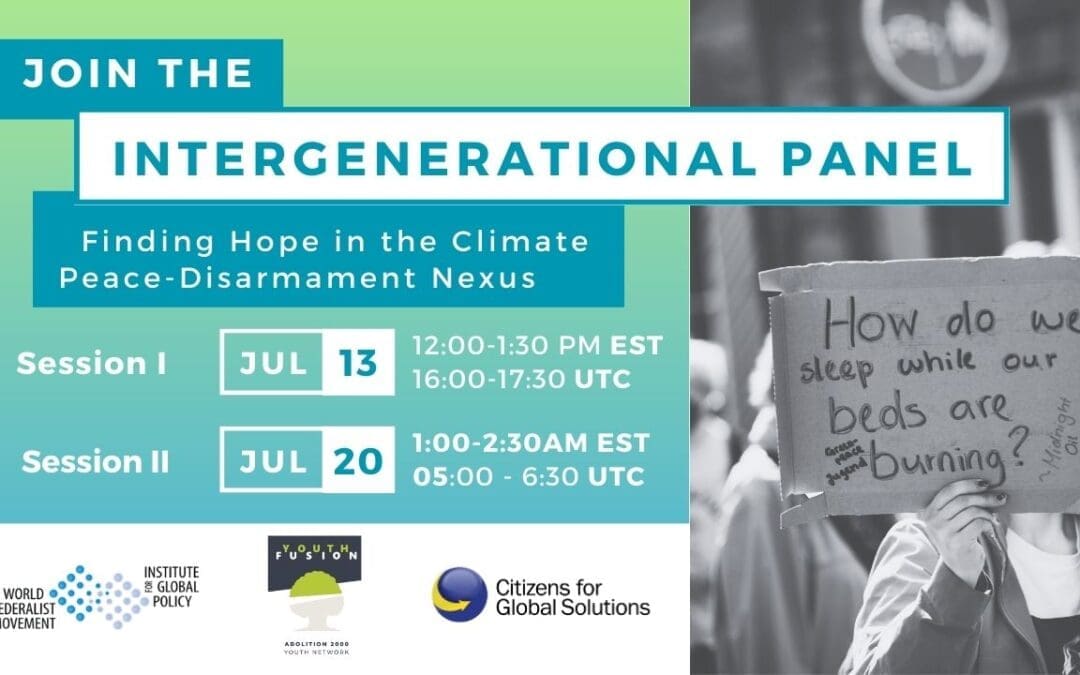
Progress on environmental protection is fundamentally hampered by armed conflict, nuclear threats, and the massive diversion of resources into weapons and war. This first session of a two-part intergenerational dialogue explored how global governance solutions could tackle these interconnected existential threats, with a focus on the Americas, Europe, Africa, and the Middle East.
About This Conversation
This Q&A panel discussion was hosted by Citizens for Global Solutions (CGS), Youth Fusion, and the World Federalist Movement – Institute for Global Policy (WFM-IGP). The series explored the potential of common security and global governance to foster cooperation on climate, peace, and disarmament issues. The intergenerational format brought together youthful energy and innovation with seasoned expertise and experience, actively engaging the audience in the movement to build stronger pathways to a peaceful and sustainable future.
Speakers
- William (Bill) R. Pace (USA), Founder and Inaugural Convenor, Coalition for an International Criminal Court; Former Executive Director, World Federalist Movement-Institute for Global Policy (WFM-IGP); Co-Founder, International Coalition for the Responsibility to Protect
- Kehkashan Basu, MSM (UAE/Canada), Founder-President, Green Hope Foundation; United Nations Human Rights Champion; Winner, 2016 International Children’s Peace Prize; Council Member, World Future Council
- Marie-Claire Graf (Switzerland), Co-Founder, Youth Negotiators Academy and Climate Youth Negotiator Programme; UN Youth Climate Champion of Switzerland
- Prof. Maja Groff (Canada/Netherlands), Convenor, Climate Governance Commission; Visiting Professor/Scholar, Faculty of Governance and Global Affairs, Leiden University; Lecturer, Hague Academy of International Law
- Prof. Juergen Scheffran (Germany), Professor of Integrative Geography; Chair of the Research Group Climate Change and Security, University of Hamburg; Principal author, The Climate-Nuclear Nexus
- Michaela Higgins Sorensen (Denmark/South Africa), Youth Fusion Co-Convener; Program Officer, PNND Gender, Peace and Security Program; Campaign Manager, Nuclear Stories project at DOCMINE
Key Themes
- The climate-nuclear nexus and how military spending diverts critical resources from climate action
- Common security frameworks as alternatives to deterrence-based approaches
- The role of climate governance institutions in bridging the gap between disarmament and environmental protection
- Youth-led movements connecting peace, climate justice, and disarmament advocacy
- Gender dimensions of peace and security in the context of climate change
Co-Sponsors
This event was co-sponsored by the 3+3 Coalition for a North-East Asia Nuclear-Weapon-Free Zone, Basel Peace Office, Climate Governance Commission, Democracia Global, Global Minnesota, Green Hope Foundation, I Am Climate Justice, Parliamentarians for Nuclear Nonproliferation and Disarmament, World Future Council, World Service Authority, World’s Youth for Climate Justice, Young World Federalists, and Youth Fusion, with promotional sponsorship from Peace Action and Upper Hudson Peace Action.
by Citizens for Global Solutions | Jun 3, 2023
Armed conflict, nuclear threats, and the massive diversion of resources into weapons and war continue to hamper progress on environmental protection. This second session of the intergenerational dialogue series explored how global governance solutions could tackle these interconnected existential threats, with a focus on the Asia-Pacific region.
About This Conversation
This Q&A panel discussion was hosted by Citizens for Global Solutions (CGS), Youth Fusion, and the World Federalist Movement – Institute for Global Policy (WFM-IGP). The series explored the potential of common security and global governance to foster cooperation on climate, peace, and disarmament issues. The intergenerational format brought together youthful energy and innovation with seasoned expertise and experience, actively engaging the audience to build stronger pathways to a peaceful and sustainable future.
Speakers
- Nicole Ponce (Philippines), Co-Founder and Coordinator, I am Climate Justice movement; Asia Front Coordinator, World’s Youth for Climate Justice
- Disha Ravi (India), Co-founder, Fridays for Future India
- Dr. Justin Sobion (Trinidad and Tobago), Legal Researcher and Teaching Assistant, New Zealand Centre for Environmental Law, University of Auckland; Coordinator, Earth Trusteeship Working Group; Co-editor, Reflections on Earth Trusteeship
- Tadashi Inuzuka (Japan), Co-President, World Federalist Movement – Institute for Global Policy; Executive Director, 3+3 Coalition for a North-East Asia Nuclear-Weapon-Free Zone; Former Senator for Nagasaki
- Augusto Lopez-Claros, Executive Director, Global Governance Forum; Senior Fellow, Edmund Walsh School of Foreign Service at Georgetown University; Former Director, Global Indicators Group at the World Bank
Key Themes
- How climate justice movements in the Asia-Pacific region are addressing the interconnected threats of environmental degradation, armed conflict, and nuclear proliferation
- The concept of Earth Trusteeship as a framework for reimagining humanity’s relationship with the planet
- The role of nuclear-weapon-free zones, particularly in Northeast Asia, in reducing security tensions and freeing resources for climate action
- Youth-led activism and intergenerational cooperation as drivers of change in global governance
- Legal and institutional mechanisms for connecting disarmament, climate, and peace agendas at the international level
Co-Sponsors
This event was co-sponsored by the 3+3 Coalition for a North-East Asia Nuclear-Weapon-Free Zone, Basel Peace Office, Climate Governance Commission, Democracia Global, Global Minnesota, Green Hope Foundation, I Am Climate Justice, Parliamentarians for Nuclear Nonproliferation and Disarmament, World Future Council, World Service Authority, World’s Youth for Climate Justice, Young World Federalists, and Youth Fusion, with promotional sponsorship from Peace Action and Upper Hudson Peace Action.
by Citizens for Global Solutions | Apr 10, 2023 | Press Release
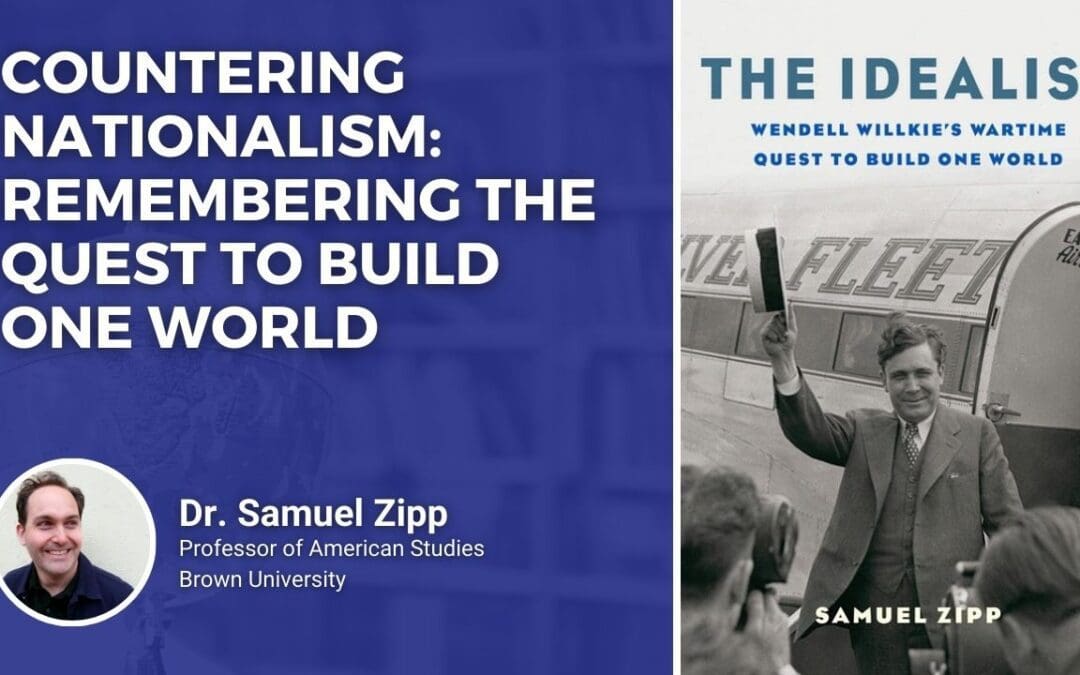
Washington, DC–Join Citizens for Global Solutions on April 22 for a special Q&A Global Conversations online event with author, Samuel Zipp to discuss his book, The Idealist: Wendell Willkie’s Wartime Quest to Build One World.
Participants: You and your fellow attendees will have the chance to learn about Countering Nationalism and Remembering the Quest to Build One World. Attend the FREE event and enter a chance to win Samuel Zipp’s book!
April 22 | 12:00PM – 1:30PM
Click here to register for the FREE event!
In August 1942, as the threat of fascism swept the world, a charismatic former Republican presidential contender, Wendell Willkie, took an unprecedented airplane journey around the world to visit battlefronts in Africa, the Middle East, Russia, and China. In One World, the runaway bestseller he published on his return, Willkie challenged Americans to resist the “America first” doctrine and warned of the dangers of “narrow nationalism”. He urged citizens to end colonialism and embrace, “equality of opportunity for every race and every nation”.
Zipp argues that Willkie’s “warnings about the perils of racially charged ‘narrow nationalism’ have never been more indispensable. As the United States reaches the end of its long turn as a great global power, the quandaries of American exceptionalism he faced remain ours today, and his example may yet offer us undiscovered resources for living in a ‘one world’ he heralded more than three-quarters of a century ago.”
“The term Willkie helped to put into common circulation -’one world’ –would become shorthand for the disruptive charge of worldly connection set off by the war. Over the years Willkie’s name would fade away but ‘one world’ would be adopted by world government advocates, anti-imperialists, environmentalists, and even corporate marketers to signify the promise of times in which global shrinkage offered new contracts and new ideas to offset the dangers of war, xenophobia and racism.”
Samuel Zipp is a cultural and urban historian at Brown University. He has written for the New York Times, the Washington Post, n+1, The Baffler, and The Nation and is the author of Manhattan Projects: The Rise and Fall of Urban Renewal Cold War New York. He also coedited a collection of the writings of Jane Jacobs.
“As a resident of Minnesota, home of a key founder of the UN, Governor Stassen, I have been a long-time devotee of the writings and speeches of Wendell Willkie. This book finally puts this internationally important leader into a truly global context.” Mark Ritchie, National Advisory Committee for Citizens For Global Solutions, former President of Global Minnesota and former Minnesota Secretary of State.
About Citizens for Global Solutions
CGS is a non-governmental, non-profit, non-partisan membership-based organization that for more than 75 years has brought together a diverse collective of individuals and organizations with a common goal of a unified world predicated upon peace, human rights, and the rule of law. From championing ratification of the UN Charter upon our establishment in 1947 to supporting creation of the International Criminal Court (ICC) 25 years ago to advocating for global instruments to confront today’s enduring challenges of war and climate degradation, CGS recognizes that true progress is a generational enterprise. We invite like-minded individuals and organizations to join us in this mission.
Contact: Donna Park dpark@globalsolutions.org