by Charles Howlett | Jun 2, 2026 | Peace & Disarmament
In his award-winning book about World War I, the historian Paul Fussell began The Great War and Modern Memory with the words: “Every war is ironic because every war is worse than expected.”
He was all too correct. During four years of bloodshed, 1914 to 1918, at least 8.5 million combatants were killed, many more were wounded, and close to 10 million non-combatants perished. In terms of economic expenditure, the war cost between $185 billion and $200 billion, roughly equivalent to $6 trillion today.
World War II was even more devastating in terms of lost lives and economic costs, with the economic loss alone running between $4 trillion and $5 trillion in 1940 dollars. Today that would be somewhere around $104 trillion. The Vietnam War cost approximately $168 billion (in today’s dollars, $1 trillion). The Gulf War of 1990-91, though brief, ended up devouring approximately $600 billion, and the Iraq-Afghanistan Wars around $8 trillion. The cost of the current conflict in Iran is expected to exceed $1 trillion.
The Iran war raises a fundamental question peace advocates have been asking since the conclusion of World War I: shouldn’t the wealth of nations be spent improving the lives of their citizens instead of wasting it on war? What if the money allocated for military purposes was used, instead, to make college more accessible, fund health care for all, ameliorate world hunger, fund disease prevention programs, and expand education programs for all children? The costs for this present conflict are already being borne out in terms of high energy costs and rising food prices directly impacting the lives of the less fortunate in our society.
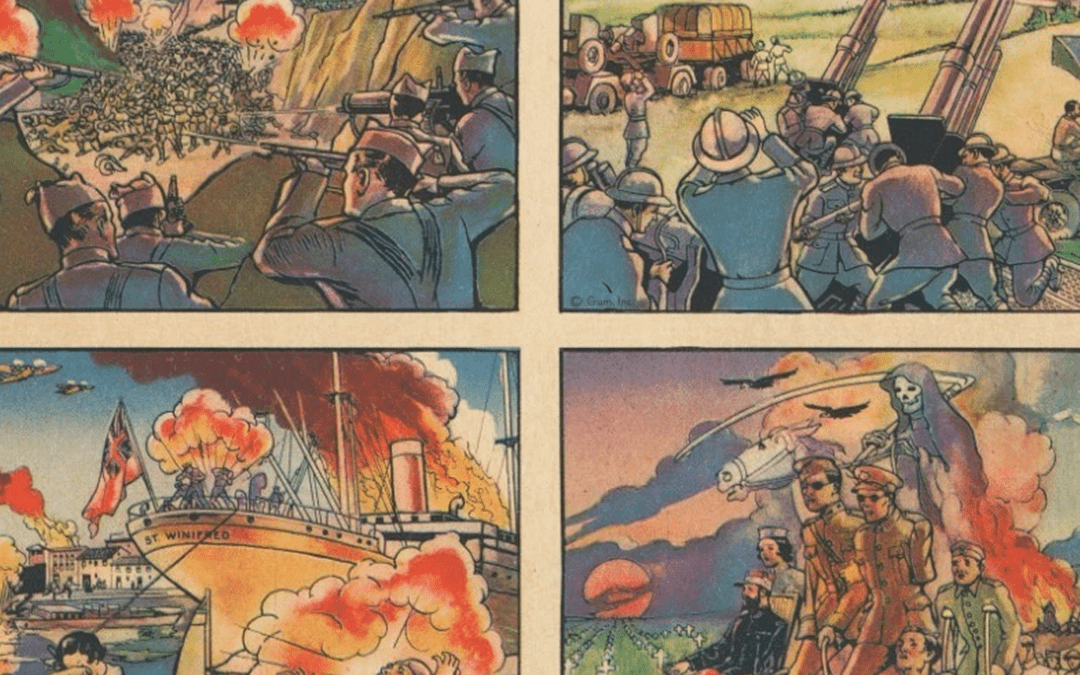
Curiously, this question was conveyed in a popular bubble gum trading card marketed shortly before the advent of World War II. That card, “The Frightful Cost of War,” resonates just as loudly today as it did 88 years ago.
Historically, the card’s origin dates back to July 1937. While listening to radio broadcasts and reading press accounts about Japan’s unprovoked military invasion of the Chinese mainland, Warren Bowman, a Philadelphia gum manufacturer, commissioned an advertising company from nearby Abington, Pennsylvania, to create a series of collector cards depicting the brutality of war. All depictions and descriptions created were based on current radio reports and newspaper stories. Each piece of gum contained in a wrapper, which sold for a penny, also included a card. On the back of each card was printed the caption: “To Know the HORRORS OF WAR is to wantPEACE.”
“The Horrors of War” collection became an instant financial success, producing some 100 million cards and netting the company over $40,000 a week. Indeed, the collection remains the most popular non-sports card set ever manufactured. A portion of the cards covered the Spanish Civil War, Mussolini’s incursion in Ethiopia, and―a very small number―Hitler’s threats to peace in Central Europe. The initial set consisted of 240 cards. Another 48 were added later. These cards contained crisp depictions with colored artwork―illustrating and describing the various military conflicts and bombings of civilians then taking place—on the front of each 2.5”x 3” rectangular card. Eye-popping drawings and chilling narratives appeared on the back.
Nearly one-third of the set focused on the impact of war on innocent civilians. In an effort to influence the mind-set of pre-adolescent purchasers, many of these cards depicted young children and babies being killed. This novel cultural approach led some critics to charge that the cards exaggerated combat scenes and ruthless killings of noncombatants by using red ink for maximum effect, thus appearing to instrumentalize war in the minds of children rather than rejecting it. Mothers and many schoolteachers questioned the effectiveness of the set as an educational lesson due to its graphic nature.
Yet most commentators agreed about the set’s lesson for children, as well as for adults, when it came to one very special card. By design, when the trading cards hit the market in the spring of 1938, the very last one in the initial set encapsulated the true message of the “Horrors of War.” That card, “The Frightful Cost of War,” is cast in a setting where children’s eyes are directed to gaze upon a blood-red setting sun surrounded by an atmosphere of smoke and fire from a destroyed farm, a cemetery filled with white crosses, fleeing wounded soldiers walking or being carried on a stretcher, amputees in a wheelchair and crutches, and what appear to be scavengers, soaring overhead. In the middle is the Grim Reaper on a white horse wielding his scythe. Frightening, yes indeed! But it also effectively challenged the popular idea that war is glorious, by illustrating the losses it entails.
This message was powerfully conveyed in the narrative on the back of the card. “War costs money…billions of dollars!” it declared. “War takes human lives…millions of them! War makes children old, breaks parents’ hearts, kills morale! War destroys cities, art treasure, civilization.”
Unfortunately, the set soon fell victim to the very evil it sought to eradicate. Less than a year after the complete set was produced, another global conflagration was underway―the most destructive war in human history. In this context, the message of the bubble gun card was quickly forgotten.
That message is needed now. When it comes to yet another unpopular war in the Middle East, “The Frightful Cost of War” remains as powerful today as it was when it first appeared on the doorstep of World War II. Now is the time for people and nations to learn its lesson and not forget it.
And, if we have learned its lesson, we need to create an international alternative to war―one providing the security we need, not the false promise of security through war. Merely repeating “war is bad, war is bad” when it comes to money and lives is simply whistling past the graveyard and will never take the politics out of national interests. Now is the time we should consider, seriously and unreservedly, creating a democratic world federation based on justice and law.
by Citizens for Global Solutions | Jun 4, 2023
Progress on environmental protection is fundamentally hampered by armed conflict, nuclear threats, and the massive diversion of resources into weapons and war. This first session of a two-part intergenerational dialogue explored how global governance solutions could tackle these interconnected existential threats, with a focus on the Americas, Europe, Africa, and the Middle East.
About This Conversation
This Q&A panel discussion was hosted by Citizens for Global Solutions (CGS), Youth Fusion, and the World Federalist Movement – Institute for Global Policy (WFM-IGP). The series explored the potential of common security and global governance to foster cooperation on climate, peace, and disarmament issues. The intergenerational format brought together youthful energy and innovation with seasoned expertise and experience, actively engaging the audience in the movement to build stronger pathways to a peaceful and sustainable future.
Speakers
- William (Bill) R. Pace (USA), Founder and Inaugural Convenor, Coalition for an International Criminal Court; Former Executive Director, World Federalist Movement-Institute for Global Policy (WFM-IGP); Co-Founder, International Coalition for the Responsibility to Protect
- Kehkashan Basu, MSM (UAE/Canada), Founder-President, Green Hope Foundation; United Nations Human Rights Champion; Winner, 2016 International Children’s Peace Prize; Council Member, World Future Council
- Marie-Claire Graf (Switzerland), Co-Founder, Youth Negotiators Academy and Climate Youth Negotiator Programme; UN Youth Climate Champion of Switzerland
- Prof. Maja Groff (Canada/Netherlands), Convenor, Climate Governance Commission; Visiting Professor/Scholar, Faculty of Governance and Global Affairs, Leiden University; Lecturer, Hague Academy of International Law
- Prof. Juergen Scheffran (Germany), Professor of Integrative Geography; Chair of the Research Group Climate Change and Security, University of Hamburg; Principal author, The Climate-Nuclear Nexus
- Michaela Higgins Sorensen (Denmark/South Africa), Youth Fusion Co-Convener; Program Officer, PNND Gender, Peace and Security Program; Campaign Manager, Nuclear Stories project at DOCMINE
Key Themes
- The climate-nuclear nexus and how military spending diverts critical resources from climate action
- Common security frameworks as alternatives to deterrence-based approaches
- The role of climate governance institutions in bridging the gap between disarmament and environmental protection
- Youth-led movements connecting peace, climate justice, and disarmament advocacy
- Gender dimensions of peace and security in the context of climate change
Co-Sponsors
This event was co-sponsored by the 3+3 Coalition for a North-East Asia Nuclear-Weapon-Free Zone, Basel Peace Office, Climate Governance Commission, Democracia Global, Global Minnesota, Green Hope Foundation, I Am Climate Justice, Parliamentarians for Nuclear Nonproliferation and Disarmament, World Future Council, World Service Authority, World’s Youth for Climate Justice, Young World Federalists, and Youth Fusion, with promotional sponsorship from Peace Action and Upper Hudson Peace Action.
by Citizens for Global Solutions | Jun 3, 2023
Armed conflict, nuclear threats, and the massive diversion of resources into weapons and war continue to hamper progress on environmental protection. This second session of the intergenerational dialogue series explored how global governance solutions could tackle these interconnected existential threats, with a focus on the Asia-Pacific region.
About This Conversation
This Q&A panel discussion was hosted by Citizens for Global Solutions (CGS), Youth Fusion, and the World Federalist Movement – Institute for Global Policy (WFM-IGP). The series explored the potential of common security and global governance to foster cooperation on climate, peace, and disarmament issues. The intergenerational format brought together youthful energy and innovation with seasoned expertise and experience, actively engaging the audience to build stronger pathways to a peaceful and sustainable future.
Speakers
- Nicole Ponce (Philippines), Co-Founder and Coordinator, I am Climate Justice movement; Asia Front Coordinator, World’s Youth for Climate Justice
- Disha Ravi (India), Co-founder, Fridays for Future India
- Dr. Justin Sobion (Trinidad and Tobago), Legal Researcher and Teaching Assistant, New Zealand Centre for Environmental Law, University of Auckland; Coordinator, Earth Trusteeship Working Group; Co-editor, Reflections on Earth Trusteeship
- Tadashi Inuzuka (Japan), Co-President, World Federalist Movement – Institute for Global Policy; Executive Director, 3+3 Coalition for a North-East Asia Nuclear-Weapon-Free Zone; Former Senator for Nagasaki
- Augusto Lopez-Claros, Executive Director, Global Governance Forum; Senior Fellow, Edmund Walsh School of Foreign Service at Georgetown University; Former Director, Global Indicators Group at the World Bank
Key Themes
- How climate justice movements in the Asia-Pacific region are addressing the interconnected threats of environmental degradation, armed conflict, and nuclear proliferation
- The concept of Earth Trusteeship as a framework for reimagining humanity’s relationship with the planet
- The role of nuclear-weapon-free zones, particularly in Northeast Asia, in reducing security tensions and freeing resources for climate action
- Youth-led activism and intergenerational cooperation as drivers of change in global governance
- Legal and institutional mechanisms for connecting disarmament, climate, and peace agendas at the international level
Co-Sponsors
This event was co-sponsored by the 3+3 Coalition for a North-East Asia Nuclear-Weapon-Free Zone, Basel Peace Office, Climate Governance Commission, Democracia Global, Global Minnesota, Green Hope Foundation, I Am Climate Justice, Parliamentarians for Nuclear Nonproliferation and Disarmament, World Future Council, World Service Authority, World’s Youth for Climate Justice, Young World Federalists, and Youth Fusion, with promotional sponsorship from Peace Action and Upper Hudson Peace Action.
by Citizens for Global Solutions | Jun 3, 2023
The World Citizen Book Club concluded its five-session series on Global Governance and the Emergence of Global Institutions for the 21st Century with a final Q&A session featuring all three authors. This closing discussion addressed corruption, international enforcement, education for transformation, and concrete steps forward for reform and bridging the governance gap.
About the Book
Global Governance and the Emergence of Global Institutions for the 21st Century by Augusto Lopez-Claros, Arthur Lyon Dahl, and Maja Groff provides ambitious but reasonable proposals for giving the globalized world the institutions of international governance necessary to address catastrophic risks beyond national control. The authors argue for extending to the international level the same principles found in well-governed national systems: rule of law, legislation in the common interest, an executive branch to implement it, and courts to enforce it. Published by Cambridge University Press.
About the Authors
- Augusto Lopez-Claros, Executive Director, Global Governance Forum; Senior Fellow, Edmund Walsh School of Foreign Service, Georgetown University; Former Director, Global Indicators Group, World Bank
- Dr. Arthur Lyon Dahl, President, International Environment Forum; Retired Deputy Assistant Executive Director, United Nations Environment Programme (UNEP)
- Maja Groff, Convenor, Climate Governance Commission; Visiting Professor/Scholar, Faculty of Governance and Global Affairs, Leiden University; Lecturer, Hague Academy of International Law
Discussion Highlights
This final session explored the challenges of corruption in international institutions and the urgent need for effective enforcement mechanisms. The authors discussed education as a transformative force for building public support for global governance reform, and outlined immediate steps that citizens and policymakers could take to begin bridging the gap between existing institutions and the governance structures the world needs.