by Lawrence Wittner | Sep 18, 2024 | Global Justice
Are the nations of the world doomed to go on fighting the brutal, horrifying wars that have long characterized human history?
We might well wonder about that as we watch, aghast, while Israeli armed forces slaughter thousands of Palestinian civilians, Russian military might relentlessly pounds Ukrainian towns and cities into rubble, and new, bloody wars erupt in numerous other lands.
Why does such widespread destruction and human suffering persist in the modern, ostensibly “civilized,” world?
A variety of explanations have been advanced. Some observers point to capitalism, others blame dictatorial rule, while still others place the onus on xenophobia, religious differences, racism, and toxic masculinity.
Each of these factors has some weight. Certainly greed, authoritarian arrogance, inflamed nationalism, religious and racial animosities, and male violence have played some role in dividing people and, thereby, fostering wars among them over the course of history.
But are these factors sufficient to explain the stubborn persistence of war? After all, wars existed long before the advent of capitalism and, furthermore, since then, non-capitalist (for example, Communist) nations have repeatedly waged wars, even against one another. Similarly, democratic nations have plunged regularly into numerous wars, some against their fellow democracies. Moreover, even countries whose populations have friendly ties, have the same racial composition and religion, and have taken major strides toward gender equality (including admission of women to the armed forces and top posts in government) seem quite willing to prepare for and engage in war with each other.
Something is clearly missing from these explanations of widespread international violence―something fundamental. Could it be the structure of international relations?
International relations specialists have long argued that the driving force behind international war is global anarchy. Humanity, like war, has existed for thousands of years. But, although humans have gradually created governments to establish effective laws regulating behavior within their territories―regions, cities, states, and, ultimately, nations―they have failed to do so for the world. Thus, on the global level, nations have been left largely to their own devices. The resulting situation resembles the American Wild West, characterized by the absence of law enforcement and the prevalence of heavily armed gangs.
For centuries, scholars have pointed to the need for creating transnational structures to end this global nightmare. The theologian and diplomat Hugo Grotius helped develop the concept of international law, while writers such as Dante Alighieri, Immanuel Kant, and H.G. Wells promoted the idea of global governance.
After the atomic bombing of Japan and the ensuing scramble for nuclear weapons starkly revealed the peril of nuclear annihilation, the call for a full-scale transformation of international relations became even sharper. Albert Einstein, the chair of the Emergency Committee of Atomic Scientists, stated bluntly: “Mankind’s desire for peace can be realized only by the creation of a world government.”
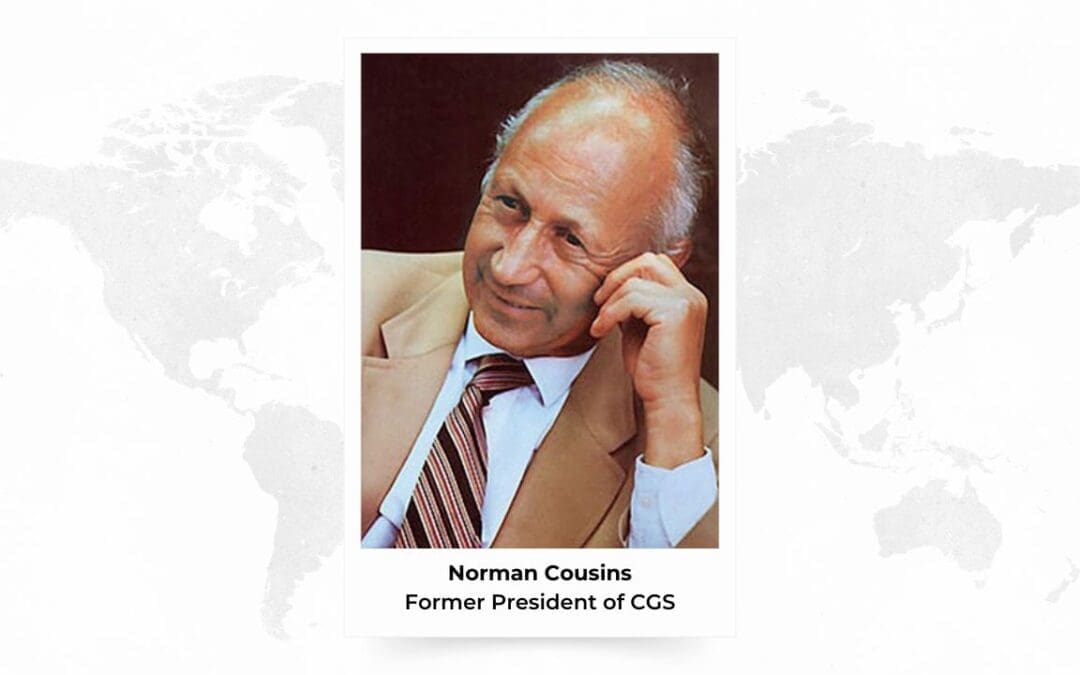
Norman Cousins, editor of one of America’s major magazines of the era (the Saturday Review), played a key role in channeling Einstein’s call into a postwar campaign for a global federation of nations. “The only security for Americans today, or for any people,” Cousins contended, is “a system of world order that enables nations to retain sovereignty over their own cultures and institutions but that creates a workable authority for regulating the behavior of nations in their relationships with one another.” Cousins served as president of United World Federalists (which morphed into the World Federalist Association and, eventually, Citizens for Global Solutions), the U.S. member organization of the World Federalist Movement.
Benjamin Ferencz, the U.S. prosecutor at the Nuremberg War Crimes Trials of the late 1940s, became an important popularizer of this world federalist approach. In his widely-read book, PlanetHood, Ferencz told Americans that, in the United States, “we have four layers of government: city, county, state, and national,” created “to avoid anarchy within our nation.” Thus, adding “one more layer of government will enable us to have an abundant future on this planet.” Indeed, “international governance―something like a United Nations of the World―will rescue us from our deadly predicament.”
Critics, of course, might argue that a United Nations already exists, and has often proved unable to prevent the recurrence of war. But Ferencz’s answer―and, usually, the answer of the world federalist movement―was that, although the United Nations had significant accomplishments to its credit, the UN Charter “was deliberately made weak” by the major powers. As a result, it “did not give the United Nations the binding strength needed to get rid of international lawlessness.” Ultimately, “the only way to permanently solve the problem of war is to replace the Law of Force with the Force of Law.” This perspective led, in recent years, to the establishment of the LAW not War campaign, designed to promote the universality of the International Court of Justice.
World federalists can also point to a dramatic decline in war when independent nations accepted limitations on their sovereignty. In the late eighteenth century, as 13 British North American colonies gained their independence, they could have followed the usual global pattern of war with one another. But, instead, they gradually created a federal union (the United States) and fought only one war within their ranks during the following 235 years. Similarly, although European nations had undergone centuries of war with each other before they went at it again in World War II, members of the European Union, formed in the aftermath of that devastating war (and now encompassing 27 nations), succeeded in ending war among them.
The issue of transcending the ages-old practice of international war certainly remains relevant today. Indeed, the United Nations is moving forward with plans for a Summit of the Future in late September. Designed to address “global governance,” among other issues, the Summit provides yet another opportunity for nations to empower the world organization to maintain international peace through the enforcement of world law.
Is that goal realistic? Perhaps so, perhaps not. But how realistic is it to continue the anarchy of nations, which today threatens universal death and destruction?
Image source: https://www.asymmetricalhaircuts.com/episodes/in-memoriam-benjamin-b-ferencz/
by Sovaida Maani Ewing | Aug 30, 2024 | Peace & Disarmament
The intensifying cascade of global crises including intractable wars, massive human rights atrocities, nuclear proliferation, climate change and environmental degradation, the growing inequality between the rich and the poor, recurring bouts of global financial instability, and the increasing risks of pandemics to name but a few, call to mind the warning sounded by Arnold Toynbee, one of the most highly-regarded authorities and foremost experts on international affairs and world history in the 20th century, that humanity would be faced with an existential crisis followed by his recommendation as to what we, the family of nations, should do in response.
Toynbee contended that in the atomic age, humanity would have to choose between political unification and mass suicide. He believed the chief obstacle to political unification was a long-standing destructive habit of the West which he referred to as the habit of “divisive feeling” to which we tended to easily succumb as opposed to reaching for our more recently-adopted habit of “world-mindedness.” The good news he said was that just as new habits could be adopted, old ones could also be modified or abandoned. He stressed that as a general rule, we humans would opt to abandon even our most deeply-rooted habits once it became clear that clinging to them would spell disaster.
He recommended that we replace our outworn habit of divisive feeling with a new habit of common action on a worldwide scale through the creation of some form of limited world-state that would be empowered to act in humanity’s collective interest in certain narrow fields of endeavor. Already, as far back as the 1970’s he believed that the global community needed to engage in common action on a world-wide scale in at least two areas: to control atomic energy through a World Authority and to administer the production and distribution of food through another World Authority. Now, just over fifty years hence, we can confidently add climate change to this list.
Toynbee predicted that global circumstances we unwittingly created through our technological advancements would eventually force us to submit to a limited world government once we realized it was our only hope for salvation in the face of an existential threat. He believed we would wait until the eleventh hour before making a radical shift to establish such a government even though we would do this kicking and screaming all the way.
He was very clear in recognizing our visceral fears about and knee-jerk reaction in opposition to a world government that might become a draconian centralized bureaucracy imposing its will on local governments around the world. He made the following compelling arguments to dispel these fears.
Firstly, a world government should be minimal and should be limited in its sphere of action. World leaders should therefore confine the authority of a world government they established only to that which was strictly necessary for their self-preservation right now.
Secondly, he stressed that in the atomic age, world government should come about voluntarily through the mutual consent and cooperation of world powers rather than through the use of force. He warned that any attempt to impose political unity by force would be ineffective as it would only lead to stiff resistance and a resurgent nationalism as soon as an opportunity to revolt presented itself.
Thirdly, the prerequisite for such an endeavor to succeed lies in the universal adoption of an ideology of world-mindedness that we had never achieved before.
Toynbee believed that the structure of a limited world state would likely be a federal one in which previously independent units would voluntarily come together in a global union. He argued that this was the most likely scenario given that states generally prefer to preserve their identity and retain their autonomy to act locally; they would likely be willing to cede power to a world government only in limited areas in which it served their collective interests to do so.
Lastly, he believed that humanity needed to forge some unity of thought as to what constituted right and wrong. In other words, it was necessary to adopt a shared set of moral values that would serve to harmonize the disparate social and cultural heritages that had evolved independently of each other over the course of human history. Without fundamental agreement on moral issues he argued, it would be difficult to achieve political unification.
Given the rapid disintegration of countries and societies around the world and the accelerating fragmentation and polarization that are rending apart the fabric of our global society, is it not time for us to step up and make the choice to collaborate, cooperate and deepen our integration as a global society? To this end is it not time we take a step in the direction of collective maturity by voluntarily consenting to political unification by forming a limited democratic federal world government? Imagine what we could achieve if we engaged in collective and consultative decision-making in order to meet the pressing needs and the greatest global challenges of our time as opposed to opting for what Toynbee coined the “Great Refusal” that would inevitably result in carnage and devastation on a scale never before seen.
Image source: rawpixel.com
by CGS | Aug 27, 2024 | Press Release
Washington, DC– Citizens for Global Solutions (CGS) is honored to announce Anthony Vance, Senior Representative, U.S. Bahá’í Office of Public Affairs joins our National Advisory Council (NAC).
Anthony oversees the development of the Bahá’ís of the United States Office of Public Affairs programs and strategic direction. He joined the office in 2010 after spending four years at the Baháʼí World Center in Haifa, Israel representing it to the diplomatic community, civil society, and parts of the host government. A lawyer by training, he spent 21 years in the U.S. Agency for International Development in legal and managerial positions in Washington, Côte d’Ivoire Kenya, Botswana, and Egypt. Mr. Vance holds a B.A. in Economics, an MBA, and a J.D. from Harvard University.
Larry David, Member, Executive Committee, CGS Education Fund Board of Directors said of Vance’s appointment, “The Baha’is and Citizens for Global Solutions have long-shared common goals relating to the need to replace an international system that allows for war with one which does not. The organizations are naturally allied. Anthony Vance’s joining the CGS Advisory Council underscores that informal alliance. CGS is fortunate to have an individual of Anthony Vance’s position and training advising its board and is strengthened by his decision.”
Dr. Justin Haner, Member of the Board of Directors
It is with great pleasure that Larry David also welcomes Justin to the Education Fund Board of Directors. Larry states, “Dr. Haner brings an academic perspective, deep preparation, and a thorough understanding of the history and scope of international law, its applications, and its shortcomings. We fellow board members are honored by Justin Haner’s choice to give volunteer service to support CGS and its focus on international peace and justice.”
Justin is a political scientist and research fellow at the Watson Institute for International and Public Affairs at Brown University. From traditional security concerns to artificial intelligence and cybersecurity, his scholarship focuses on the transformative power that international law and organizations can have on solving complex global and regional security issues. Committed to ensuring his work resonates beyond the classroom, he campaigns on the dire need to reform the United Nations, including as a co-drafter of the People’s Pact for the Summit of the Future and an active contributor to the Coalition for the UN We Need. Justin is also a committed public servant with twelve years of combined experience in the military and local government. As a former Captain in the US Army Infantry, he led a mechanized rapid reaction force just south of the Korean DMZ and was selected to serve as Executive Officer to the United Nations Command Honor Guard. He currently serves as an elected Representative for Town Meeting and appointed Capital Budget Committee board member in Walpole, MA, where he works on a variety of local issues from promoting racial and gender inclusivity, to reducing his town’s environmental impact.
About Citizens for Global Solutions
Citizens for Global Solutions is a non-governmental, non-profit, non-partisan membership-based organization that for more than 75 years has brought together a diverse collective of individuals and organizations with a common goal of a unified world predicated upon peace, human rights, and the rule of law. From championing ratification of the UN Charter upon our establishment in 1947 to supporting creation of the International Criminal Court (ICC) 25 years ago to advocating for global instruments to confront today’s enduring challenges of war and climate degradation, CGS recognizes that true progress is a generational enterprise. We invite like-minded individuals and organizations to join us in this mission.
Contact: outreach@globalsolutions.org
by Lawrence Wittner | Aug 8, 2024 | Peace & Disarmament
Although the current U.S. presidential campaign has focused almost entirely on domestic issues, Americans live on a planet engulfed in horrific wars, an escalating arms race, and repeated threats of nuclear annihilation. Amid this dangerous reality, shouldn’t we give some thought to how to build a more peaceful future?
Back in 1945, toward the end of the most devastating war in history, the world’s badly battered nations, many of them in smoldering ruins, agreed to create the United Nations, with a mandate to “maintain international peace and security.”
It was not only a relevant idea, but one that seemed to have a lot of potential. The new UN General Assembly would provide membership and a voice for the world’s far-flung nations, while the new UN Security Council would assume the responsibility for enforcing peace. Furthermore, the venerable International Court of Justice (better known as the World Court) would issue judgments on disputes among nations. And the International Criminal Court―envisioned at the time but created nearly four decades later―would try individuals for crimes of genocide, crimes against humanity, war crimes, and crimes of aggression. It almost seemed as if a chaotic, ungovernable, and bloodthirsty pack of feuding nations had finally evolved into the long-standing dream of “One World.”
But, as things turned out, the celebration was premature.
The good news is that, in some ways, the new arrangement for global governance actually worked. UN action did, at times, prevent or end wars, reduce international conflict, and provide a forum for discussion and action by the world community. Thanks to UN decolonization policies, nearly all colonized peoples emerged from imperial subjugation to form new nations, assisted by international aid for economic and social development. A Universal Declaration of Human Rights, adopted in 1948, set vastly-improved human rights standards for people around the world. UN entities swung into action to address new global challenges in connection with public health, poverty, and climate change.
Even so, despite the benefits produced by the United Nations, this pioneering international organization sometimes fell short of expectations, particularly when it came to securing peace. Tragically, much international conflict persisted, bringing with it costly arms races, devastating wars, and massive destruction. To some degree, this persistent conflict reflected ancient hatreds that people proved unable to overcome and that unscrupulous demagogues worked successfully to inflame.
But there were also structural reasons for ongoing international conflict. In a world without effective enforcement of international law, large, powerful nations could continue to lord it over smaller, weaker nations. Thus, the rulers of these large, powerful nations (plus a portion of their citizenry) were often reluctant to surrender this privileged status.
Symptomatically, the five victorious great powers of 1945 (the United States, the Soviet Union, Britain, France, and China) insisted that their participation in the United Nations hinged upon their receiving permanent seats in the new UN Security Council, including a veto enabling them to block Security Council actions not to their liking. Over the ensuing decades, they used the veto hundreds of times to stymie UN efforts to maintain international peace and security.
Similarly, the nine nuclear nations (including these five great powers) refused to sign the 2017 Treaty on the Prohibition of Nuclear Weapons, which has been endorsed by the overwhelming majority of the world’s nations. Behind their resistance to creating a nuclear weapons-free world lies a belief that there is much to lose by giving up the status and power that nuclear weapons afford them.
Of course, from the standpoint of building a peaceful world, this is a very short-sighted position, and the reckless behavior and nuclear arrogance of the powerful have led, at times, to massive opposition by peace and nuclear disarmament movements, as well as by many smaller, more peacefully-inclined nations.
Thanks to this resistance and to a widespread desire for peace, possibilities do exist for overcoming UN paralysis on numerous matters of international security. Unfortunately, it would be very difficult to abolish the Security Council veto outright, given the fact that, under the UN Charter, the five permanent members have the power to veto that action, as well. But Article 27(3) of the Charter does provide that nations party to a dispute before the Council must abstain from voting on that issue―a provision that provides a means to circumvent the veto. In addition, 124 UN nations have endorsed a proposal to scrap the veto in connection with genocide, crimes against humanity, and mass atrocities, while the UN General Assembly has previously used “Uniting for Peace” resolutions to act on peace and security issues when the Security Council has evaded its responsibility to do so.
Global governance could also be improved through other measures. They include increasing the number of nations accepting the compulsory jurisdiction of the International Court of Justice and securing wider ratification of the founding statute of the International Criminal Court (which has yet to be ratified by Russia, the United States, China, India, and other self-appointed guardians of the world’s future).
It won’t be easy, of course, to replace the law of force with the force of law. Only this May, the prosecutor of the International Criminal Court took a bold step toward strengthening international norms by announcing that he was seeking arrest warrants for top Israeli officials and Hamas commanders for crimes in and around Gaza. In response, the Republican-controlled U.S. House of Representatives passed the “Illegitimate Court Counteraction Act,” legislation requiring the U.S. executive to impose sanctions on individuals connected with the ICC.
Despite the nationalist backlash, however, the time has arrived to consider bolstering international institutions that can build a more peaceful world. And the current U.S. presidential campaign provides an appropriate place for raising this issue. After all, Americans, like the people of other lands, have a personal stake in ensuring human survival.
by Donna Park | Jul 12, 2024 | Peace & Disarmament
Although I am now a mother and grandmother, when I was in college in the early 1970s I protested against the Vietnam War. Thankfully, all the protests I joined stayed peaceful. I was lucky I wasn’t at Kent State University, where, on May 4, 1970, four unarmed student protesters were shot and killed and another 9 were wounded by the Ohio National Guard, which had opened fire on them with high-powered rifles.
Even though the demonstrations in which I participated were peaceful, we were often told we were “anti-American” if we were against war. “Love it or leave it,” we were told. My dad was a veteran of World War II. He wasn’t happy with my participation in the protests, and he was especially upset when I wrote a letter to the editor of my hometown newspaper, publicly stating I was against the war. Indeed, he threatened to pull me out of college.
But my friends and I were not anti-American. We were anti-war…and many of us still are. I love America, but I do not love the war machine that makes some people wealthy while causing widespread death, suffering, and environmental disasters. I am against war, but still insist we care for our veterans who are injured physically and emotionally by war.
The traditional argument for war is that it makes us safe and secure. But it is hard to see how any war in this century has made us either safe or more secure. One could even argue that wars are making us less secure by creating more enemies. In my opinion, we need more Americans standing up and saying we are against war and need to find a better way to make us safe and secure.
So I am proud of the college students who have protested peacefully against the war in Gaza. Just as I was called anti-American in the 1970s, many of them are being called anti-Semitic 50 years later. I believe the vast majority of them are not anti-Semitic but, rather, are anti-war, against the killing of civilians (especially children), and opposed to the destruction of people’s homes and hospitals. In fact, there are many Jewish students who are protesting the war. Some of them are facing harsh criticism from their parents for failing to defend the state of Israel. I applaud these students for holding onto their convictions that war and killing are wrong, even in the face of criticism from home.
I would like to encourage today’s students―and people in general― to promote an alternative way to solve the conflicts among nations that sometimes lead to wars. Within the United States, we avoid violence and wars among our states by relying on judicial action to resolve disputes. The same peaceful settlement of disputes is possible on the international level through the International Court of Justice (ICJ), the principal judicial organ of the United Nations.
Currently, though, only 74 nations accept the compulsory jurisdiction of the ICJ. Legal Alternatives to War (LAW Not War) is a recently-launched global campaign to extend this Court’s jurisdiction. The principal objective of the campaign is to increase the number of States accepting the compulsory jurisdiction of the ICJ, with the goal of achieving universal acceptance of jurisdiction by 2045, the 100th anniversary of the United Nations. In addition, the campaign works to enhance ICJ jurisdiction by promoting greater use by UN bodies of the option to request Advisory Opinions from the ICJ, such as the current requests for opinions on State responsibility for climate change, and encouraging disputing States to make more frequent use of the option of taking cases to the ICJ by mutual agreement.
Relying on the force of law instead of the law of force is a better way to address conflicts among nations and, in this fashion, keep us all safe and secure.
by Sovaida Maani Ewing | Jul 2, 2024 | Peace & Disarmament
We live in a global family of more than 190 countries. Disputes and squabbles inevitably arise in all families; what matters is how we settle them. Just as immature families might see bullying and violence, at the global level we see countries threatening and waging war, paying dearly in unnecessary death and suffering. By contrast, a mature family resolves its disputes peacefully, often with the help of a dispassionate third party. Providing the world family such a dispassionate dispute settler was the driving purpose for creating the International Court of Justice (ICJ) (colloquially known as the World Court) in the aftermath of the Second World War. Unfortunately, the Court suffers from fundamental flaws that have hindered its ability to preserve peace and avoid violent conflict between countries.
The first flaw is that the World Court does not have compulsory jurisdiction over all disputes arising between countries. When such disputes arise, it can only obtain jurisdiction in one of three ways: if a country chooses to grant it permanent jurisdiction for all disputes (although even this jurisdiction can be limited in time or type of dispute by “reservations” registered by a state); if a country grants it ad hoc jurisdiction over a specific issue; or if the Court is granted jurisdiction under the terms of a treaty agreed between countries. In other words, the World Court does not automatically have jurisdiction over all disputes between states; the disputing countries must have opted to grant it such jurisdiction.
It is obvious that such a system is untenable if we are to have any prayer of maintaining law and order. Consider the uproar that would ensue were we to propose a similar system domestically, in our localities, cities, and countries. None of us would stand for it. Law and order would be impossible to maintain. Would anyone who commits murder opt in to trial before a court? If we are serious about ending war, and about resolving our intra-state disputes amicably, it is high time that we reform our international system of justice and the rules governing it. All countries must agree to renounce war as an instrument of resolving disputes and instead submit themselves to compulsory jurisdiction of the World Court.
We see the urgent need for compulsory jurisdiction in countries’ tortured work-arounds to obtain justice in major breaches of world peace today. One example is the recent case brought by South Africa against Israel about the latter’s treatment of residents of Gaza. In a properly functioning system, South Africa should have been able to challenge potential violations of the Geneva Conventions for the treatment of non-combatants in war in the World Court. Yet, it resorted to bringing this case under the Genocide Convention instead, for two reasons. First, Israel had not granted the Court either permanent or ad hoc jurisdiction over the case. Second, the Geneva Conventions do not confer jurisdiction upon the Court, whereas the Genocide Convention does. This sort of work-around is not unusual: countries resort to suing each other under the Genocide Convention, or the Convention against Torture, or the International Convention on the Elimination of All Forms of Racial Discrimination, because they each grant the World Court jurisdiction. By contrast, none of the International Humanitarian Law Treaties, like the Hague Conventions or Geneva Conventions, confer mandatory jurisdiction.
But this work-around leaves the Humanitarian Law Treaties a dead letter and reduces the chances for international justice to be done, at the ultimate cost of failing to resolve international disputes. For the Genocide Convention outlaws an extremely serious crime that, appropriately, requires South Africa to meet an extremely high and difficult standard, as demonstrated by the Court’s prior case law. For example, when Croatia took Serbia to the World Court for genocide, the Court in its 2015 decision found that Serbia had engaged in actions that satisfied the physical element of the crime of genocide, but there was insufficient evidence of mental intent to commit genocide—the second element required to prove the crime of genocide. Moreover, it found that while Serbia had engaged in the forced displacement of large numbers of Croats, such actions did not rise to the level of genocide. These actions might well have violated the Geneva Conventions’ rules for treating non-combatants, but the Court did not have jurisdiction to decide. The South Africa / Israel case will face the same hurdle and similarly risks leaving bitterly disputed events unadjudicated by peaceful means.
The second fundamental flaw in the design of the World Court is that, although its decisions are binding under Article 94 of the UN Charter, no effective means have been provided to enforce them. Consequently, nations often disregard the decisions of the Court with impunity. It is crucial that we apply all the ingenuity with can muster to come up with an effective system of enforcement or else resign ourselves to a world in which nations have carte blanche to act in defiance of a rules-based order. In the case of our murderer, even if he could be tried and convicted, it would be nonsensical to expect him to enforce his own sentence.
Recent decisions of the World Court, including its recent ruling demanding that Israel halt its military assault on Rafah and its 2022 ruling directing Russia to immediately suspend its military operations in Ukraine, demonstrate the bankruptcy of our international judicial system. In both cases, defendants have been able to flout the Court’s rulings with impunity due to the absence of an adequate enforcement capability.
The time has come to cure these defects in our international system of justice by amending the UN Charter to grant the World Court compulsory jurisdiction over all disputes between nations and to create a viable mechanism for enforcing its judgments against recalcitrant states.
Image source: International Court of Justice; originally uploaded by Yeu Ninje at en.wikipedia., Public domain, via Wikimedia Commons
by John Vlasto | Jun 22, 2024 | World Federation
Most people do not benefit from wars or from degradation of our global environment. Allowing them to continue year after year carries existential risk through unconstrained conflict or environmental catastrophe. So, given the fact that the risk far exceeds the reward, why don’t we stop this self-destructive behavior?
The reason is that our global institutions are inadequate to the task. The United Nations was founded after the Second World War as a club of sovereign nations, with the five winners of that long-ago conflict given a veto in the Security Council. As the renowned physicist Albert Einstein (a founder of the movement we continue today) warned at the time, “With all my heart I believe that the world’s present system of sovereign nations can only lead to barbarism, war, and inhumanity.” And so it has proved. War, inhumanity, and barbarism towards our environment continue unabated.
The solution is to create global governance that is fit to handle modern challenges – governance that is effective, equitable, accountable to the people, and strictly limited to global issues that are beyond the reach of individual nations, such as the planetary environment, pandemics, and war.
We know how to do this. The European Union provides one example, the United States of America another. In 1788, George Mason, speaking against the state of Virginia joining the newly proposed U.S. federal government, asked: “Is it to be supposed that one National Government will suit so extensive a country, embracing so many climates, and containing inhabitants so very different in manners, habits, and customs?” As it turns out, yes – despite many challenges, under its federal government the U.S. has grown to be one of the richest and most powerful countries on Earth. The European Union, too, has had its challenges, but is unquestionably preferable to the two world wars that catalyzed its creation.
A federal system, with governance at different levels to tackle challenges at different levels from local to global, has been proposed for generations. President Harry Truman remarked in 1945: “If Kansas and Colorado have a quarrel over a watershed they don’t call out the national guard in each state and go to war over it. They bring suit in the Supreme Court and abide by its decision. There isn’t a reason in the world why we can’t do that internationally.” Such a federal system works in the United States, it works in Europe, it works in many diverse countries and regions around the world, and it could work equally well at the global level.
A global federation of nations would not threaten national sovereignty over national concerns, it would enhance it. In a rules-based international order, nations would be free to do their own thing, subject to not harming others. In our current system, where multinational corporations run rings round national governance, nations are forced into a damaging race to the bottom. No country can afford to move first on reducing carbon emissions when other countries can simply freeride. It is a classic tragedy of the commons. Such tragedies are resolved by agreeing to and enforcing rules that serve the common good.
All this is known, which begs the question why nothing is done. Recently I asked this question of an experienced UN diplomat. Did he think that humanity is taking an existential risk with its future? Yes. Is the solution to create more effective, equitable and accountable global governance? Yes. How? To which he replied “I despair” – not the answer I was looking for. When pushed, he quoted what is known as Juncker’s Curse (named after a former European Commission president): “We all know what to do, but we don’t know how to get re-elected once we have done it.”
Although there are many politicians who know that we need to strengthen global governance to tackle urgent global challenges, the people are not demanding it. People are demanding a ceasefire in Gaza, preservation of the Amazon rainforest, and lower carbon emissions. But the common thread – strengthening global governance – so that countries can go to court to settle their differences rather than resort to war, can put a global price on carbon so there is a financial incentive to preserve the rainforest and lower emissions – this is not widely perceived or, therefore, demanded.
If you agree with this analysis – that the solution to the existential global challenges we face is to create global governance that is effective, equitable and accountable, while protecting national sovereignty over national issues – then the best thing you can do to save humanity from itself is to promote this understanding. Talk to your family and friends. Write to your political representatives, demanding meaningful engagement with current international governance institutions, and calling for a new and reformed global system. Get involved in the campaign to strengthen global governance towards democratic world federation.
Many Americans are already involved in this campaign through Citizens for Global Solutions, the U.S. member organization of the World Federalist Movement.
If people demand the global governance we need, then politicians can act. If politicians do not act soon, it may be too late.
by Sovaida Maani Ewing | Jun 18, 2024 | Peace & Disarmament
The threat of nuclear war is at the highest level it has been since the Cuban Missile Crisis in 1962. However, there is a crucial difference: in 1962, most of us were alert to the threat and its existential nature. Today, by contrast, many of us are oblivious to our history or have simply forgotten it, which poses a huge danger: that of sleepwalking our way into a nuclear war with catastrophic consequences for our country and all of humanity.
This danger is exacerbated by three factors.
The first is the proliferation of nuclear arms and the renewed interest on the part of non-nuclear weapons states to acquire nuclear weapons. The war in Gaza has stirred fears that Iran will race for the bomb and join the nuclear weapons’ club. There are good reasons for such a fear: Recent reports quote the International Atomic Energy Agency (IAEA) as saying that Iran is now enriching uranium up to 60 percent, considerably more than the 3.67% permitted under the Joint Comprehensive Plan of Action (JCPOA). The IAEA also believes Iran already possesses enough fissile material to make three nuclear weapons. Moreover, the breakout time (the time required to produce enough fissile material at the 90 percent concentration needed for nuclear weapons, not taking into account the time needed to build a deliverable nuclear warhead) is now zero. The fact that the Iran has prevented the IAEA, the world’s nuclear watchdog, from properly monitoring its nuclear activities since early 2021 only exacerbates these concerns. Added to all this are Iran’s own threats that she will reconsider her nuclear stance if her nuclear facilities are threatened.
These fears have a potentially cascading effect: they are likely to spur other countries in the Middle East, including Saudi Arabia and the UAE, to seek nuclear capabilities of their own starting with civilian capabilities. Indeed, Saudi Prince Mohammad has already stated that were Iran to build nuclear weapons, Saudi would follow suit. Alas, the more nuclear weapons the world has, the greater the chance they will be used intentionally or accidentally.
A similar scenario is playing out further afield in Asia where China’s assertion of territorial claims to disputed islands in the South China Seas like the Paracels and Spratlys and their adjacent waters rich in reserves of natural resources and its claims to the islands of Senkaku/Diaoyu in the East China Sea, coupled with China’s stated desire to absorb Taiwan, are making other countries in the region fearful of China’s power. Japan and South Korea are particularly nervous, especially given the nuclear threat from North Korea. Their fears have been exacerbated by America’s uneven support of Ukraine in the face of Russian territorial aggression. Even though the United States is bound by a trilateral cooperation agreement to defend Japan and the Republic of Korea under its nuclear umbrella they are worried that the support they have been promised may not be forthcoming. These factors taken together are leading both countries to float the idea of acquiring their own nuclear weapons.
The second factor exacerbating the threat of nuclear war is that the guardrails in the form of a treaty regime so painstakingly crafted by the international community designed to reduce the number of nuclear weapons have been crumbling. The Intermediate-Range Nuclear Forces (INF) Treaty collapsed in 2019. The Anti-Ballistic Missile Treaty is defunct; and while the new Strategic Arms Reduction Treaty (START Treaty) — the last Treaty governing nuclear weapons between the U.S. and Russia– is theoretically in effect until 2026, Russia has suspended its participation in the Treaty and has allegedly not complied with her obligations under it since 2023.
The third factor enhancing the threat of nuclear war is the escalating rhetoric of countries like Russia. In early May of this year, Russia sent a clear warning that its arsenal of nuclear weapons was always in a state of combat readiness and announced that it would be holding military drills with troops based near Ukraine to prepare for the possible use of tactical nuclear weapons. This was Russia’s most explicit threat to date that it might use such weapons in Ukraine.
The combination of these three factors should serve to wake us up to the reality facing us before it’s too late. We can no longer afford to be complacent about the dangers of nuclear war, especially as we know, from past experience, that conflicts can escalate rapidly, spin beyond our control and lead to unintended consequences. It’s time we stopped and considered the price humanity would have to pay if we had even a “limited” nuclear war – limited geographically or in time. Experts suggest that using even one percent of our nuclear weapons would have a severe impact on the world’s climate, leading to a nuclear winter and a global famine in which 2 billion people―a quarter of the world’s population―would be at risk of starvation. These are unacceptable costs. Are we really willing to pay them?
As we stand on the precipice of unprecedented horror and untold suffering, we have a choice to make: we can continue our self-destructive dive into the abyss or work assiduously as a community of nations to build a global system of collective security that will ensure global peace and security. Such a system should be grounded in collectively agreed-upon international rules which are enforced even-handedly against any nation that threatens the peace using an international standing force that acts at the behest of, and in service to, the international community.
Image source: Photo courtesy of National Nuclear Security Administration / Nevada Site Office, Public domain, via Wikimedia Commons
by Lawrence Wittner | Jun 18, 2024 | Peace & Disarmament
International law―the recognized rules of behavior among nations based on customary practices and treaties, among them the United Nations Charter and the Universal Declaration of Human Rights―has been agreed upon by large and small nations alike. To implement this law, the nations of the world have established a UN Security Council (to maintain international peace and security) and a variety of international courts, including the UN’s International Court of Justice (which adjudicates disputes between nations and gives advisory opinions on international legal issues) and the International Criminal Court (which prosecutes individuals for crimes of genocide, crimes against humanity, war crimes, and the crime of aggression).
Yet nations continue to defy international law.
In the ongoing Gaza crisis, the Israeli government has failed to uphold international law by rebuffing the calls of international organizations to end its massive slaughter of Palestinian civilians. The U.S. government has facilitated this behavior by vetoing three UN Security Council resolutions calling for a ceasefire, while the Israeli government has ignored an International Court of Justice ruling that it should head off genocide in Gaza by ensuring sufficient humanitarian assistance to the Palestinian population. The Israeli government has also refused to honor an order by the International Court of Justice to halt its offensive in Rafah and denounced the International Criminal Court’s request for arrest warrants for its top officials.
Russia’s military assault upon Ukraine provides another example of flouting international law. Given the UN Charter’s prohibition of the “use of force against the territorial integrity or political independence of any state,” when Russian military forces seized and annexed Crimea and commenced military operations to gobble up eastern Ukraine in early 2014, the issue came before the UN Security Council, where condemnation of Russia’s action was promptly vetoed by Russia. Similarly, in February 2022, when the Russian government commenced a full-scale invasion of Ukraine, Russia again vetoed Security Council action. That March, the International Court of Justice, by an overwhelming vote, ordered Russia to halt its invasion of Ukraine—but, as usual, to no avail.
Unfortunately, these violations of international law are not unusual for, over many decades, numerous nations have ignored the recognized rules of international conduct.
What is lacking is not international law but, rather, its consistent and universal enforcement. For decades, the five permanent members of the UN Security Council (the United States, Russia, China, Britain, and France) have repeatedly used their veto power in that entity to block UN action to maintain international peace and security. Furthermore, nearly two-thirds of the world’s nations do not accept the compulsory jurisdiction of the International Court of Justice, while more than a third of the world’s nations (including some of the largest, such as Russia, the United States, China, and India) have resisted becoming parties to the International Criminal Court. Indeed, responding to the International Criminal Court’s request for arrest warrants for Israeli officials, the U.S. House of Representatives promptly passed legislation to sanction that international organization.
Despite such obstacles, these international organizations have sometimes played very useful roles in resolving international disputes. The UN Security Council has dispatched numerous peacekeeping missions around the world―including 60 alone in the years since the dissolution of the Soviet Union―that have helped defuse crises in conflict-ridden regions.
For its part, the International Court of Justice (ICJ) paved the way for the Central American Peace Accords during the 1980s through its ruling in Nicaragua v United States, while its ruling in the Nuclear Tests case helped bring an end to nuclear weapons testing in the Pacific. In addition, the ICJ’s ruling in Chad v Libya resolved a territorial dispute between these two nations and ended their military conflict.
Although the International Criminal Court has only been in operation since 2002, it has thus far convicted ten individuals of heinous crimes, issued or requested warrants for the arrest of prominent figures charged with war crimes (including Vladimir Putin, Benjamin Netanyahu, and the leaders of Hamas), and conducted or begun investigations of yet other notorious individuals.
But, of course, as demonstrated by the persistence of wars of aggression and massive violations of human rights, enforcing international law remains a major problem in the contemporary world.
Therefore, if the world is to move beyond national impunity―if it is finally to scrap the long and disgraceful tradition among nations of might makes right―it is necessary to empower the world’s major international organizations to enforce the international law that nations have agreed to respect.
This strengthening of global governance is certainly possible.
Although provisions in the UN Charter make outright abolition of the UN Security Council veto very difficult, other means are available for reducing the veto’s baneful effects. In many cases ―including those of the Ukraine and Gaza conflicts―simply invoking Article 27(3) of the UN Charter would be sufficient, for it states that a party to a dispute before the Security Council shall abstain from voting in connection with that dispute. Furthermore, 124 UN nations have already endorsed a proposal for renunciation of the veto when taking action against genocide, crimes against humanity, and mass atrocities. Moreover, the UN General Assembly has occasionally employed “Uniting for Peace” resolutions to take action when the Security Council has failed to do so.
Improving the effectiveness of the international judicial system has also generated attention in recent years. The LAW Not War campaign, championed by organizations dedicated to improving global governance, advocates strengthening the International Court of Justice, principally by increasing the number of nations accepting the compulsory jurisdiction of the Court. Similarly, the Coalition for the International Criminal Court, representing numerous organizations, calls on all nations to ratify the Court’s founding statute and, thereby, “expand the Court’s reach and reduce the impunity gap.”
National impunity is not inevitable, at least if people and governments of the world are willing to take the necessary actions. Are they? Or will they continue talking of a “rules-based international order” while they avoid enforcing the rules?
Image source: International Court of Justice; originally uploaded by Yeu Ninje at en.wikipedia., Public domain, via Wikimedia Commons.
by Lawrence Wittner | May 2, 2024 | Peace & Disarmament
What will it take to end the nuclear nightmare that has gripped the world since the atomic bombings of 1945?
For a time, that nightmare seemed to have abated for, in response to massive popular resistance to the prospect of nuclear war, governments turned to signing nuclear arms control and disarmament agreements. Even previously hawkish government officials proclaimed that “a nuclear war cannot be won and must never be fought.”
In recent decades, however, nuclear-armed nations have scrapped nuclear arms control and disarmament treaties, begun the massive upgrading and expansion of their nuclear arsenals, and publicly threatened other nations with nuclear war. The Bulletin of the Atomic Scientists, which has assessed the nuclear situation since 1946, has turned the hands of its “Doomsday Clock” to 90 seconds to midnight, the most dangerous setting in its history.
Why has this renewed flirtation with nuclear Armageddon occurred?
One reason for the nuclear revival is that, in a world of independent, feuding nations, governments turn naturally to arming themselves with the most powerful weapons available and, sometimes, to war. Thus, with the decline of the worldwide nuclear disarmament campaign of the 1980s, governments have felt freer to engage their natural proclivities.
A second, less apparent reason is that the movement and government officials alike have ceased thinking systemically. Or, to put it another way, they have forgotten that the motor force behind nations’ reliance upon nuclear weapons is international anarchy.
In the late 1940s, during the first wave of the popular campaign against the Bomb, the movement recognized that nuclear weapons grew out of the centuries-old conflicts among nations. Consequently, millions of people across the globe, shocked by the atomic bombings of 1945, rallied around the slogan “One World or None.”
In the United States, Norman Cousins, the young editor of the Saturday Review of Literature, sat down on the evening of the destruction of Hiroshima and wrote a lengthy editorial, “Modern Man Is Obsolete.” The “need for world government was clear long before August 6, 1945,” he observed, but the atomic bombing “raised the need to such dimensions that it can no longer be ignored.” Becoming a key writer, speaker, and fundraiser for the cause, Cousins turned the editorial into a book that went through 14 editions, appeared in seven languages, and had a circulation in the United States of seven million copies. He also became a leader in a new, rapidly-growing organization, United World Federalists, which by mid-1949 had 720 chapters and nearly 50,000 members.
Around the world, the atomic bombing provoked a similar response. Atomic scientists, horrified by the prospect of worldwide destruction, published a book titled One World or None, organized international antinuclear campaigns among scientists, and emphasized the need for a global solution to the nuclear problem. Many, like Albert Einstein, became prominent world federalists or, like Robert Oppenheimer, viewed international control of nuclear weapons as a task that necessitated overriding national sovereignty.
The antinuclear uprising of the late 1940s had some impact upon public policy. Major governments, previously enthusiastic about nuclear weapons, grew ambivalent about their development and use. Indeed, the appearance of the Baruch Plan, the world’s first serious nuclear disarmament proposal, owed much to the postwar agitation.
Nevertheless, as the Cold War emerged, the officials of the great powers rejected the new way of thinking about relations among nations championed by Einstein and other activists. Instead of restructuring international relations to cope with the unprecedented peril of the Bomb, they incorporated the Bomb into the traditional framework of international conflict. The result was a nuclear arms race and a growing sense that agitation for transforming the international order was, at best, naïve, or, at worst, subversive.
These narrowed political horizons meant that, when the antinuclear movement revived in the late 1950s, it championed more limited objectives, beginning with a call for ending nuclear testing. And this goal proved attainable, at least in part, because halting atmospheric nuclear testing did not seriously hinder the great powers, which could move tests underground and, thereby, upgrade their nuclear arsenals. The result was the passage of the world’s first nuclear arms control agreement, the Partial Test Ban Treaty of 1963.
Admittedly, ban-the-bomb movements also sprang up in numerous countries. But, although they were sometimes headed by long-time proponents of world government, including Norman Cousins (chair of America’s National Committee for a Sane Nuclear Policy) and Bertrand Russell (president of Britain’s Campaign for Nuclear Disarmament), they, too, focused on weapons rather than on reforming the international system. The result was a welcome surge of nuclear arms control treaties in the late 1960s and early 1970s that quieted the fears of activists and led to the movement’s decline.
When the Cold War revived in the late 1970s and early 1980s, so did an outraged antinuclear campaign. Indeed, this third wave of the nuclear disarmament movement proved the largest and most successful yet, securing substantial decreases in nuclear arsenals and significantly reducing the danger of nuclear war.
Of all the major actors of that era, though, only Mikhail Gorbachev seemed ready to move beyond weapons cutbacks to advocate the development of a new international security system. But with the disintegration of the Soviet Union, Gorbachev was swept from power. And, in recent decades, rising international tensions have swept away the antinuclear campaign’s hard-won gains, as well.
Those gains, though evanescent, were important, for they helped the world to avoid nuclear war while giving it time to press on toward a nuclear weapons-free future.
But this history also suggests that, in the struggle for survival in the nuclear age, confronting the continued anarchy of nations cannot be avoided. Indeed, given the severity of our current international crises and the escalating nuclear menace that they generate, the time has come to revisit the forgotten issue of strengthening the international security system.