

- This event has passed.
Existing Legal Limits to Security Council Veto Power in the Face of Atrocity Crimes (Session 1)
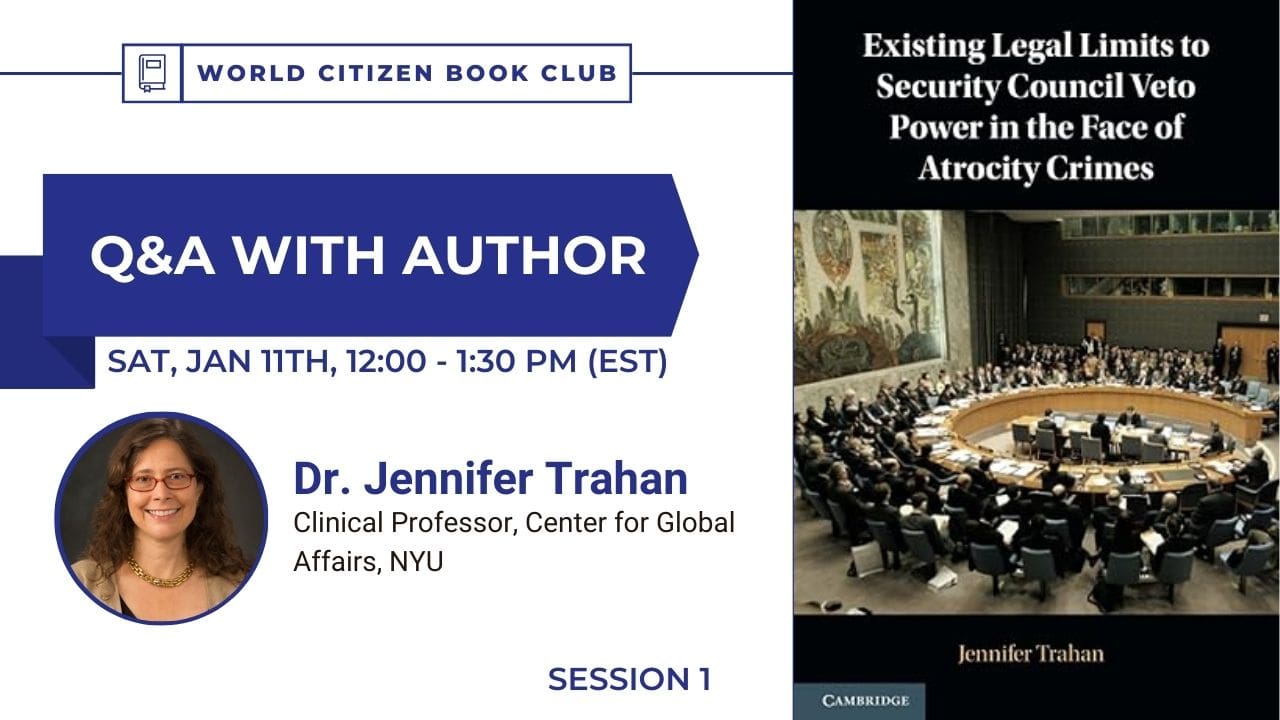
The World Citizen Book Club launched a two-session series on Existing Legal Limits to Security Council Veto Power in the Face of Atrocity Crimes by Jennifer Trahan. In this first session, participants examined the book’s central argument that the veto power wielded by permanent members of the UN Security Council is subject to existing legal constraints—particularly when atrocity crimes are occurring.
About the Book
Trahan outlines three independent legal bases for limiting the Security Council veto during atrocity crimes. The UN Charter provisions creating the veto cannot override the UN’s Purposes and Principles, nor can they supersede jus cogens (peremptory norms of international law). Additionally, the Geneva and Genocide Conventions impose positive obligations on all permanent members in situations involving war crimes and genocide. The book demonstrates how vetoes and veto threats have blocked the Security Council from pursuing measures that could have prevented or alleviated atrocity crimes in Myanmar, Darfur, Syria, and elsewhere. Published by Cambridge University Press, 2020; recipient of the 2020 Book of the Year Award from the American Branch of the International Law Association (ABILA).
About the Author
Jennifer Trahan is a Clinical Professor at NYU’s Center for Global Affairs and Director of their Concentration in International Law and Human Rights. An internationally renowned expert on international law and justice, she has published extensively on the International Criminal Court’s crime of aggression. She serves as Convenor of the Global Institute for the Prevention of Aggression and as a special advisor on the creation of a Special Tribunal on the Crime of Aggression for Ukraine.
Discussion Highlights
The first session introduced the book’s legal framework and examined how the veto has historically obstructed Security Council action during mass atrocities. Participants discussed the tension between the political realities of the Security Council and the legal obligations embedded in the UN Charter and international humanitarian law.