by Lawrence Wittner | Nov 28, 2022 | Disarmament, Peace
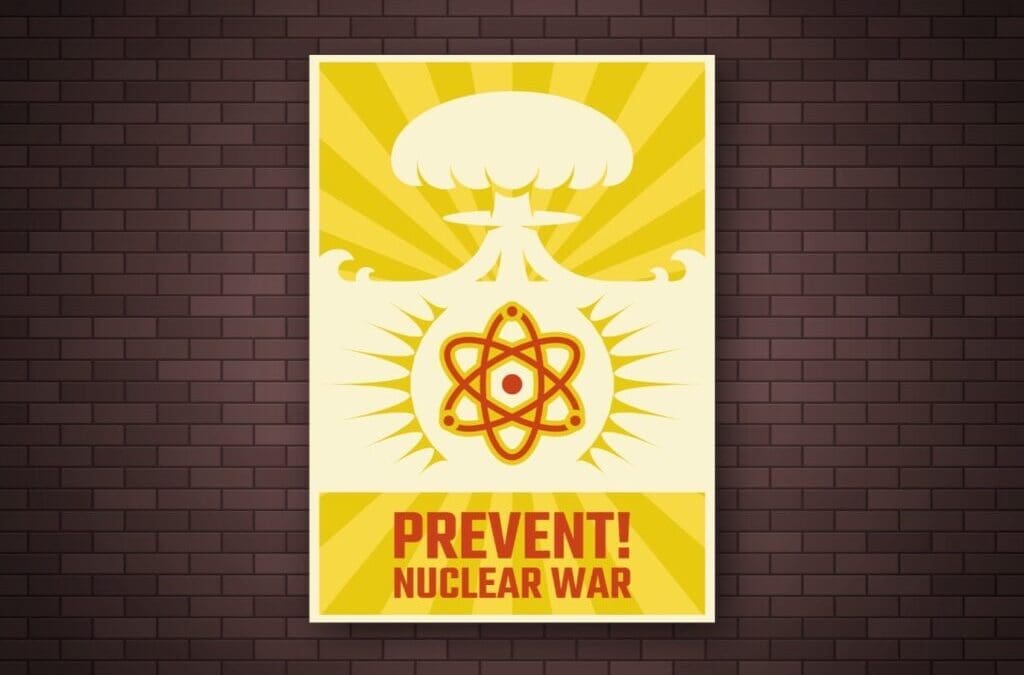
Even international alliances can unravel when nations confront the insanity of a nuclear holocaust.
An illustration of this point occurred recently, after Vladimir Putin once again threatened Ukraine and other nations with nuclear war. “To defend Russia and our people, we doubtlessly will use all weapons resources at our disposal,” the Russian president said. “This is not a bluff.” In response to this statement and to sharp UN condemnation of Russian nuclear threats, Chinese president Xi Jinping issued a public statement early this November, assailing “the use of, or threats to use nuclear weapons.” To “prevent a nuclear crisis” in Europe or Asia, he insisted, the world should “advocate that nuclear weapons cannot be used” and “a nuclear war cannot be waged.”
Aren’t these two nuclear-armed nations currently aligned in their resistance to U.S. foreign policy? Yes, they are, and when it came to Putin’s war upon Ukraine, Xi refrained from suggesting a Russian withdrawal. But nuclear war, as the Chinese leader made clear, was simply not acceptable.
This was not the first time a Russian-Chinese alliance was ruffled by a dispute over the use of nuclear weapons. An even deeper conflict occurred during the late 1950s and early 1960s when, ironically, the roles of the two nations were exactly the reverse.
At that time, the Chinese government, led by Mao Zedong, was embarked on a crash program to develop nuclear weapons. In October 1957, China’s weapons program secured a major gain when the Russian and Chinese governments signed the New Defense Technical Accord, in which the Russians agreed to supplementing the nuclear assistance they had already provided to the Chinese by supplying them with a prototype atomic bomb, missiles, and useful technical data.
But Russian officials soon had reason to doubt the wisdom of assisting China’s nuclear weapons development program. As Soviet premier Nikita Khrushchev recalled, the following month, at a Moscow conclave of Communist party leaders from around the world, Mao gave a speech on nuclear war that startled those in attendance. According to the Soviet leader, the “gist” of Mao’s speech was: “We shouldn’t fear war. We shouldn’t be afraid of atomic bombs and missiles. No matter what kind of war breaks out―conventional or thermonuclear―we’ll win.” When it came to China, Mao reportedly said, “we may lose more than three hundred million people. So what? War is war. The years will pass, and we’ll get to work producing more babies than ever before.”
Khrushchev found Mao’s remarks “deeply disturbing,” and recalled with irritation: “Everybody except Mao was thinking about how to avoid war. Our principal slogan was ‘On with the Struggle for Peace and Peaceful Coexistence.’ Yet here came Mao . . . saying we shouldn’t be afraid of war.’ In early 1958, as Soviet doubts increased about the reliability of China’s leadership in dealing with nuclear weapons, Khrushchev decided to postpone shipment of the prototype atomic bomb to China.
Eventually, the Soviet government not only withdrew its assistance to the Chinese nuclear weapons program in 1960, but took steps that placed the Soviet Union at loggerheads with the Chinese leadership. Key among these steps was working out an agreement on a nuclear test ban treaty with the governments of the United States and Britain—an agreement that, in part, was designed to block the ability of China to become a nuclear power. This Soviet shift toward a nuclear arms control and disarmament treaty with the West was bitterly opposed by China’s rulers, who were determined to develop nuclear weapons and, by 1964, succeeded in doing so. Meanwhile, the Sino-Soviet rift grew ever more heated, with the Chinese pulling out of the Soviet-dominated World Peace Council and ferociously competing with the Russians for leadership of the world Communist movement.
There are some lessons that can be learned from these incidents, in which major powers displayed signs of veering toward nuclear war. The obvious one is that even military allies might balk, at times, when they see an international confrontation slipping toward a nuclear disaster. Another, less evident, is that nations with access to nuclear weapons are not necessarily restrained from threatening or waging nuclear war by the prospect of nuclear retaliation from other nuclear powers. Or, to put it another way, nuclear deterrence is unreliable. Above all, these events and others underscore the fact that, while nuclear weapons exist, the world remains in peril.
Fortunately, abolishing nuclear weapons before they destroy the world is not an utterly utopian prospect. Thanks to popular pressure and disarmament treaties, the number of nuclear weapons around the globe has been reduced since 1986 from about 70,000 to 12,700. Moreover, a UN Treaty on the Prohibition of Nuclear Weapons, crafted and approved by an overwhelming majority of the world’s nations, went into effect in January 2021.
Unfortunately, none of the world’s nine nuclear powers has signed or ratified this nuclear weapons abolition treaty. Until they do so and, therefore, stop producing, stockpiling, and distributing nuclear weapons to other countries, the world will continue to live in a state of nuclear peril, subject only to occasional flashes of sanity by these same nuclear-armed nations.
Surely, people around the world deserve a better future.
by Lawrence Wittner | Oct 13, 2022 | Peace, UN Reform
The war in Ukraine provides us with yet another opportunity to consider what might be done about the wars that continue to ravage the world.
The current Russian war of aggression is particularly horrific, featuring a massive military invasion of a smaller, weaker nation, threats of nuclear war, widespread war crimes, and imperial annexation. But, alas, this terrible war is but one small part of a history of violent conflict that has characterized thousands of years of human existence.
Is there really no alternative to this primitive and immensely destructive behavior?
Failed Alternatives
One alternative, which has long been embraced by governments, is to build up a nation’s military might to such an extent that it secures what its proponents call “Peace through Strength.” But this policy has severe limitations. A military buildup by one nation is perceived by other nations as a danger to their security. As a result, they usually respond to the perceived threat by strengthening their own armed forces and forming military alliances. In this situation, an escalating atmosphere of fear develops that often leads to war.
Actually, governments are not entirely wrong about their perception of danger, for nations with great military power really do bully and invade weaker countries. Furthermore, they wage wars against one another. These sad facts are not only demonstrated by the Russian invasion of Ukraine, but by the past behavior of other “great powers,” including Spain, Britain, France, Germany, Japan, China, and the United States.
If military strength brought peace, war would not have raged over the centuries or, for that matter, be raging today.
Another war-avoidance policy that governments have turned to on occasion is isolation, or, as its proponents sometimes say, “minding one’s own business.” Sometimes, of course, isolationism does keep an individual nation free from the horrors of a war engaged in by other nations. But, of course, it does nothing to stop the war—a war that, ironically, might end up engulfing that nation anyway. Also, of course, if the war is won by an aggressive, expansionist power or one grown arrogant thanks to its military victory, the isolated nation might be next on the victor’s agenda. In this fashion, short-term safety is purchased at the price of longer-term insecurity and conquest.
The More Promising Alternative
Fortunately, there is a third alternative―one that major thinkers and even, at times, national governments have promoted. And that is strengthened global governance. The great advantage of global governance is its replacement of international anarchy with international law. What this means is that, instead of a world in which each nation looks exclusively after its own interests―and thus, inevitably, ends up in competition and, eventually, conflict with other nations―there would be a world structured around international cooperation, presided over by a government chosen by the people of all nations. If this sounds a bit like the United Nations, that is because, in 1945, toward the end of the most destructive war in human history, the world organization was created with something like that in mind.
Unlike “peace through strength” and isolationism, the jury is still out when it comes to the usefulness of the United Nations along these lines. Yes, it has managed to pull the nations of the world together to discuss global issues and to create global treaties and rules, as well to avert or end many international conflicts and to use UN peacekeeping forces to separate groups engaged in violent conflict. It has also sparked global action for social justice, environmental sustainability, world health, and economic advance. On the other hand, the United Nations has not been as effective as it should be, especially when it comes to fostering disarmament and ending war. All too often the international organization remains no more than a lonely voice for global sanity in a world dominated by powerful, war-making nations.
The logical conclusion is that, if we want the development of a more peaceful world, the United Nations should be strengthened.
How the United Nations Could Be Strengthened
One of the most useful measures that could be taken would be to reform the UN Security Council. As things now stand, any one of its five permanent members (the United States, China, Russia, Britain, and France) can veto UN action for peace. And this is often what they do, enabling Russia, for example, to block Security Council action to end to its invasion of Ukraine. Wouldn’t it make sense to scrap the veto, or change the permanent members, or develop a rotating membership, or simply abolish the Security Council and turn over action for peace to the UN General Assembly―an entity that, unlike the Security Council, represents virtually all nations of the world?
Other measures to strengthen the United Nations are not hard to imagine. The world organization could be provided with taxing power, thus freeing it from the necessity for begging nations to cover its expenses. It could be democratized with a world parliament representing people rather than their governments. It could be bolstered with the tools to go beyond creating international law to actually enforcing it. Overall, the United Nations could be transformed from the weak confederation of nations that currently exists into a more cohesive federation of nations―a federation that would deal with international issues while individual nations would deal with their own domestic issues.
Against a backdrop of thousands of years of bloody wars and the ever-present danger of a nuclear holocaust, hasn’t the time arrived to dispense with international anarchy and create a governed world?