My father was always the smartest person in the room. Despite never studying medicine, he once assisted a pre-med friend in preparing for an exam entirely by recalling intricate anatomical structures from a biology course he had taken thirty years prior.
My father was also a smoker. Some of my earliest memories are my tearful pleas to him to stop, knowing, as we both did, the risks. My dad did the math and determined that he didn’t yet need to change behavior. He would coin clever phrases like “maybe I might” and “I want to want to quit.” This reticence instilled in me, from a very young age, a curiosity about what truly motivates people to change. Is it data? We had that. Is it the cries of children? We had that, too.
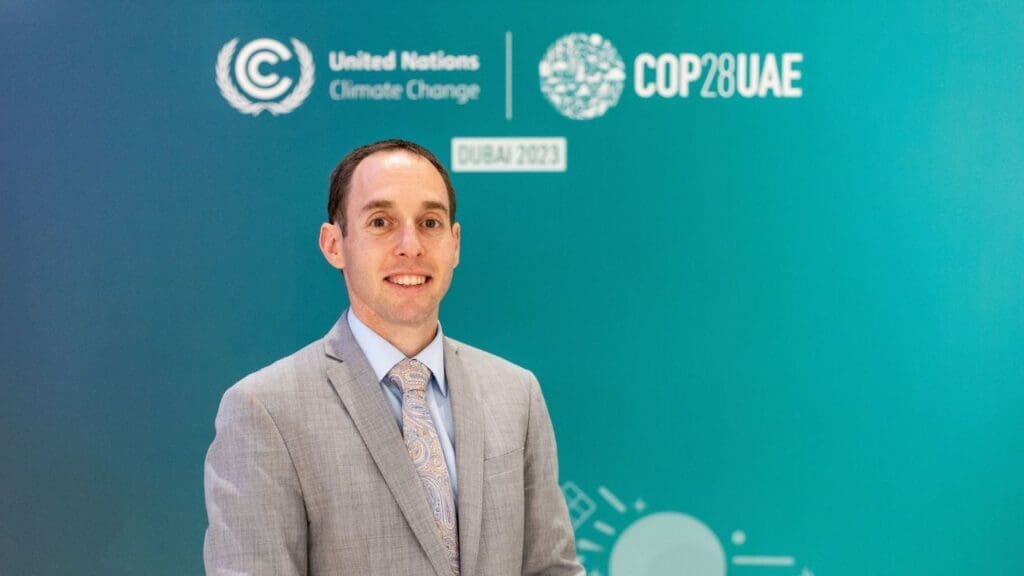
As I awoke earlier this week to the news that agreement had been reached in Dubai, I, like many, chose to see hope in this small step. I will work tirelessly to contribute my small portion to this great collective effort to stave off the worst consequences of climate change. Yet a question remains in my mind—to what degree can these agreements bend the curve of our behavior? How can we ensure the trajectory will be meaningfully different with this consensus having been reached?
I look to examples the international community has created to shape the behavior of governments and humanity more broadly. The Security Council, the human rights system, the sustainable development goals. Each has had an impact in its own way. A stronger enforcement mechanism like the Security Council increases legitimacy, but limits consensus. A systematic and mandatory review system, like the Universal Periodic Review, ensures oversight and greater fact-finding, but is dependent on Member State compliance for results. And an entirely voluntary system, like the Sustainable Development Goals, can inspire the masses and allow the tracking of progress. Yet for the SDGs, and based on recent reports, the curve has yet to be bent sufficiently to achieve the prosperity a bright-eyed 2015 international community hoped for.
These are all helpful in their own right. But the forces of inertia are strong. Volition and motivation are needed.
Nowhere is this more relevant than in the case of climate agreements. Many nations which have contributed the least to climate change must respond to consequences not of their making. And those which exercise an outsized influence on the shape and direction of human affairs, for reasons of history and current priorities, are being asked to sacrifice a degree of short-term well-being of their economies for the long-term security of themselves and others. The science is clear; the issue is summoning the will to overcome the uncomfortable to achieve the necessary. In a way, these countries are my brilliant father.
When my dad was diagnosed with pancreatic cancer—the risk of which was increased by his smoking habit—he quit immediately. It was remarkable. But it was too late. He might have gotten cancer anyway, and it isn’t fair to place blame not knowing the alternate reality. But he certainly did not follow the rules of the precautionary principle in his behavior.
I am heartened to know that in communities around the world, action is being taken now to improve humanity’s relationship with the natural world. People are not waiting. Agreements like those reached in Dubai, in Paris, and elsewhere are important. They represent the consensus of governments, and we, as well-wishers of humanity and the planet, should encourage and expect ever higher ambition.
Yet regardless of our opinion of the outcome in 2023, we have a responsibility to continue looking for the stores of motivation and the diversity of options for individuals, institutions, and communities to make the necessary changes in light of the mounting evidence. If any lesson is to be taken from my family, it is that waiting is not a viable option.
This article was originally published in Bahá’í International Community’s blog.
Photo credit: Baha’i International Community