
- This event has passed.
Applying a Gender-Sensitive, Victim-Forward, and Locally Contextualized Lens to Proposals for a Permanent UN Peacekeeping Solution
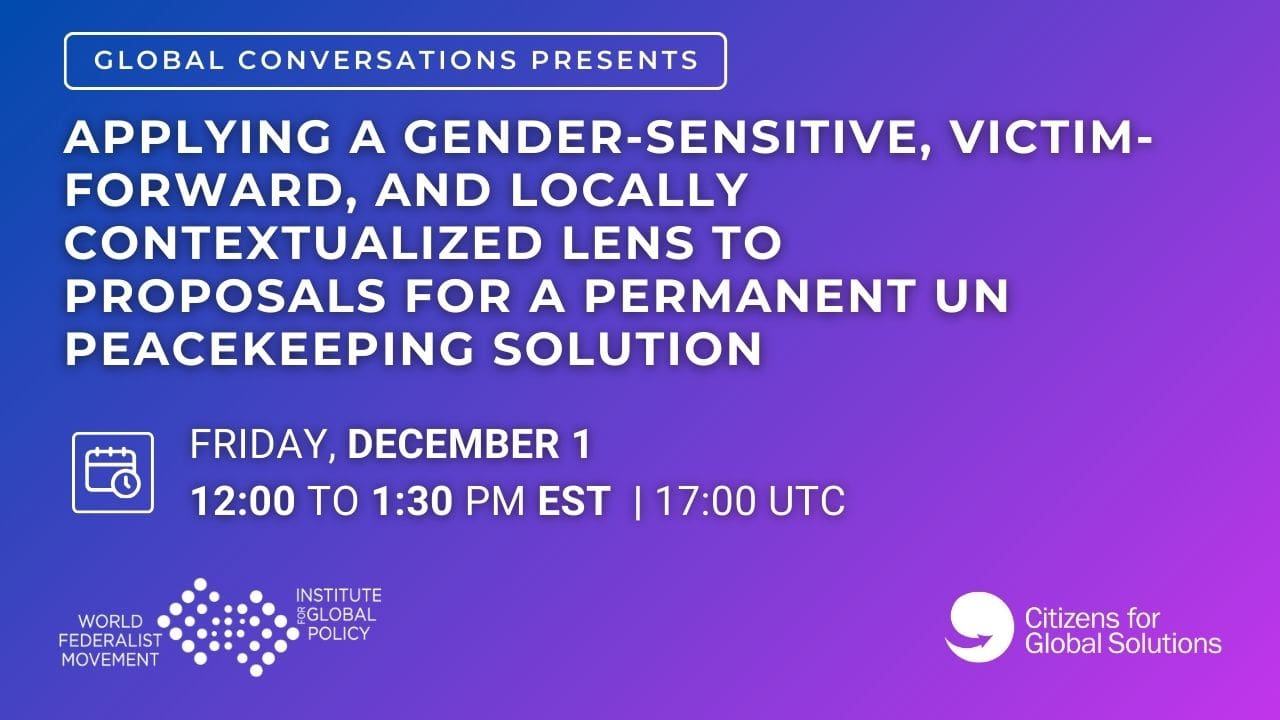
This Q&A panel discussion – hosted by Citizens for Global Solutions (CGS) and World Federalist Movement/Institute for Global Policy (WFM-IGP) – will explore lessons learned from past and current UN peacekeeping operations and why all current United Nations permanent peace force proposals should incorporate a gendered lens framework for prevention and accountability of sexual exploitation of women and children.
Background
UN Charter & the Peaceful Settlement of Disputes
Article 1 of the UN Charter states, “…effective collective measures for the prevention and removal of threats of peace, and for the suppression of acts of aggression or other breaches of the peace, and to bring about by peaceful means, and in conformity with the principles of justice and international law, adjustment or settlement of international disputes or situations which might lead to breaches of the peace…”
These principles are further laid out in Articles 33-38 and Action with Respect to Threats to the Peace, Breaches of the Peace, and Acts of Aggression (Articles 39-51) is the foundation for the UN in order for the UN to implement a series of instruments to ensure peace. Over time these instruments have included diplomacy, peacekeeping, disarmament, and sanctions. When mediation, arbitration, and tribunals fail, it often comes under the mandate of the Security Council. In 1956, UN peacekeeping forces were developed and since then have expanded to also include humanitarian aid, terrorism, human rights monitoring, and democratization, etc.
While there exist several gaps in the UN’s current model of peacekeeping (such as forces report to both UN command and their own member state’s command and the effort to mobilize is often too late to prevent conflict), the continued systematic failure in both the prevention and prosecution of sexual exploitation of women and children by UN peacekeepers remains a central issue of concern.
Permanent United Nations Standing Force Peacekeeping Solutions
Proposals to create an international standing peace force have been on the table since the League of Nations. However, in 1956, Grenville Clark and Louis Sohn published their detailed and ambitious proposal, “World Peace through World Law”, which became the foundation for many of the world federalist proposals today.
Implementing a UN peace force would complement existing UN arrangements with a standing ‘first-responder’, immediately available for deployment once authorized by the UN Security Council. UNEPS would provide a more effective UN that can respond rapidly and reliably to prevent armed conflict, protect people, ensure prompt start-up of demanding peace operations and to address human needs in complex emergencies.
However, in order to protect women and children from sexual exploitation, it is imperative that current world federalist United Nations standing peace force proposals not just address the current failure but incorporate a feminist lens and perspective.
Program
Keynote & Moderator
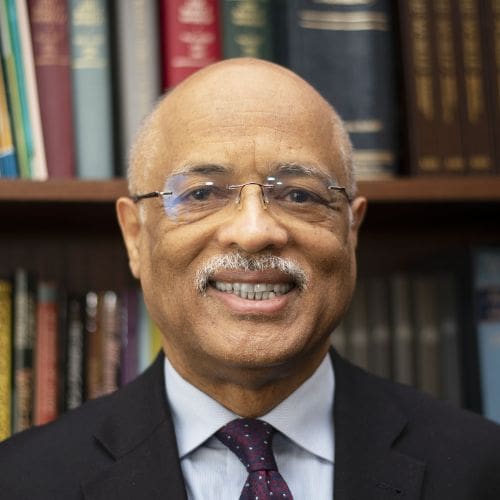
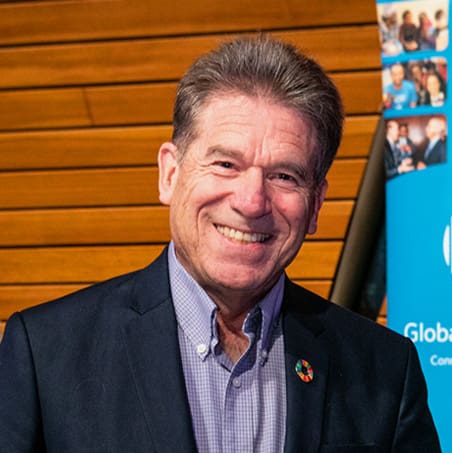
Augusto Lopez-Claros, Executive Director, Global Governance Forum. Senior Fellow at the Edmund Walsh School of Foreign Service at Georgetown University. Former Director of the Global Indicators Group in DEC of the World Bank.
Event Agenda
- Introduction and how a permanent United Nations standing force would address current gaps in peacekeeping.
- Lessons Learned in gender/victim survivor considerations in current United Nations peacekeeping operations.
- Case study of South Pacific Peacekeeping Force (SPPKF) in Bougainville in 1994.
- Cross-sectoral frameworks and methodologies for putting the concerns of gender, vulnerable populations, trauma survivors forward
- Implementation and way forward
Objectives of the Event
- Increase awareness of including a gender perspectives into current UN standing peace force proposals;
- Understand lessons learned from current UN peacekeeping failures to protect women and children from sexual exploitation;
- Examining the Bougainville Peace Agreement on how successful gender approaches can be incorporated into successful peacekeeping operations;
- Next steps towards implementation.
Resources
- UN Security Council 2008 Resolution 1820
- Gender, Peace and Security
- Global Governance and the Emergence of Global Institutions for the 21st Century, pp 131 – 180
- They Came Together Not to be Silenced Report
- Soldiers Without Guns – Women of Bougainville
- Ensuring Participation Of Women In Peace And Disarmament
- Political and Peacekeeping Affairs of the UN
- US Civil Society Working Group’s Recommendations for the Forthcoming US Strategy on Women, Peace and Security
- Assembly of State Parties to the Rome Statute (ASP) Side Events:
-
- Tuesday, 5 December 2023 Judicial Approaches to Sexual and Gender-Based Crimes at the
- International Criminal Court – Report Launch (co-hosted by Canada, Chile, International Gender Champions and Women’s Initiatives for Gender Justice) 13:15 – 14:30
About the Organizers
Citizens for Global Solutions (CGS) is a non-governmental, non-profit, non-partisan membership-based organization that for more than 75 years has brought together a diverse collective of individuals and organizations with a common goal of a unified world predicated upon peace, human rights, and the rule of law. From championing ratification of the UN Charter upon our establishment in 1947 to supporting creation of the International Criminal Court (ICC) 25 years ago to advocating for global instruments to confront today’s enduring challenges of war and climate degradation, CGS recognizes that true progress is a generational enterprise.
World Federalist Movement – Institute for Global Policy (WFM-IGP The World Federalist Movement/Institute for Global Policy (WFM/IGP), established in 1947, is a non-profit organization registered in the USA and the Netherlands. Guided by its vision of a just, free, and peaceful world, WFM/IGP works to promote the rule of law and global governance of transnational issues including those related to peace, human rights, and the environment. Our vision is a just, free, and peaceful world, where humanity and nature flourish in harmony, while our mission is to create more effective, transparent, and accountable global governance leading to democratic world federation.